Introduction
Between new multihundred‑million dollar financings, multi‑orbit inflight connectivity (IFC) contracts and the consolidation of ground infrastructure, the satellite communications market is experiencing a phase of rapid economic recomposition. Recent developments — CesiumAstro’s $730 million Series D, SES’s airline wins, NASA’s Ka‑band relay contests, AT&T/AST SpaceMobile handoff trials, and the teleport acquisition by SatPort — together reveal how capital, customers and infrastructure are aligning for the next wave of commercial growth.
Capital pours into systems integration and constellations
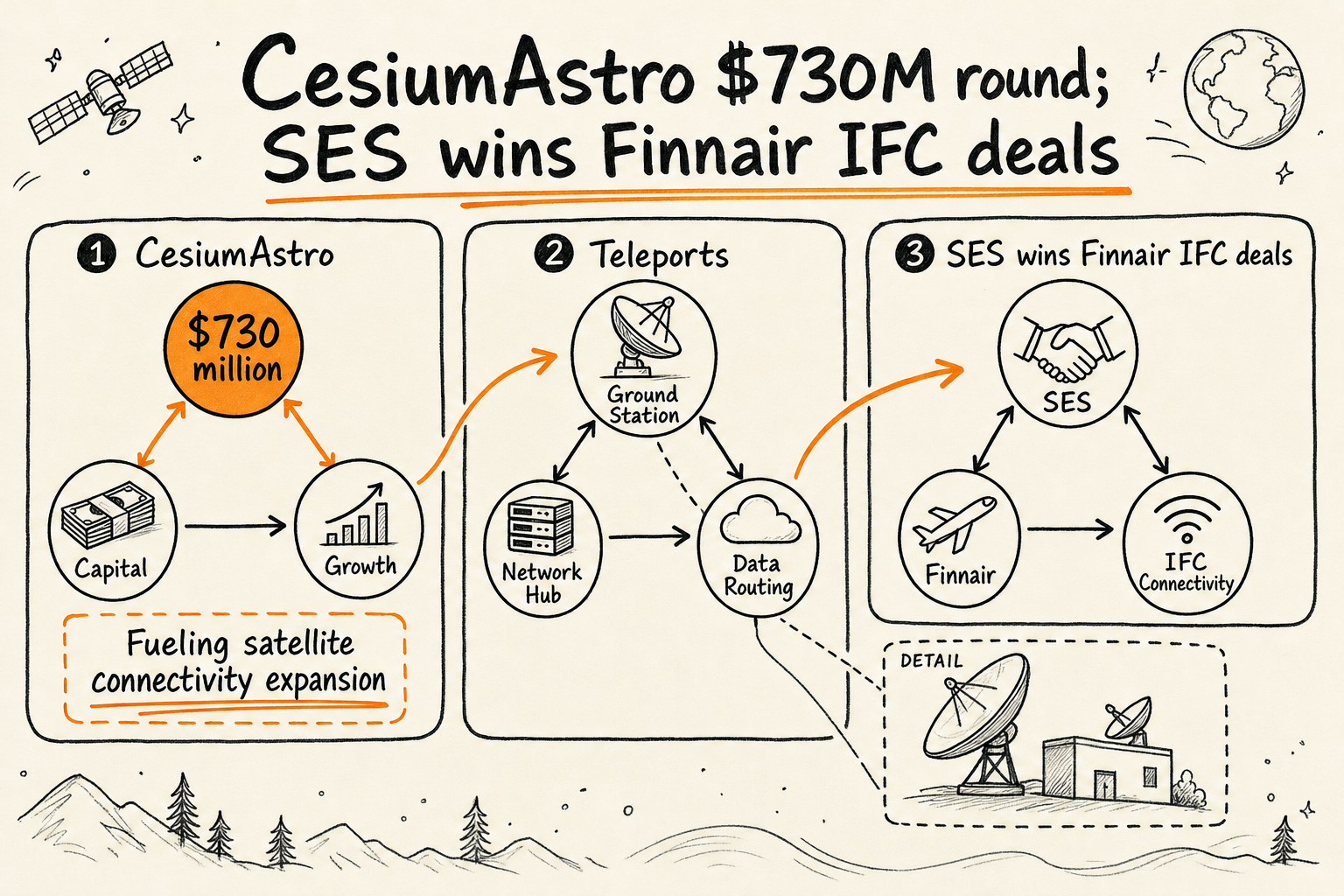
CesiumAstro’s headline $730 million raise at a valuation north of $4.5 billion — and its plan for a 737‑satellite Synchronicity constellation — is both bold and illustrative. Investors are no longer writing checks only for rockets or single satellites; they are funding vertically integrated operators that promise hardware, phased constellations, and networked services. Large, late‑stage rounds like this signal investor confidence in recurring revenue models for satcom and in the defendable margins offered by integrated systems and defense contracts.
That financing sits alongside more targeted contract awards. NASA’s recent Ka‑band relay concept contracts to Viasat, SES and Astranis under SCaN/CSP underscore persistent public demand for commercial capability to augment government communications. By splitting concept contracts among incumbents and newer entrants, NASA is implicitly underwriting industrial diversity while creating potential downstream revenue for awardees.
Demand is consolidating around mobility: aviation, maritime and device connectivity
SES’s wins with Finnair and Air Astana for multi‑orbit IFC services, and its reported Q3 revenue lift driven by aviation and defense, reflect a broader trend: mobility customers have become the most consistent commercial drivers of incremental satcom revenue. Airlines value the higher average revenue per passenger that robust IFC enables, and service providers can monetize premium multi‑orbit architectures that blend GEO capacity with LEO continuity.
Complementary demand appears in maritime and government projects: KT SAT’s leadership of a South Korean maritime connectivity initiative with ST Engineering iDirect points to secure, state‑backed market opportunities that promise longer contract tails than consumer broadband. These segments provide predictable, enterprise‑grade contracts that help undergird future constellation economics.
Ground infrastructure and network integration are strategic bottlenecks
SatPort’s acquisition of Speedcast’s teleport business (12 teleports plus related assets) signals an underappreciated strategic pivot: teleports, not just satellites or user terminals, are consolidating into neutral, scaleable hubs. Teleports facilitate ground handoffs, spectrum management, and integration with terrestrial carriers — and they will become bargaining chips in a world where multi‑operator, multi‑orbit services need coordinated ground footprints.
This nexus of ground and space is also visible in AT&T and AST SpaceMobile’s demonstration of seamless handoff between terrestrial cellular and direct‑to‑device (D2D) satellite networks. That technical proof matters commercially: it lowers friction for MNOs to adopt satellite augmentation by preserving customer experience and easing roaming/peering relationships. In short, the satellite industry is not just selling pipes; it is selling interoperability with incumbent telecom business models.
Two counterintuitive takeaways
1) More capital does not mean more fragmentation. One might assume huge financings accelerate fragmentation into dozens of specialized players. Instead, investors are rewarding consolidation and vertical integration — companies that can own satellite design, operations and customer relationships. CesiumAstro’s integrated play and SatPort’s teleport aggregation both reflect that preference.
2) Government contracting is becoming a demand stabilizer, not merely a prestige play. NASA’s selection of multiple commercial Ka‑band concepts and government maritime projects in South Korea show public customers are strategically deploying commercial providers to de‑risk programs and sustain industrial capacity. This increases revenue predictability for commercial firms, making them more investable.
Implications and what to watch next
Expect several developments over the next 12–24 months. First, integrated constellations backed by large financing rounds will accelerate deployments, but meaningful revenue realization depends on securing enterprise and government anchor customers — not just consumer signups. Second, multi‑orbit IFC and D2D integration trials will pressure regulators and carriers to update roaming, spectrum and peering frameworks. Third, teleport consolidation will continue, creating new bargaining power and potential choke points that could favor large operators unless regulators ensure open access.
Finally, the interplay between public contracts (NASA, national governments) and private finance will shape which architectures win: those that can demonstrate secure, interoperable services for aviation, maritime, defense and national infrastructure are most likely to convert investor enthusiasm into durable cash flow.
Conclusion
The satcom sector’s current phase resembles classic industrial consolidation: capital flows to vertically integrated players, customers cluster around mobility and government contracts, and control of ground‑space junctions — teleports and interconnection agreements — becomes strategically decisive. For investors, policymakers and operators, the lesson is clear: deploying hardware is only the first step; winning the economics of connectivity requires mastering integration, regulation and long‑term enterprise contracting.