NASA's ambitious Dragonfly mission has entered a critical new phase as the rotorcraft undergoes integration and testing ahead of its scheduled launch in July 2028. The mission aims to explore Titan, Saturn's largest moon, which holds a unique position in the solar system due to its dense atmosphere and the presence of complex organic molecules.
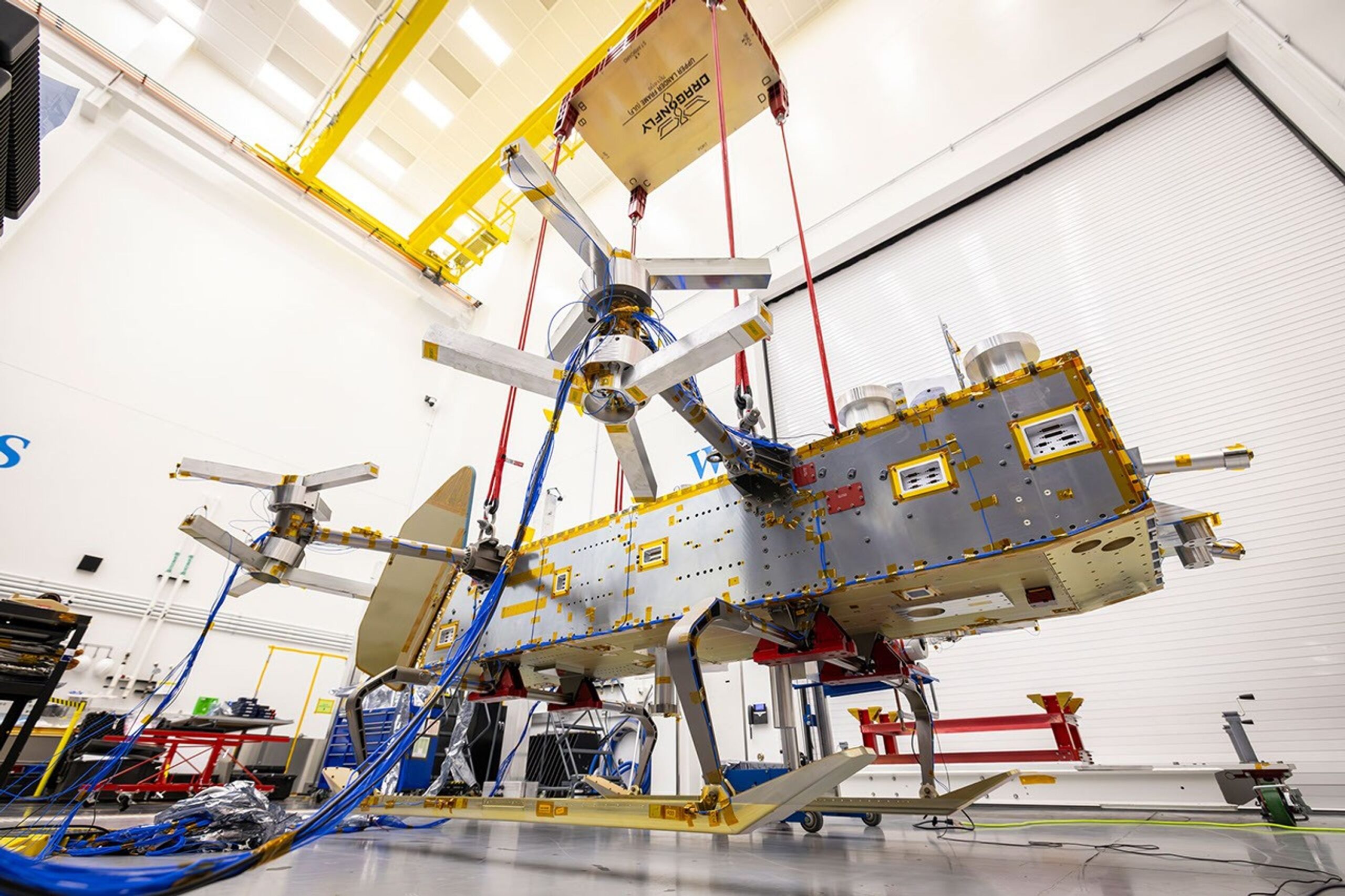
The Johns Hopkins Applied Physics Laboratory (APL), which is leading the mission, has recently completed frame qualification testing for Dragonfly. This significant milestone follows seven years of development and is crucial for ensuring that the craft can withstand the rigorous conditions of launch and operation on Titan. The lightweight aluminum honeycomb structure of Dragonfly has been validated for both launch and flight loads, with special attention to maintaining low mass while protecting the landing skids from rocky terrain.
Dragonfly is designed to operate in Titan's dense atmosphere, which is about 1.5 times thicker than Earth's, and its low gravity environment makes it an ideal location for aerial exploration. The rotorcraft will be the first vehicle capable of autonomous flight on another planetary body, moving from site to site to conduct scientific investigations. Its mission is not to search for life but to explore the prebiotic chemistry and complex organic molecules that are considered the building blocks of life.
Western University planetary scientist Dr. Catherine Neish, serving as a co-investigator, anchors Canada's contribution to the mission. The scientific goals of Dragonfly include analyzing the composition of Titan's surface and atmosphere, searching for complex organic molecules, and studying an environment that is believed to closely resemble early Earth conditions.
The structural tests conducted at APL involved suspending Dragonfly's frame during vibration tests to study how rotor-induced oscillations propagate through the vehicle. These tests are essential to ensure that the vibrations do not interfere with the onboard systems. Simi Berman, the thermomechanical subsystem lead at APL, explained that the team has also installed 850 custom-made foam tiles for thermal management. These tiles fit together like a three-dimensional puzzle to insulate the vehicle in Titan's extreme cold, which averages around minus 184 degrees Celsius.
Johns Hopkins APL's Principal Investigator for the mission, Zibi Turtle, remarked on the innovative aspects of the mission, emphasizing its role in investigating the chemistry that predates the emergence of life on Earth. The mission builds upon the legacy of the European Space Agency's Huygens probe, which landed on Titan in 2005 and transmitted data for 72 minutes.
As the integration phase continues, the next steps involve the installation of onboard electronics, scientific instruments, and the systems necessary for Dragonfly's exploration of Titan's surface. These components are being integrated meticulously to ensure seamless operation once the rotorcraft arrives on Titan in 2034.
Dragonfly's mission represents a significant leap forward in planetary science and exploration technology. The successful deployment and operation of this rotorcraft could pave the way for future missions to other planetary bodies with similar atmospheric conditions. By exploring Titan, scientists hope to gain insights into the processes that might have led to the emergence of life on Earth and assess Titan's potential as a location for future human exploration.