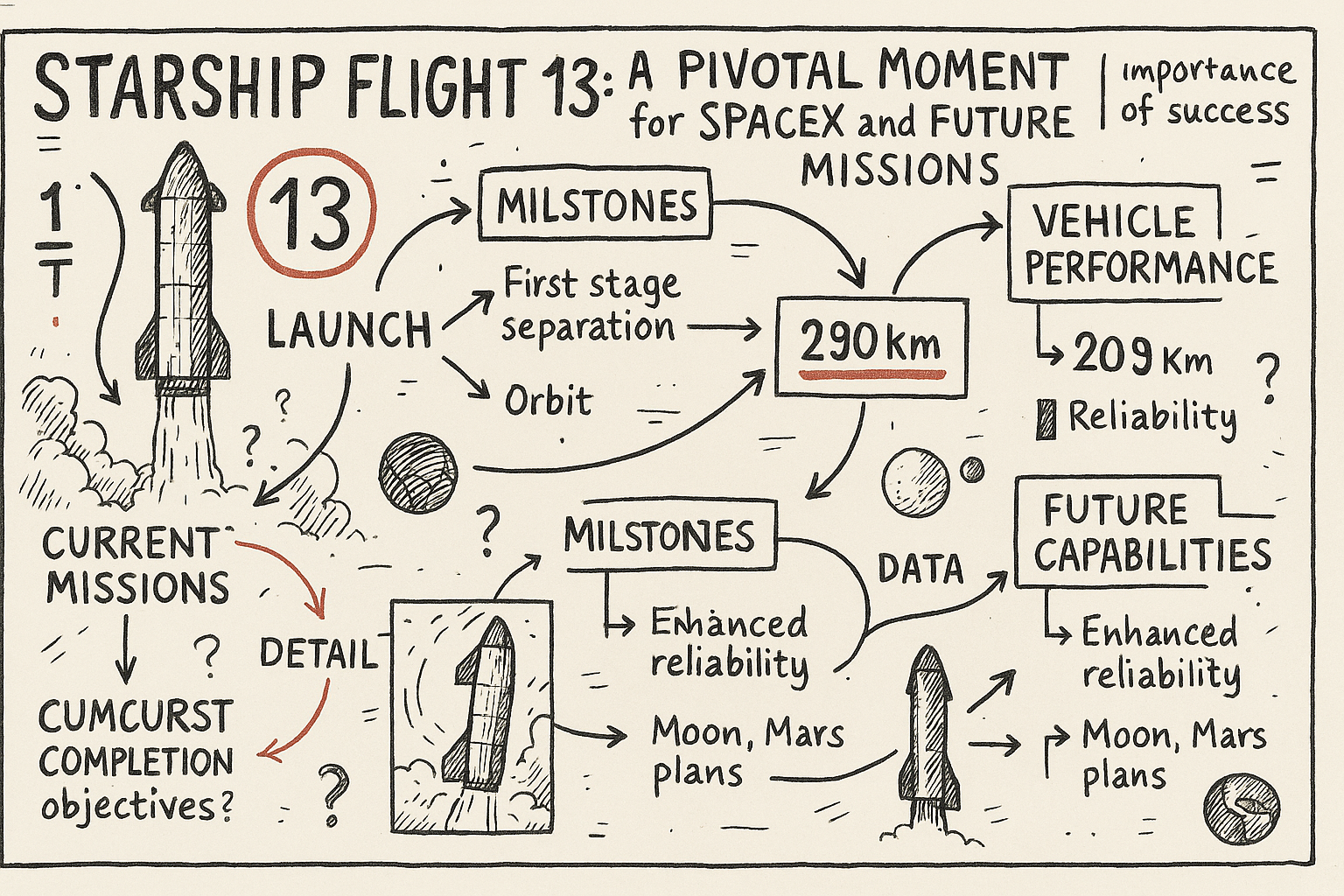
The upcoming launch of SpaceX's Starship on its 13th test flight marks a significant milestone in both the company's history and the broader landscape of space exploration. As the world's largest rocket, Starship is designed to be a fully reusable spacecraft capable of carrying humans and cargo to a wide range of destinations, including Mars. The implications of this launch extend beyond the immediate technical challenges, hinting at a future where space travel becomes a routine part of human life.
Starship's Evolution and Technical Achievements
Starship's journey has been marked by both triumphs and setbacks, with each flight providing invaluable data that informs subsequent iterations. The 13th flight is particularly noteworthy as it potentially represents the final suborbital test before transitioning to orbital missions. This shift is critical for SpaceX's long-term goals, which include not only Mars colonization but also facilitating a new era of commercial space travel.
In preparation for this flight, SpaceX successfully ignited all 33 engines on the Starship booster, demonstrating the rocket's immense power and robustness. This achievement underscores SpaceX's iterative design philosophy, where rapid prototyping and testing lead to accelerated progress. Each engine ignition and launch brings the company closer to a fully operational Starship, capable of revolutionizing space travel.
Commercial Implications and Partnerships
In addition to its technical prowess, SpaceX's strategic partnerships are reshaping the commercial space sector. NASA's decision to launch its SunRISE mission on a SpaceX Falcon Heavy rocket highlights the trust and reliability that SpaceX has built over years of successful launches. This partnership not only benefits SpaceX financially but also strengthens its position as a leader in commercial spaceflight.
Moreover, the routine nature of SpaceX's launches, as evidenced by the 600th flight of a flight-proven rocket, is setting a new standard in the industry. The ability to reuse rockets reduces costs significantly, making space more accessible and paving the way for more frequent and diverse missions.
Strategic Shifts and Future Prospects
Looking ahead, the success of Starship's Flight 13 could catalyze a shift in how the world views space travel. While SpaceX is at the forefront, its achievements pressure competitors to innovate and adapt. This competitive environment could lead to breakthroughs in propulsion technology, spacecraft design, and mission planning, ultimately benefiting all stakeholders in the space industry.
Furthermore, as SpaceX moves towards orbital flights, the potential for human missions to Mars becomes more tangible. The success of these missions could inspire a new generation of scientists, engineers, and dreamers, eager to explore the final frontier.
Conclusion: A New Dawn for Space Exploration
Starship Flight 13 is more than just a test flight; it is a harbinger of a new era in space exploration. As SpaceX continues to push the boundaries of what is possible, it challenges us to rethink our relationship with space. The technological advancements, commercial partnerships, and strategic foresight demonstrated by SpaceX are not just shaping the future of space travel—they are redefining it.