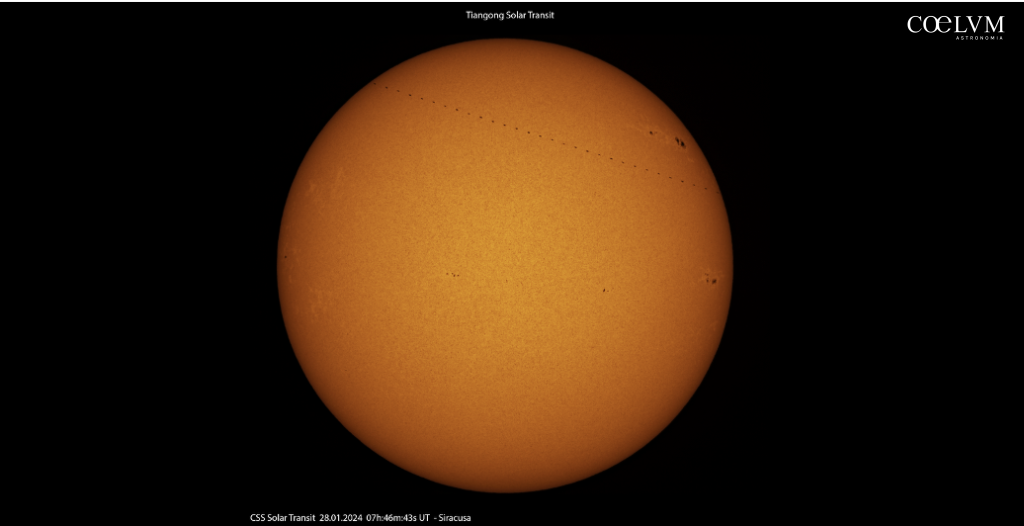
July 2026 presents an intriguing time for both professional astronomers and amateur skywatchers, with a series of satellite transits across the Moon and the Sun. These occurrences provide not only a fascinating spectacle but also a valuable opportunity for scientific observation and public engagement with astronomy.
According to Coelum Astronomia, a prominent Italian publication dedicated to celestial events, the month of July is marked by several instances where artificial satellites will transit in front of the Moon and the Sun. These events are particularly noteworthy because they allow for the observation of the interaction between human-made objects and celestial bodies, an alignment that is relatively rare and fleeting.
Satellite transits are events where a satellite passes directly between an observer on Earth and a larger celestial body, such as the Moon or the Sun. The shadow or silhouette of the satellite can be seen against the bright backdrop of the celestial body, often creating an impressive visual. These transits can be challenging to observe due to their brief duration and the precision required to capture them as they occur.
July 2026 also features a series of astronomical conjunctions, as noted in the supplementary context from Coelum. Conjunctions are events where two celestial bodies appear to be very close to each other in the sky. This month, the Moon will have close encounters with various planets and bright stars, adding to the celestial display. Although these conjunctions are frequent, they still captivate observers due to their beauty and the insight they provide into the movements of celestial bodies.
Apart from satellite transits, the month is also significant for those interested in asteroids. The Coelum report highlights that three asteroids from the main belt—Melpomene, Flora, and Juno—will be in opposition on July 8, 9, and 26, respectively. Opposition is when a celestial object is directly opposite the Sun in the sky, making it fully illuminated and visible from Earth. This alignment offers ideal conditions for observation and study.
The celestial events of July 2026 are not only a feast for the eyes but also an educational opportunity. They allow enthusiasts to understand the dynamics of our solar system better and the role of artificial satellites in space exploration and observation. These events also serve as a reminder of the ever-evolving nature of our night sky, shaped by both natural celestial mechanics and human ingenuity.
The historical context of satellite transits and celestial observations stretches back to the early days of human curiosity about the sky. With the advent of telescopes, astronomers could study the movements of planets and stars with greater accuracy. The addition of satellites in the mid-20th century added a new dimension to this field, providing platforms for observation and communication that have become integral to modern life.
As we look to the future, the role of satellites will continue to expand. They are crucial for advancing our understanding of space and for applications such as weather monitoring, global communications, and navigation. The transits in July 2026 serve as a reminder of the interconnectedness of technology and astronomy, and how each can enhance the other's capabilities.
For those interested in experiencing these celestial events first-hand, checking local astronomical forecasts and utilizing resources from observatories and astronomy clubs can provide guidance on the best times and methods for observation. Whether through a telescope, binoculars, or the naked eye, the night sky offers a continually changing tapestry that invites exploration and discovery.