Pluto's largest moon, Charon, continues to intrigue scientists as new research suggests that its spin may be gradually slowing down, a phenomenon known as despinning. This revelation is based on recent geological analyses that offer fresh perspectives on the moon's early thermal evolution and could illuminate the dynamics of other icy satellites in our solar system.
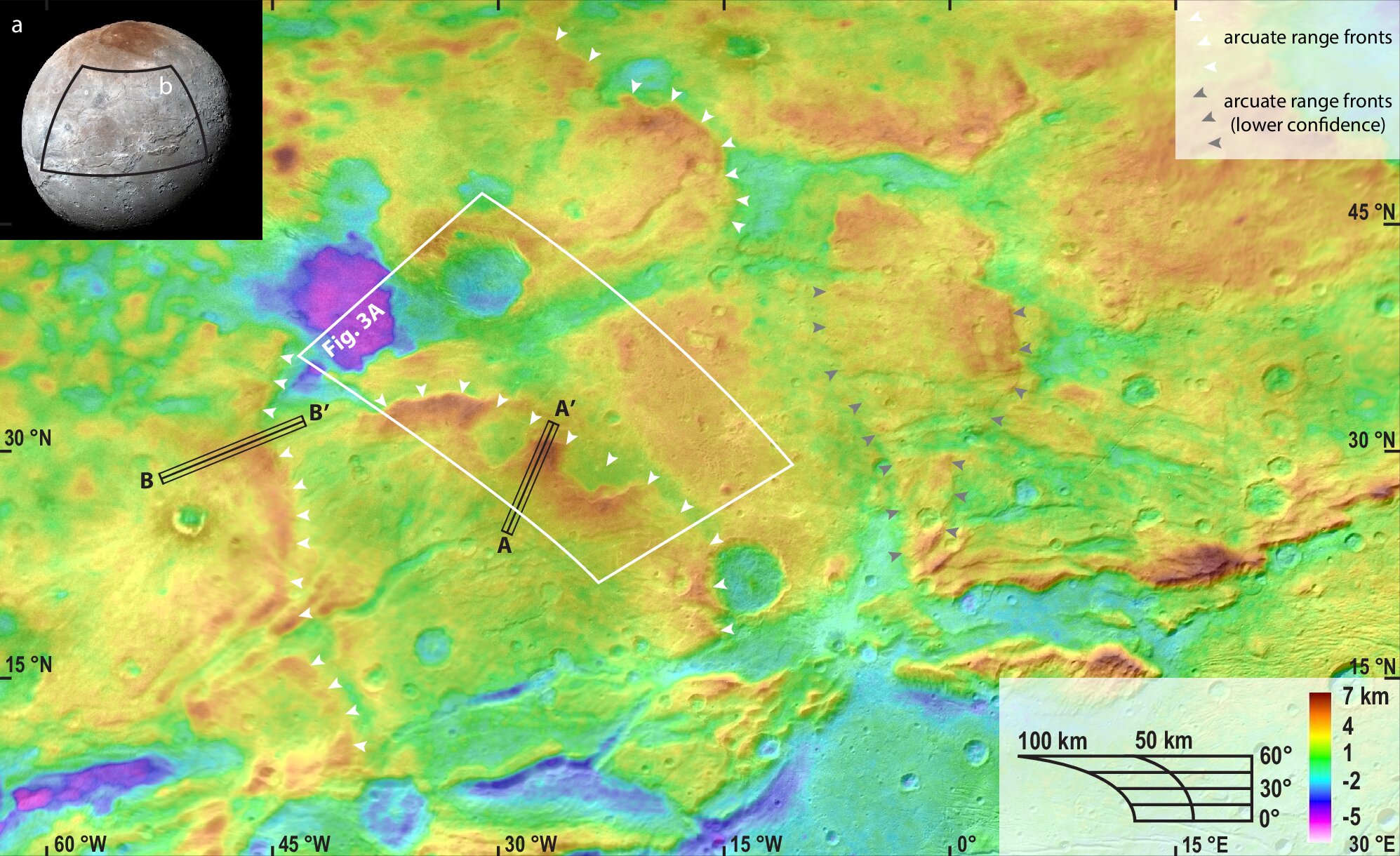
The study, published in Nature Communications, highlights the tectonic features observed on Charon's surface, specifically in a region called Oz Terra. These features, which extend over 200 kilometers, present asymmetrical slopes indicative of compressional forces rather than extensional ones. Hanzhang Chen and his research team employed detailed modeling to analyze these variations in orientations and types of tectonic structures. Their findings suggest that Charon's initial rotation period was approximately 14.3 hours, contrasting sharply with its current tidally locked state of about 153.3 hours.
This evidence of despinning is significant because it offers a rare geological record of a moon’s rotational evolution, shedding light on the broader thermal and orbital histories of similar icy satellites. Despinning is theorized to occur when tidal forces exerted by a parent planet gradually slow a moon's rotation, altering its shape and thermal dynamics. For Charon, the presence of an ice shell at least 30 to 36 kilometers thick at its formation time is crucial. It implies that Charon began its evolutionary journey in a cold state, leading to the development of a thick, rigid ice shell early in its history.
Understanding the dynamics of Charon’s despinning is not just about unraveling the past of a single celestial object. It provides a window into the processes that may affect other icy bodies in our solar system. Charon's surface is about 4 billion years old and has undergone relatively limited resurfacing compared to other icy satellites. This pristine condition makes it an excellent candidate for studying long-term geological changes.
While the findings are substantial, uncertainties remain regarding the modeling assumptions and stress estimates. These uncertainties do not diminish the study's value but rather highlight the need for continued exploration and investigation. The insights gained from Charon could help refine models of tidal despinning and improve our understanding of how these processes have shaped other moons and planets.
This discovery adds to the fascinating puzzle of the Pluto system. Recently, researchers have also identified evidence of massive landslides on Pluto, indicating active geological processes. These landslides, discovered in three impact craters, suggest that Pluto, much like Charon, is a dynamic world with a complex geological history.
In the broader context of space exploration, the New Horizons mission, which provided the data for these findings, continues to push the boundaries of our understanding. Originally launched to study Pluto and its moons, the mission has since broadened its scope to explore the outer reaches of the solar system, including tracking the solar wind as it slows down near the boundary with interstellar space.
The ongoing research into Charon and the surrounding Pluto system underscores the importance of space missions in uncovering the secrets of our solar system's formation and evolution. As we continue to analyze the data sent back from these distant worlds, each new discovery brings us closer to comprehending the intricate dynamics that govern celestial bodies.
Charon’s slowing spin is more than a mere curiosity; it is a testament to the complex interplay of forces that have shaped, and continue to influence, the frozen landscapes of the outer solar system. These findings not only enhance our understanding of Charon itself but also provide a framework for studying other icy worlds that orbit distant stars.