NASA/ESA/CSA JWST finds brown dwarfs as light as 2 Jupiter masses in IC 348
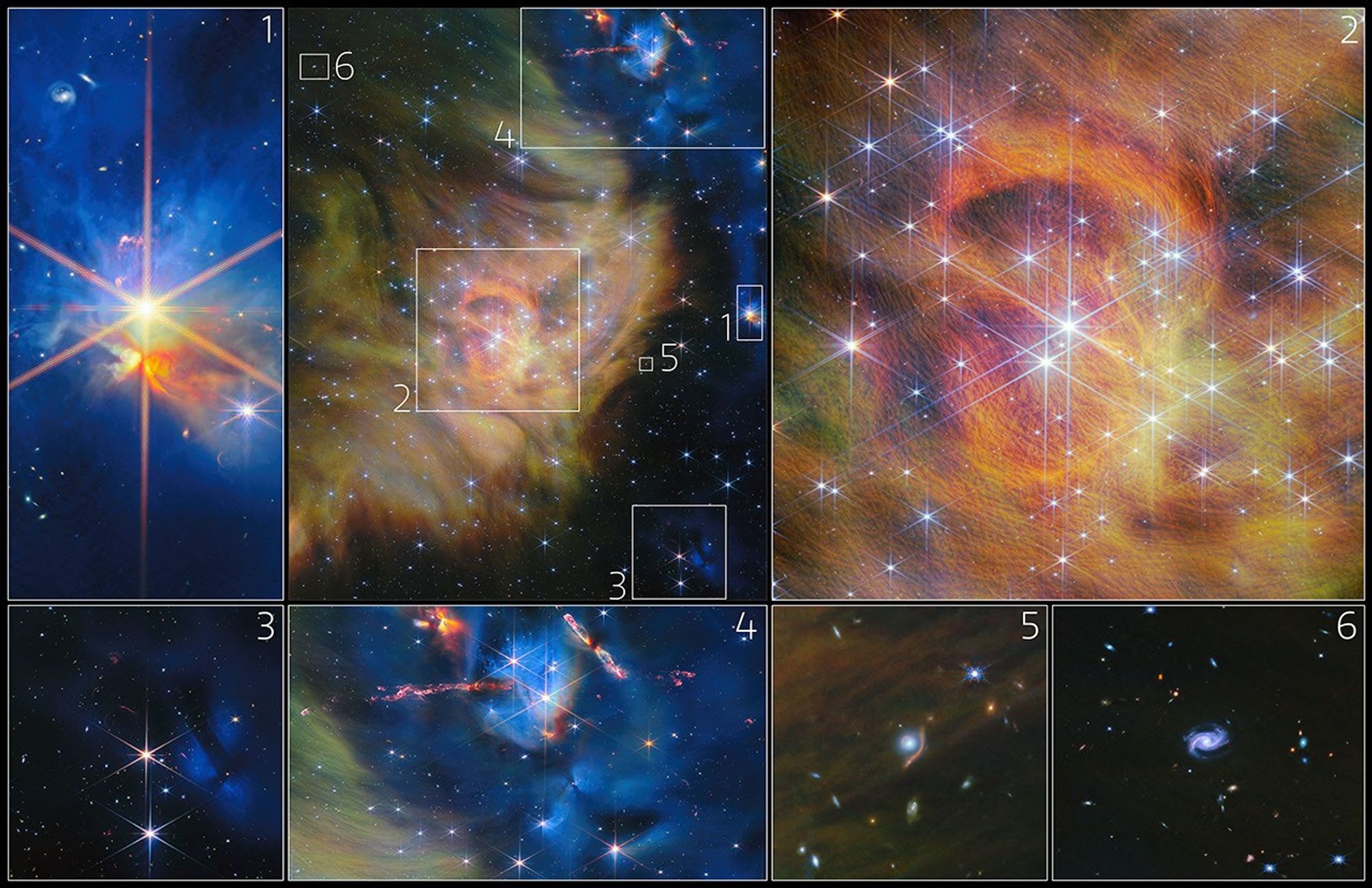
The James Webb Space Telescope (JWST) has imaged the nearby star-forming region IC 348 and, in observations discussed in September 2026, revealed brown dwarfs with masses down to about two times that of Jupiter. The image and follow-up analysis, led by researchers including Kevin Luhman of the Pennsylvania State University and members of the European Space Agency team, show young stars, protostellar jets, Herbig–Haro objects and extremely low-mass substellar objects embedded in cold molecular clouds roughly 1,000 light-years from Earth in the constellation Perseus.
The JWST data for IC 348 combine near-infrared imaging that penetrates dust with high sensitivity, allowing astronomers to probe the faintest objects in a nearby stellar nursery. The Near-Infrared Camera (NIRCam) on Webb first observed this region in 2022, and deeper observations in 2024 extended the search for the smallest brown dwarfs. According to the NASA/ESA/CSA releases and reporting in Media INAF, the new analysis pushes the brown dwarf mass limit to about two Jupiter masses in IC 348, a range previously unexplored with comparable confidence.
Brown dwarfs form by the collapse of molecular cloud material in a manner similar to stars but do not attain the core temperatures and pressures necessary to sustain hydrogen fusion. The conventional dividing line between very low-mass stars and brown dwarfs is near eight percent of the Sun’s mass; below that threshold lies the brown dwarf regime. The JWST observations of IC 348 therefore probe objects substantially below that boundary, down to masses comparable with giant planets.
The JWST image also highlights active phases of star formation. In the upper right of the image, several protostars are visible, some producing powerful jets of material. Where these jets collide with the surrounding gas and dust they create luminous Herbig–Haro objects: a long, almost horizontal feature identified as HH 797 actually comprises two protostars, each with its own jet oriented similarly. Nearby is HH 211, described by Media INAF as having a helical appearance with thin jets accompanied by broader flows. NASA’s public collage of details from the Webb image emphasizes clusters of embedded stars, faint outflows and even background spiral galaxies seen through the dusty region.
These results matter for multiple reasons. First, detecting brown dwarfs with masses near two Jupiter masses challenges how we classify the smallest free-floating objects in star-forming regions and how we understand the initial mass function — the distribution of masses with which objects form in a cloud. Second, the detections demonstrate JWST’s ability to probe extreme low-mass regimes in nearby nurseries that were previously inaccessible, enabling studies of how such objects form and evolve in dense environments. Kevin Luhman and collaborators had previously identified brown dwarfs of roughly three to four Jupiter masses in earlier Webb data; the newer observations extend that lower boundary further.
It is important to note uncertainties inherent to mass estimates at these extremes. Deriving masses for very young, low-mass objects depends on models of evolution and assumptions about age, temperature and luminosity; such inferences carry systematic uncertainties and are, therefore, not direct measurements. The Media INAF coverage and the NASA/ESA descriptions present the mass values as the outcome of the Webb observations and analysis rather than absolute, model-independent facts.
IC 348, at about 1,000 light-years distance in Perseus, has long been a laboratory for studies of star formation. JWST’s panoramic, high-resolution infrared view adds new levels of detail: from central stellar clusters to faint flows and dusty filaments. The image exemplifies the mission’s broader contributions, following other recent Webb releases that illuminated nebulae and star-forming regions with unprecedented clarity.
Looking forward, these findings will motivate deeper spectroscopic follow-up and comparisons with theoretical models. Spectroscopy of the faintest objects can refine temperature and composition estimates, improving mass constraints. Continued JWST observations of other nearby star-forming regions will test whether similarly low-mass brown dwarfs are common or whether IC 348 is unusual in producing such small free-floating objects. Such work bears directly on questions about the formation boundary between planets formed in disks and brown dwarfs formed by cloud collapse.
For now, the JWST view of IC 348 stands as a detailed snapshot of a dynamic stellar nursery: revealing protostellar jets and Herbig–Haro objects, mapping the embedded young stellar population, and extending the census of brown dwarfs down to masses of roughly two times Jupiter’s. The observations underscore the telescope’s capacity to illuminate the faintest constituents of nearby star-forming regions and to challenge models of how stars and substellar objects form.
Credits: NASA, ESA, CSA; image and analysis contributions cited include Kevin Luhman (Pennsylvania State University), Catarina Alves de Oliveira (ESA) and Mahdi Zamani (ESA/Webb), as reported by Media INAF and NASA/ESA releases.