NASA LRO discovers a large new lunar crater and an unusual thermal signature
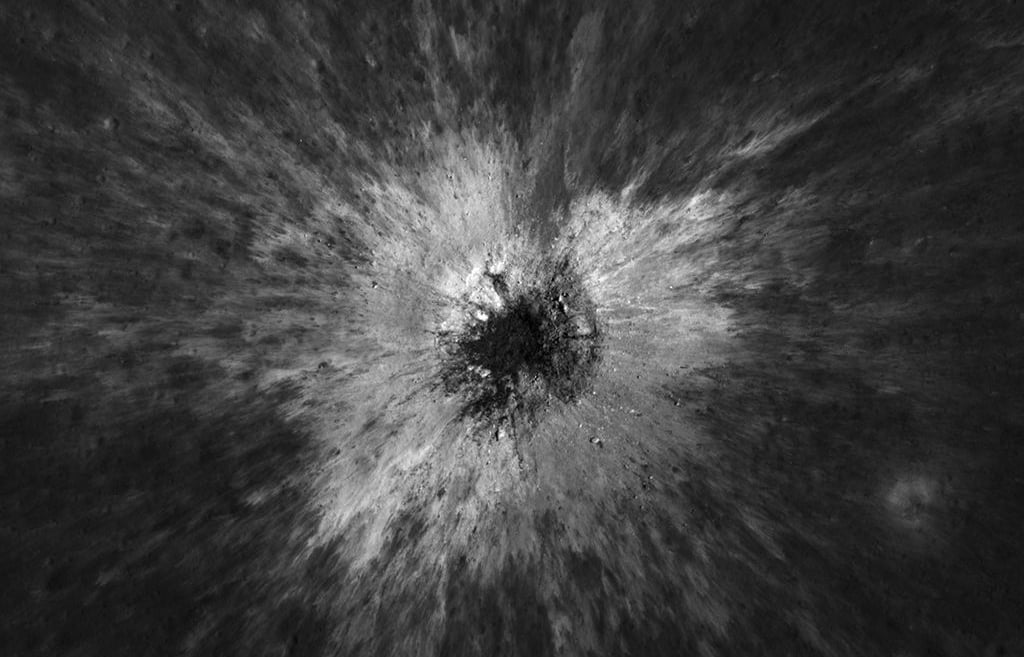
NASA’s Lunar Reconnaissance Orbiter (LRO) has revealed a newly formed impact crater on the Moon that measures approximately 222 metres across and 43 metres deep. The feature, now named McGetchin Crater after lunar scientist Tom McGetchin, formed sometime between 11 April and 22 May 2024, according to analysis of LRO imagery.
The discovery began as a routine data-quality check when Robert Wagner, an image-processing specialist from Intuitive Machines working with Lunar Reconnaissance Orbiter Camera (LROC) data, noticed an unusually bright spot with a dark halo while scanning large lunar maps. By comparing recent images with archival data, Wagner confirmed that the bright patch marked the site of a new crater.
The inferred impactor is estimated to have been roughly the size of a three- to six-story building. The crater’s dimensions — 222 m in diameter and 43 m in depth — correspond to an object capable of producing a conspicuous, once-in-a-century disturbance on the lunar surface; scientists estimate craters of this size appear approximately once every 100 years.
The McGetchin Crater spans more than two American football fields in length and is about three vertically stacked yellow school buses in depth, comparisons used by the reporting team to help convey scale. Images released by NASA Goddard in collaboration with Intuitive Machines and Robert Wagner show the before-and-after appearance of the site: the fresh crater is a bright spot surrounded by a darker halo where surface material was excavated and redistributed.
Beyond its size and fresh morphology, McGetchin Crater has produced an intriguing thermal emission phenomenon observed in LRO data. While the primary reporting highlights the identification and dating of the impact, it also notes that instruments aboard LRO detected thermal anomalies associated with the new feature. The precise details of that thermal emission pattern and its interpretation were identified by LRO investigators examining the site.
Fresh lunar impacts expose bedrock and subsurface material, and they alter the thermal properties of surface regolith — factors that can produce measurable differences in thermal emission compared with surrounding terrain. Detecting such thermal signatures provides a complementary means to optical imaging for confirming the freshness of an impact and for studying the physical character of excavated material. The LROC dataset that led to McGetchin’s discovery therefore offers both morphological and thermal perspectives on a recent, substantial impact.
McGetchin’s recognition relied on careful comparison of new and old LROC imagery, underscoring the value of long-term, high-resolution orbital mapping of the Moon. LRO has been a central asset for documenting ongoing changes to the lunar surface, and this event adds to a catalog of rare, large fresh impacts that inform models of meteoroid flux and surface evolution.
Knowing when an impact occurred is important for multiple reasons. Dating the event between 11 April and 22 May 2024 sets a firm timeline for modeling ejecta distribution, thermal evolution, and space weathering rates on newly exposed material. Those constraints feed into broader questions about how quickly the lunar surface changes and how regolith properties evolve after being freshly exposed to space.
Large, fresh craters like McGetchin also serve as natural laboratories for planning future exploration. Exposed subsurface layers can reveal compositional contrasts not visible on older, weathered surfaces. For missions that aim to sample or prospect near-surface materials, recent impacts provide accessible sites with less-mature regolith, potentially simplifying interpretation of in-situ measurements.
While the LRO discovery team has provided size, depth, formation window, and the crater’s name, further study will be required to interpret the thermal emission phenomenon in detail. Continued monitoring by LRO instruments and subsequent analyses will refine understanding of the impactor’s properties, ejecta distribution, and the thermal evolution of the new crater.
McGetchin Crater stands as a reminder that even relatively nearby bodies like the Moon remain dynamically active on human timescales. As LRO and other lunar assets continue to map and monitor the surface, additional fresh features and the subtle physical processes they reveal will inform scientific and operational planning for future lunar exploration.