 Company Profile
Isar Aerospace
Germany's flagship private launch provider, developing Spectrum — the first commercial rocket to lift off from Continental Europe.
Overview
About Isar Aerospace
Isar Aerospace is a German commercial launch service provider founded in March 2018 to deliver cost-effective, flexible access to low Earth orbit and sun-synchronous orbit for small-to-medium satellites. Headquartered in Ottobrunn near Munich, the company has built one of Europe's largest privately funded rocket programmes around its in-house Spectrum launch vehicle and Aquila engine.
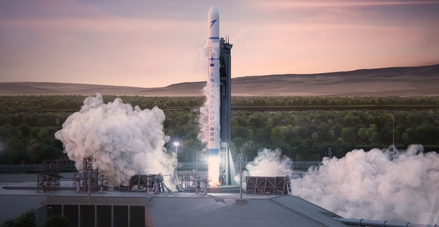
On 30 March 2025, Isar Aerospace became the first private company to launch an orbital-class rocket from Continental Europe when Spectrum lifted off from Andøya Spaceport in Norway. The vehicle flew for roughly 30 seconds before losing attitude control following an unexpected vent-valve opening and was terminated, but Isar gathered the dataset it needed to iterate on the design.
Backed by Series A through Series D rounds — including a €270 million Series D closed in June 2026 — valuing the company at around €2 billion, Isar is positioned as the most capitalised independent launch start-up in Europe. The company has secured launch service agreements exceeding $1 billion in contracted backlog and is preparing the second Spectrum flight — the qualifying mission "Onward and Upward" — from Andøya in 2026.
Launch Record
Isar Aerospace has flown 1 orbital mission tracked in the NovΔ mAInd launch database, at a 100% success rate. Our tracking covers 2026-09-05 to 2026-09-05; earlier flights are outside this dataset.
Computed from our own launch tracker, not supplied by the company. See the full launch tracker →
Products & Vehicles
Spectrum
Spectrum is Isar Aerospace's two-stage, liquid-propellant orbital launch vehicle, designed in-house and manufactured at the company's Ottobrunn site.
Specifications
- Height: 28 m
- Diameter: 2 m
- Liftoff mass: ~40,000 kg
- Payload to LEO (500 km): 1,000 kg
- Payload to SSO (500 km): 700 kg
- Stage 1: 9 × Aquila engines, LOX/propane
- Stage 2: 1 × Aquila Vacuum engine
- First flight: 30 March 2025 (test flight — terminated after ~30 s)
- Launch site: Andøya Spaceport, Norway (dedicated launch complex)
Spectrum is optimised for high flight rate, vertical integration and a containerised ground segment that can deploy to multiple spaceports. Both stages passed integrated 30-second static-fire tests in late 2025 ahead of the second flight.
Track Record
Company Milestones
2018 — Founded in Munich by Daniel Metzler, Markus Brandl and Josef Peter Fleischmann.
2019–2020 — Seed and Series A funding; Aquila engine development begins; propulsion test stand opens in Ottobrunn.
2021 — €75 million Series B; first commercial launch contracts announced; successful Aquila engine static fires.
2022 — €155 million Series C led by Lakestar; multi-engine static fires; launch service agreements signed with Airbus Defence and Space and OHB.
2023 — Series C extended, total raised exceeds €400 million; full-duration first-stage static fire; commercial backlog passes $1 billion.
30 March 2025 — Spectrum lifts off from Andøya Spaceport, Norway. First private orbital launch attempt from Continental Europe. Anomalous vent-valve opening at T+30 s causes loss of attitude control; the vehicle is terminated and falls back into the sea. No casualties; pad infrastructure intact.
Late 2025 — Both Spectrum stages pass 30-second integrated static-fire tests, validating readiness for Flight 2.
Q1 2026 — Bloomberg reports Isar in talks to raise ~€250 million at a ~€2 billion valuation.
9 June 2026 — Closed a €270 million Series D funding round, led by new investors Island Green Capital and Molten Ventures, with NATO Innovation Fund and existing investors (HV Capital, Lakestar, UVC Partners, KfW Capital) also participating, bringing total raised to ~€870 million.
2026 (planned) — "Onward and Upward", the second Spectrum flight and qualification mission, carrying five CubeSats and one experiment, after several scrubs (January, March 19, March 25).
Roadmap
What's next
The immediate priority is the second Spectrum flight — the "Onward and Upward" qualification mission — from Andøya Spaceport. After several scrubs in early 2026 (pressurisation valve issue in January, weather delays in March), Isar is now targeting a window in mid-2026. The mission will carry five CubeSats and one experiment as the first commercial payloads.
In parallel Isar is scaling Spectrum serial production at Ottobrunn and evaluating additional launch site partnerships in Europe to broaden the inclinations it can serve. A successful Flight 2 will trigger the start of contracted backlog flights, which already exceed $1 billion in signed agreements.
Long term the company is positioning itself as Europe's flagship independent launch provider for the constellation, Earth observation and government-payload markets.
Recent coverage on NovΔ mAInd
18 articles on Isar Aerospace published by NovΔ mAInd.
Upcoming launches
Tracked in our own launch database. See the full launch tracker →