 Company Profile
SpaceX
Vertical launch provider, satellite operator, and interplanetary transport developer
Overview
Space Exploration Technologies Corp. (SpaceX) is the world's most active launch service provider and operator of the Starlink satellite constellation. Founded in 2002 by entrepreneur Elon Musk with the goal of reducing space transportation costs and enabling Mars colonization, SpaceX pioneered reusable orbital-class rockets and has fundamentally reshaped the commercial launch industry.
The company operates the Falcon 9 and Falcon Heavy launch vehicles, achieving routine first-stage recovery and reuse. SpaceX is also the first private entity to send humans to orbit, transport cargo and crew to the International Space Station under NASA contracts, and deploy a megaconstellation for global broadband service. As of 2025, SpaceX executed 165 orbital missions—more than any government or commercial entity worldwide.
SpaceX reported $18.6 billion in revenue for 2025, driven primarily by its Starlink connectivity segment, which accounted for a majority of income despite the company reporting a $4.9 billion net loss and $2.6 billion operating loss. The company completed its initial public offering on Nasdaq (ticker: SPCX) on June 12, 2026, with an implied valuation of approximately $1.77 trillion. Its vertically integrated approach spans launch vehicle manufacturing, satellite production, ground station infrastructure, and propulsion systems development. SpaceX is simultaneously developing Starship, a fully reusable super-heavy-lift vehicle intended for lunar missions under NASA's Artemis program and eventual Mars expeditions.
Launch Record
SpaceX has flown 140 orbital missions tracked in the NovΔ mAInd launch database, at a 99.3% success rate, averaging 7.0/month. Our tracking covers 2025-01-04 to 2026-09-06; earlier flights are outside this dataset.
Computed from our own launch tracker, not supplied by the company. See the full launch tracker →
Products & Vehicles
Falcon 9
Falcon 9 is a two-stage medium-lift launch vehicle with a reusable first stage powered by nine Merlin engines. Payload to LEO: 22,800 kg. Payload to GTO: 8,300 kg. First flight: June 4, 2010. The Block 5 variant, introduced in 2018, features enhanced reusability with minimal refurbishment between flights. Falcon 9 is certified for NASA crew and cargo missions and holds the record for most consecutive successful launches of any operational vehicle. Individual boosters have flown more than 20 times.
Falcon Heavy
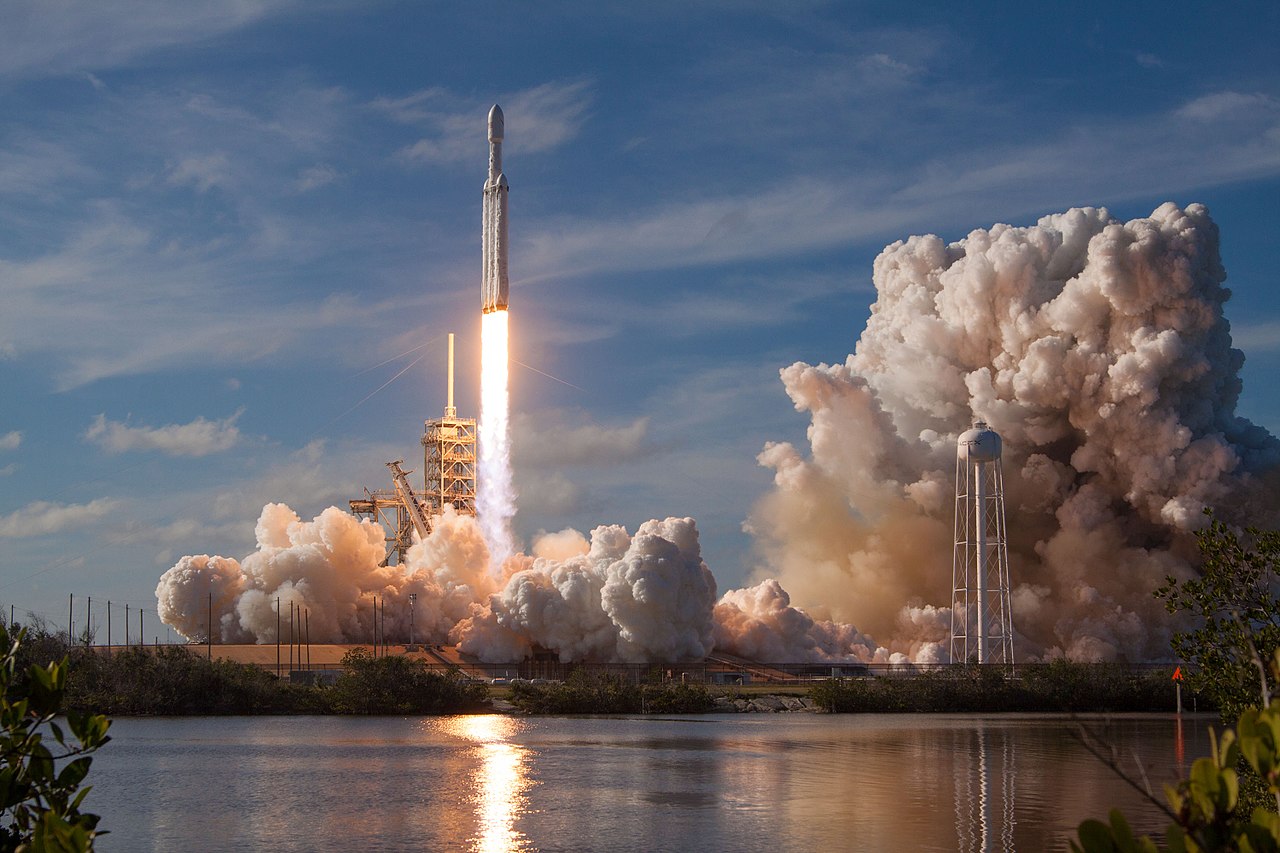
Falcon Heavy is a super-heavy-lift vehicle composed of a Falcon 9 core stage with two strap-on Falcon 9 first-stage boosters. Payload to LEO: 63,800 kg. Payload to GTO: 26,700 kg. Payload to Mars: 16,800 kg. First flight: February 6, 2018. All three cores are designed for recovery and reuse. After an 18-month hiatus, Falcon Heavy resumed operations in April 2026.
Starship
Starship is a fully reusable two-stage super-heavy-lift vehicle under development. The system comprises a Super Heavy booster with 33 Raptor engines and a Starship upper stage with six Raptors. Projected payload to LEO: 100–150 metric tons (expendable mode significantly higher). Starship is the primary vehicle for NASA's Artemis lunar lander variant and SpaceX's Mars architecture. Version 3 of the prototype was expected to debut in 2026. Development continues with iterative testing from Boca Chica, Texas, though the FAA grounded the vehicle in May 2026 following a launch mishap.
Dragon
Dragon is a reusable spacecraft available in cargo (Dragon 2 Cargo) and crew (Crew Dragon) variants. Pressurized cargo capacity: ~6,000 kg. Crew capacity: 7 astronauts. Dragon is the only operational vehicle capable of returning significant cargo from the ISS and has transported NASA and commercial astronauts since 2020.
Starlink
Starlink is a low Earth orbit broadband constellation comprising thousands of satellites in multiple orbital shells. As of 2025, SpaceX launched over 3,200 satellites in the year alone, a 60% increase from 2024. Starlink provides global internet connectivity and represents SpaceX's largest revenue segment, accounting for 69% of total revenue in Q1 2026.
Track Record
Early Development and Falcon 1
SpaceX became the first privately funded company to launch a liquid-fueled rocket to orbit with Falcon 1 on September 28, 2008, after three prior failures. This milestone secured a $1.6 billion NASA Commercial Resupply Services contract in December 2008.
Falcon 9 and Reusability
Falcon 9 debuted in June 2010. In December 2015, SpaceX successfully landed an orbital-class booster for the first time. By 2017, the company re-flew a recovered first stage, proving commercial reusability. Falcon 9 has since become the world's workhorse rocket, with individual boosters flying over 20 missions.
Human Spaceflight
In May 2020, SpaceX's Crew Dragon launched NASA astronauts Robert Behnken and Douglas Hurley to the ISS on Demo-2, restoring American crewed orbital capability. SpaceX has since conducted multiple Crew Dragon missions for NASA and commercial customers, including the Inspiration4 all-civilian mission in 2021.
Starlink Deployment
Starlink's first operational satellites launched in 2019. By 2023, SpaceX was deploying satellites at unprecedented scale, reaching over 5,000 operational satellites by 2025. Starlink achieved profitability and became SpaceX's largest revenue source.
Starship Development
Starship began high-altitude testing in 2020. The first integrated flight test occurred in April 2023. NASA selected Starship as the Artemis III lunar lander in 2021, with a contract valued at $2.9 billion. Development accelerated with Version 3 prototypes entering testing in 2026, though setbacks including a May 2026 FAA grounding highlighted ongoing technical challenges.
Record Launch Cadence
SpaceX launched 165 orbital missions in 2025, surpassing all other entities globally and setting a new company record.
Roadmap
Initial Public Offering
In December 2025, Elon Musk confirmed SpaceX's intention to pursue an IPO. The company confidentially filed for a public offering in April 2026 and completed its Nasdaq listing (ticker: SPCX) on June 12, 2026, pricing at $135/share for an implied valuation of approximately $1.77 trillion — one of the largest IPOs in history.
Starship Version 3 and Artemis
Starship Version 3 is under development with enhanced capabilities critical to NASA's Artemis program, which plans to land astronauts on the Moon using a Starship-derived Human Landing System. Flight testing of Version 3 began in early 2026, though operational readiness remains contingent on regulatory approval and successful test campaigns.
Orbital Data Centers
SpaceX is pursuing spaceborne data processing facilities in coordination with xAI and Tesla. The company announced plans for "Terafab," a chip fabrication venture intended to produce silicon at terawatt-scale energy consumption. Orbital datacenter development involves coordination with Amazon and regulatory bodies.
Mars Architecture
SpaceX's stated long-term objective remains establishing a self-sustaining city on Mars using Starship as the primary transport system, though no firm mission dates have been announced.
Recent coverage on NovΔ mAInd
50 articles on SpaceX published by NovΔ mAInd.
Upcoming launches
Tracked in our own launch database. See the full launch tracker →