NASA awarded L3Harris Technologies an Engineering Test Unit (ETU) contract on 9 October 2026 to produce a final all‑glass test telescope for the European Space Agency’s Laser Interferometer Space Antenna (LISA) mission, the agencies and industry partners announced this week. The ETU will be used to validate the telescope design in a near‑flight configuration before production of the flight hardware that NASA will supply to ESA for the mid‑2030s mission.
Under the arrangement, L3Harris will design, assemble and integrate the ETU — described by sources as the last test unit prior to flight production. The company previously delivered a full‑scale prototype in May 2024, which underwent testing at NASA’s Goddard Space Flight Center and provided data used to inform the new unit. In June 2026 L3Harris also delivered a metal structural model of the telescope as part of the development sequence.
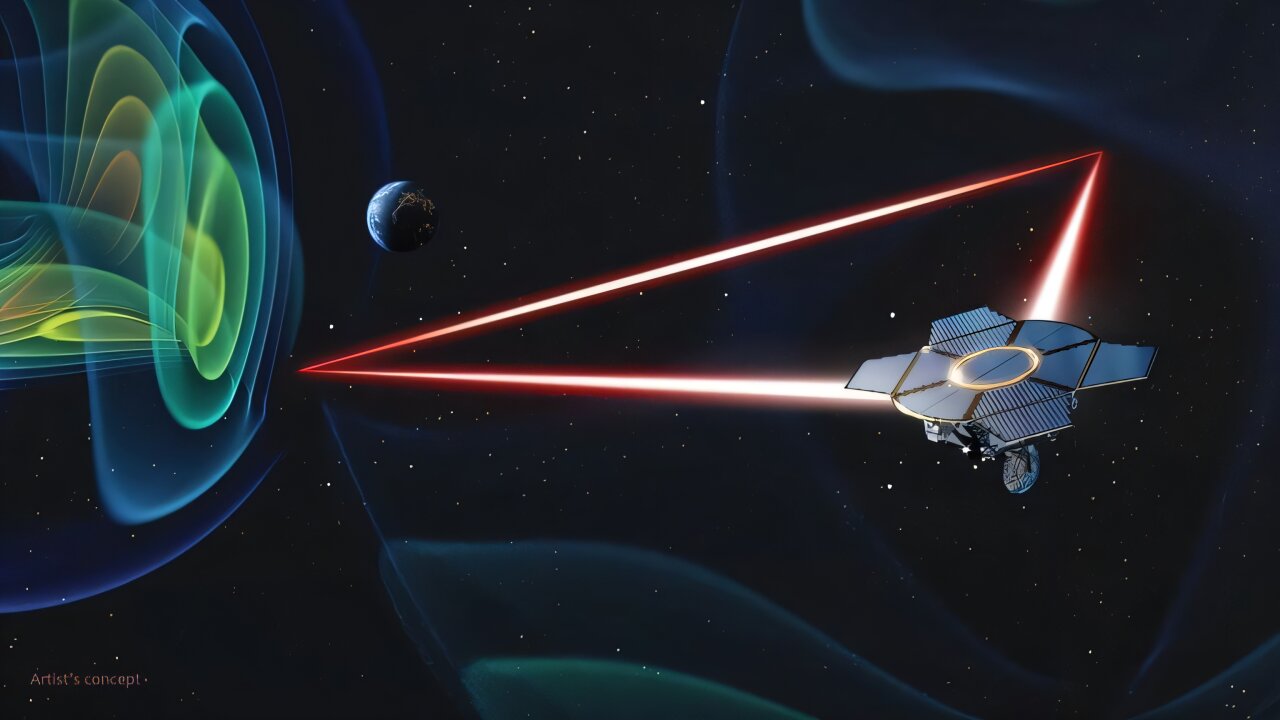
NASA is contributing the telescopes and other critical hardware, along with engineering and scientific support, as part of its role as a collaborative partner on LISA. The mission, led by ESA with Germany’s OHB and Thales Alenia Space selected to build the three spacecraft, will be the first space‑based gravitational‑wave observatory. LISA will fly three spacecraft in an Earth‑trailing formation with arms about 1.6 million miles (2.5 million kilometers) long, measuring tiny changes in the distances between test masses using infrared laser beams exchanged through precision telescopes.
Sources describe the L3Harris telescope as an all‑glass design made from an amber‑colored glass‑ceramic chosen for its resistance to shape change across a wide temperature range; mirrors are gold‑coated. Each LISA spacecraft will carry two such telescopes capable of transmitting and receiving the mission’s precision infrared laser beams. The instrument must support distance measurements sensitive to variations "smaller than the width of a helium atom," in the words of NASA project scientist Ira Thorpe at Goddard, quoted in the NASA and Phys.org coverage.
Jeff Hanke, president of Space Systems, Space & Mission Systems for L3Harris, said in Satellite Today that "LISA will open a new window into the universe that ground‑based observatories cannot access," and that by "listening to the low‑frequency ripples in space‑time across millions of kilometers, LISA allows the study of massive, distant and rare cosmic events that are otherwise invisible." The same Satellite Today report notes that L3Harris has manufactured a full‑scale prototype and that each satellite will include two of the company’s telescopes.
NASA and media reports emphasize that the ETU is an engineering verification unit and not a flight item: Astrospace (in Italian) explicitly states the ETU "will not be one of the telescopes installed on the LISA satellites" but will verify the design in its most flight‑like configuration and prepare procedures for subsequent flight hardware production. That distinction aligns with NASA and industry practice of building engineering test units to reduce risk during qualification and production.
LISA’s scientific goals, summarized across the sources, center on opening access to low‑frequency gravitational waves that cannot be observed from ground detectors. The mission aims to detect mergers of massive black holes billions of light‑years away, map compact binary populations such as white dwarf pairs, and probe other phenomena that produce long‑wavelength gravitational radiation. ESA currently plans a mid‑2030s launch.
Technical details repeated in the coverage include the 2.5 million‑kilometer arm length (1.6 million miles) of the triangular constellation and the role of the telescopes in transmitting and receiving infrared laser beams between spacecraft. Phys.org and NASA imagery note the telescope’s amber glass‑ceramic appearance and gold‑coated mirror surface; NASA’s Goddard testing of the earlier prototype supplied performance data now used to refine the ETU.
Contextually, the ETU contract represents the next hardware milestone in a long‑running international effort to take gravitational‑wave astronomy into space. LISA stems from decades of collaboration between ESA and NASA and follows the success of terrestrial observatories such as LIGO and Virgo, which detect high‑frequency waves from stellar‑mass black hole and neutron star mergers. By moving to much longer baselines in space, LISA targets lower frequencies produced by far more massive or more widely separated sources.
Looking ahead, the ETU work supports the schedule toward flight‑qualified telescopes that NASA will provide for the three LISA spacecraft. ESA’s selection of OHB and Thales Alenia Space for the spacecraft buses sets the industrial framework; the ETU will inform the final production phase that must meet demanding optical and thermal stability requirements for the mission’s unprecedented interferometry across millions of kilometres.
For the global gravitational‑wave community, the L3Harris ETU contract and the tested all‑glass telescope design mark tangible progress: the program is moving from prototypes and structural models toward hardware validated in a near‑operational configuration. If tests continue to validate the approach, NASA will proceed to produce the flight telescopes that will enable LISA to probe a largely unexplored gravitational‑wave band when it launches in the mid‑2030s.