Hop Aero raises $11 million to push Rook toward mid‑2027 flight
Hop Aero announced on Sept. 30, 2026 that it raised $11 million in funding to advance development of its suborbital, point‑to‑point logistics concept and to accelerate work on its full‑scale Rook 2 vehicle. The round, which combines capital the company raised before and during its participation in the summer Y Combinator batch, was led by Initialized Capital, the seed‑stage fund that has invested in other space companies.
The financing came in the form of SAFEs, according to Hop Aero, which allow the startup to take money now and issue equity later. Hop Aero cofounder and CEO Matija Milenovic told Payload that the team "ended up raising more than we initially planned" and that they were able to decline several investor offers, positioning the company to prepare for a Series A.
Hop Aero is developing Rook as an autonomous suborbital delivery vehicle intended to launch swarms of autonomous systems hundreds of miles and deploy them into contested environments. In public descriptions of its technology demonstrations, Hop Aero emphasized testing across propulsion, vehicle systems and payload deployment during its YC batch.
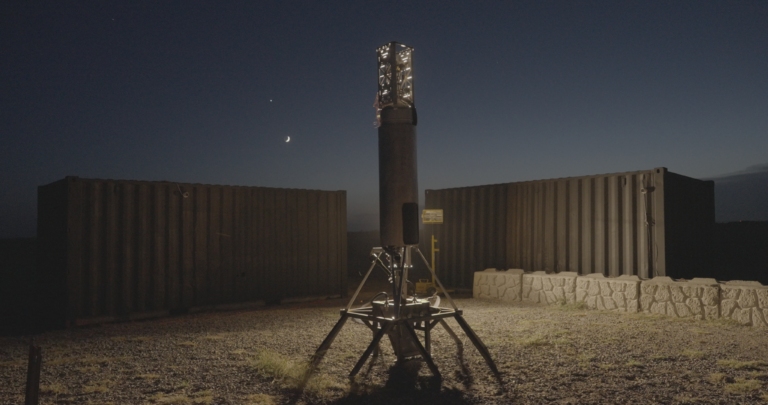
At the Infinity One Oklahoma Spaceport, the company hot‑fired a 3D‑metal‑printed engine and ran four internal engine designs on a test stand without any engines failing. That engine—designed with the company’s hopOS software—was then installed in approximately a half‑scale Rook prototype for a full static fire that exercised the fuel tanks, plumbing and wiring harnessing. Separately, Hop conducted a ground demonstration in which it slid four drones out of a payload bay on a rail, a test aimed at showing how the vehicle could deploy a swarm once it reaches the drop zone.
The propulsion hot‑fire and payload‑deployment ground demonstrations de‑risked selected subsystems, but Hop Aero has acknowledged remaining challenges. None of the tests to date have demonstrated an untethered flight or solved the central technical hurdle that has kept rocket cargo delivery on paper for years: surviving hypersonic reentry and achieving an intact, on‑target landing. Hop Aero has yet to fly any vehicle untethered.
Milenovic told Payload that the new funds will let Hop Aero pursue development of the full‑scale Rook 2 vehicle. The company plans Rook 2’s first flight for mid‑2027 and said this production vehicle will use a different engine and a different propulsion architecture from the half‑scale test articles. Hop Aero’s immediate plans include pouring concrete at the Oklahoma Spaceport by the end of the year to support larger vehicles, and the seven‑person team has been expanding operations there despite weather challenges during testing.
Hop Aero’s team compressed testing after a drought threatened a statewide fire ban in Oklahoma. The seven‑person staff worked up to 20‑hour days over a condensed schedule to finish tests before any potential ban could close the site. The company expects infrastructure work at the spaceport to enable larger‑scale testing as it moves toward full‑scale Rook builds.
Hop Aero’s pitch emphasizes rapid, long‑range delivery of autonomous systems into contested areas, a capability the company says is in demand from defense customers. The demonstrations to date focused on propulsion and on payload integration and deployment mechanisms; Hop Aero itself and industry observers note that controlled reentry, thermal protection and precision, survivable landings remain open technical problems for any concept that seeks to deliver cargo by suborbital rocket.
Suborbital point‑to‑point logistics has been a recurring idea in aerospace for decades, resurfacing in modern private‑sector proposals as propulsion, materials and autonomy have advanced. Previous attempts and proposals have often been stalled by the difficulty of returning heavy or fragile payloads intact after hypersonic descent. Hop Aero’s approach—combining rapidly iterated 3D‑printed engines, in‑house software for propulsion, and a payload‑deployment mechanism—addresses multiple subsystems in parallel but still leaves the landing problem as a key milestone to clear before operational service.
With $11 million committed and a scheduled first flight of Rook 2 in mid‑2027, Hop Aero now faces a sequence of technical milestones: complete full‑scale engine development and qualification for the different propulsion architecture it plans to use on Rook 2; demonstrate an untethered flight; and validate a reentry and landing solution that preserves payload integrity. Progress on those fronts will determine whether the company can move from demonstrator hardware to a vehicle capable of the missions it describes to potential defense customers.
The investment led by Initialized Capital and the company’s participation in Y Combinator provide Hop Aero with runway to pursue those milestones and to prepare for a Series A round. How quickly the team can close the open technical gaps—particularly hypersonic reentry survivability and precision landing—will be central to whether suborbital point‑to‑point logistics transitions from experimental demonstrations to operational capability.
Sources: Payload — "Exclusive: Hop Aero Raises $11M for Suborbital Point‑to‑Point Delivery" (Sept. 30, 2026).