Introduction
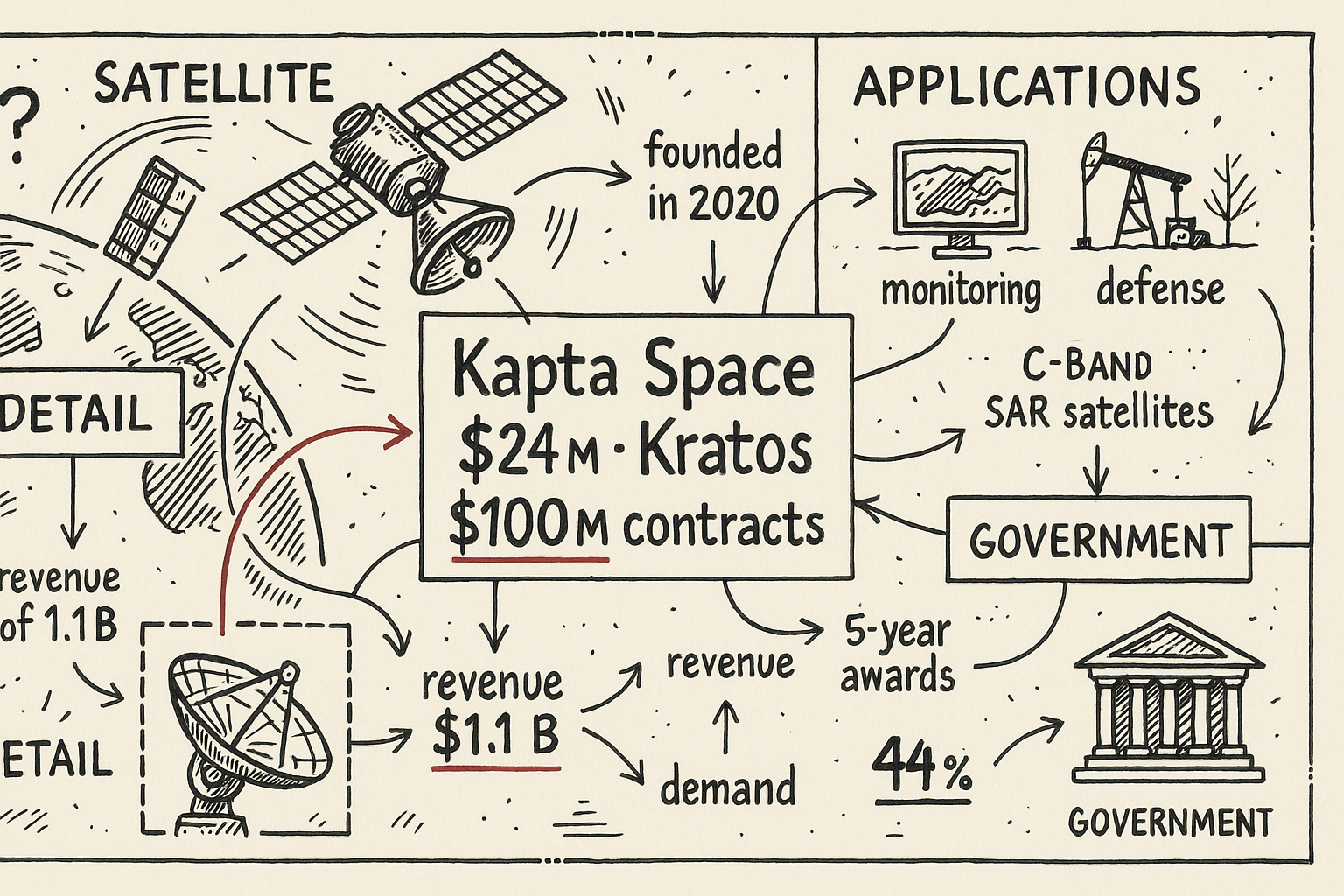
Across separate announcements this October, small companies and legacy primes alike signaled the same thing: orbit is increasingly being treated as a contested, revenue-bearing domain. Seattle spinout Kapta Space raised $24 million to scale metamaterial radar payloads; Kratos reported more than $100 million in recent contracts for space intelligence data. Between seed financings for virtual on‑orbit data centers, antenna wins for a Navy airborne command aircraft, and satellite security spacecraft rounds, the market’s center of gravity is tilting toward defense-aligned capabilities. This analysis connects those moves, explains why the shift matters economically, and teases out likely next steps for investors and operators.
Where we are: money flows meeting mission demand
The headline numbers are blunt: Kapta Space’s Series A and Kratos’s six‑ and seven‑figure awards both point to robust government demand that is translating into sustaining capital. Fortastra’s $30 million Series A to build security spacecraft and Satlyt’s $8 million seed round for virtual AI data centers in space show venture investors are willing to underwrite long development timelines when the customer pipeline includes the Department of Defense and allied services. Meanwhile, HawkEye 360’s pivot of RF sensor capabilities to characterize orbital objects underscores a market logic: many high-value space applications—signals intelligence, space domain awareness (SDA), resilient communications—sit at the intersection of commercial agility and government mission requirements.
Why that tilt is happening now
Three structural forces explain the reorientation. First, geopolitics and doctrine: the U.S. and partners have declared space a warfighting domain, and defense budgets are rising to match. That creates predictable, contractable revenue streams—valuable to venture-backed companies that can show near-term deliverables. Second, technology maturation: lower-cost metasurface radars, software-defined payloads, and compact RF/SDA sensors have crossed enough technical thresholds that prototypes can be fielded quickly. Kapta’s metamaterial radar and HawkEye’s RF constellation are examples. Third, integration demand: legacy primes like Northrop Grumman and Kratos are buying services and sensors more than building everything in-house, opening procurement pathways for smaller firms.
Economic consequences for the space ecosystem
At the ecosystem level, two outcomes emerge. Positive: increased government contracting reduces capital risk and can catalyze regional clusters—Seattle’s Q3 haul of $3.5 billion illustrates how defense-aligned success stories beget more investment into adjacent startups and suppliers. Negative: a pull toward defense work risks crowding out pure-commercial consumer or climate-focused ventures, concentrating talent and capital in lower-margin, single‑customer business models. That tradeoff matters for policymakers wanting a diverse national space industrial base.
Surprising patterns and counterintuitive implications
First, defense demand is accelerating innovation velocity, not throttling it. Venture investors often fear government procurement’s bureaucracy; yet current deals show the DoD is buying newer, modular payloads and paying to get them deployed—shortening the commercialization path for certain hardware and data services. Second, commoditization of some sensor elements (e.g., antennas, RF processing) is creating a two‑tier market: bespoke, high-value analytics (SDA products, fused intelligence) command premium margins, while hardware becomes a low-margin volume play. Firms that own the analytics layer will capture disproportionate value.
What to watch next
Watch contract pipelines and buying modalities. If the DoD doubles down on as-a-service procurement and smaller, faster risk‑reduction buys, expect more VC rounds tied to defense-contracted revenue. Conversely, if budgets reallocate away from SDA toward large strategic programs, small vendors could face a revenue cliff. Technically, keep an eye on integration wins (e.g., ThinKom antennas on TACAMO aircraft)—airborne and terrestrial nodes will define how space services are used tactically. Finally, consolidation is likely: primes will continue to acquire or partner with nimble startups that have proven prototypes and contract traction.
Investor and operator playbook
For investors: prioritize startups with dual-use products and a path to government certification, especially those that control software-defined analytics. For startup founders: design for integration—modular payloads, standards-based data outputs, and clear security compliance pathways make you a preferred vendor. For policymakers: balance defense contracting with incentives for climate and commercial applications to avoid monoculture in the national industrial base.
Conclusion
The recent stream of deals—from Kapta Space’s $24 million raise to Kratos’s $100 million contract wins—reveals a maturing economic logic: orbit is becoming a services market driven by defense needs and enabled by rapidly evolving sensor and compute technology. That combination accelerates deployment but concentrates risks. The companies that stitch hardware, software, and data together, and can sell into both government and commercial markets, will be the economic winners in this new phase.