Summary
Across eight recent papers and press items, a coherent theme emerges: the universe keeps forcing us to revise the limits of how fast structures form and how subtle signals can be extracted from noisy data. Two technical advances — refined glare-removal in JWST imaging and precision pulsar timing arrays — are delivering complementary constraints that reach from nearby exoplanets and impostor brown dwarfs to the formation and possible fission of the most extreme compact objects.
JWST: squeezing planets from glare and vetting early galaxies
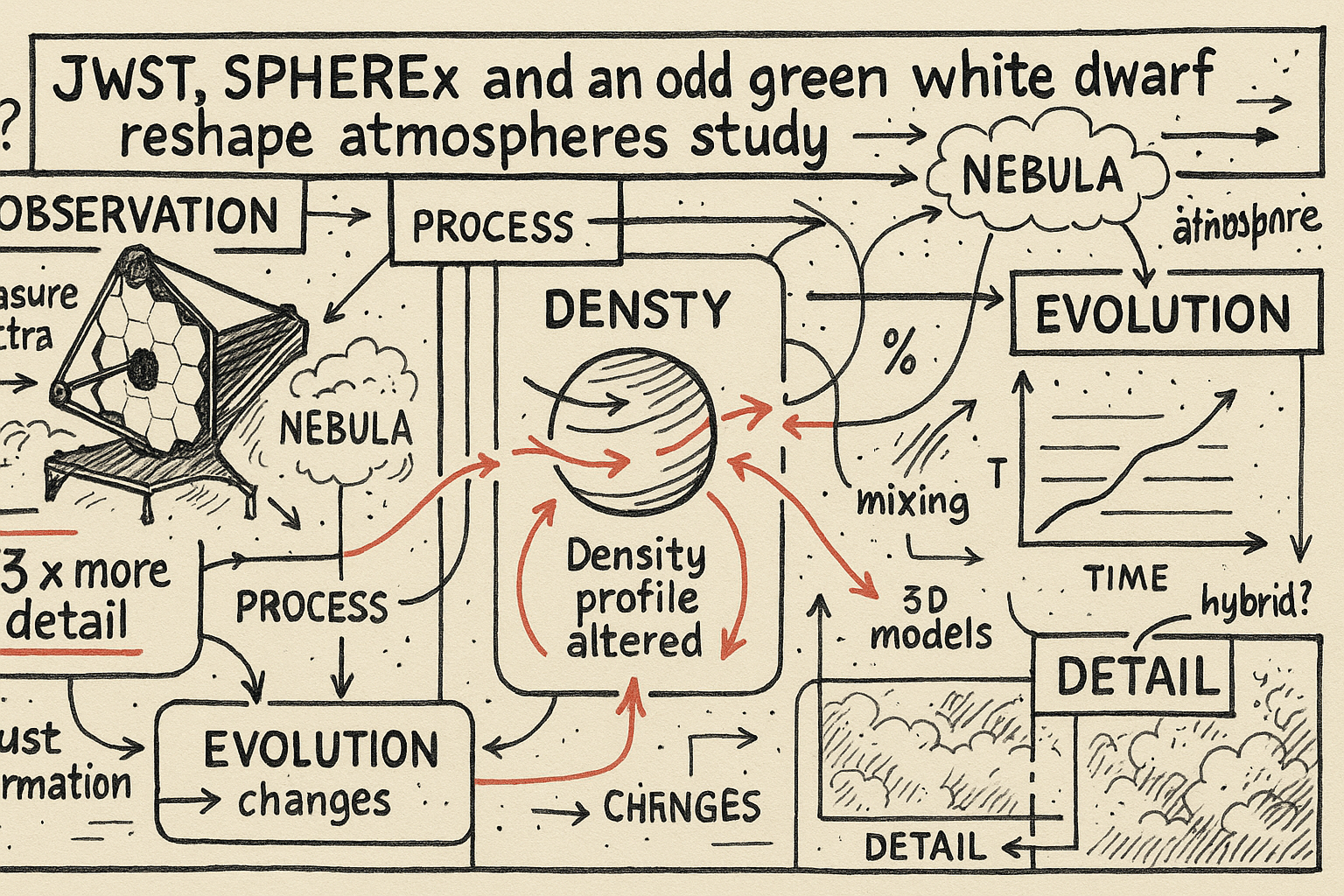
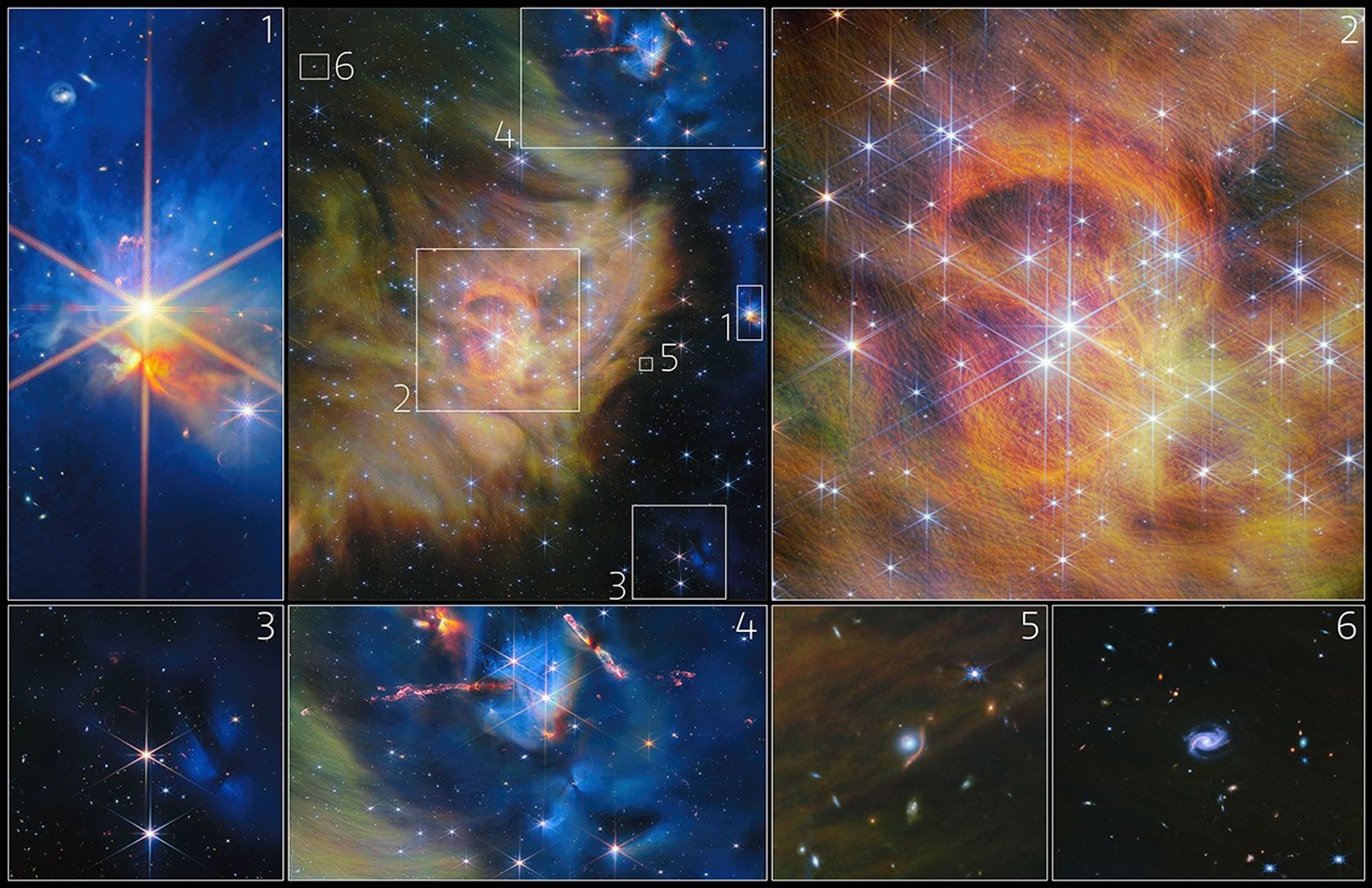
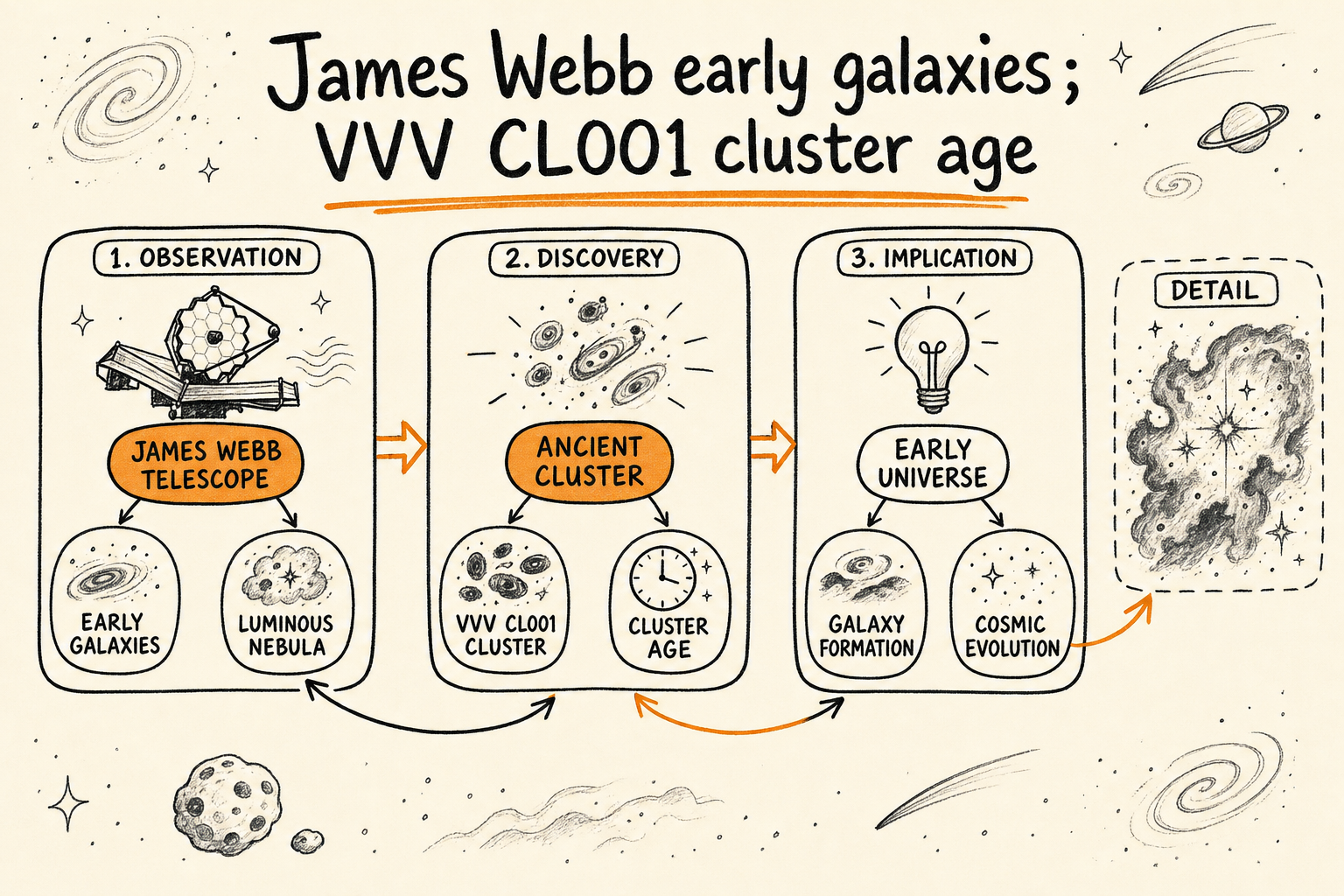
In one corner, astronomers revisited two-year-old JWST imagery with a new glare-removal technique and extracted a giant planet that had been hidden in the star’s wash. That work underlines a practical truth: JWST’s raw sensitivity is necessary but not sufficient. Post-processing algorithms — we might call them computational optics — are becoming as decisive as the hardware. The same telescope also kept producing surprises in studies of the early universe, from the sprawling, dust-rich galaxy nicknamed Leviathan, whose stars are spread rather than compact, to a red object, Capotauro, that initially looked like a first-generation galaxy but turned out to be a cold brown dwarf after multi-epoch imaging revealed proper motion.
Those two outcomes are instructive. First, JWST is expanding parameter space both for faint, close-in exoplanets and for spatially resolved high-redshift galaxies. Second, distinguishing distant, red-shifted galaxies from moving, cool foreground objects depends on patient, time-resolved strategies — revisits years apart — a lesson from the Capotauro correction.
Pulsars and the mass limits on supermassive-black-hole pairs
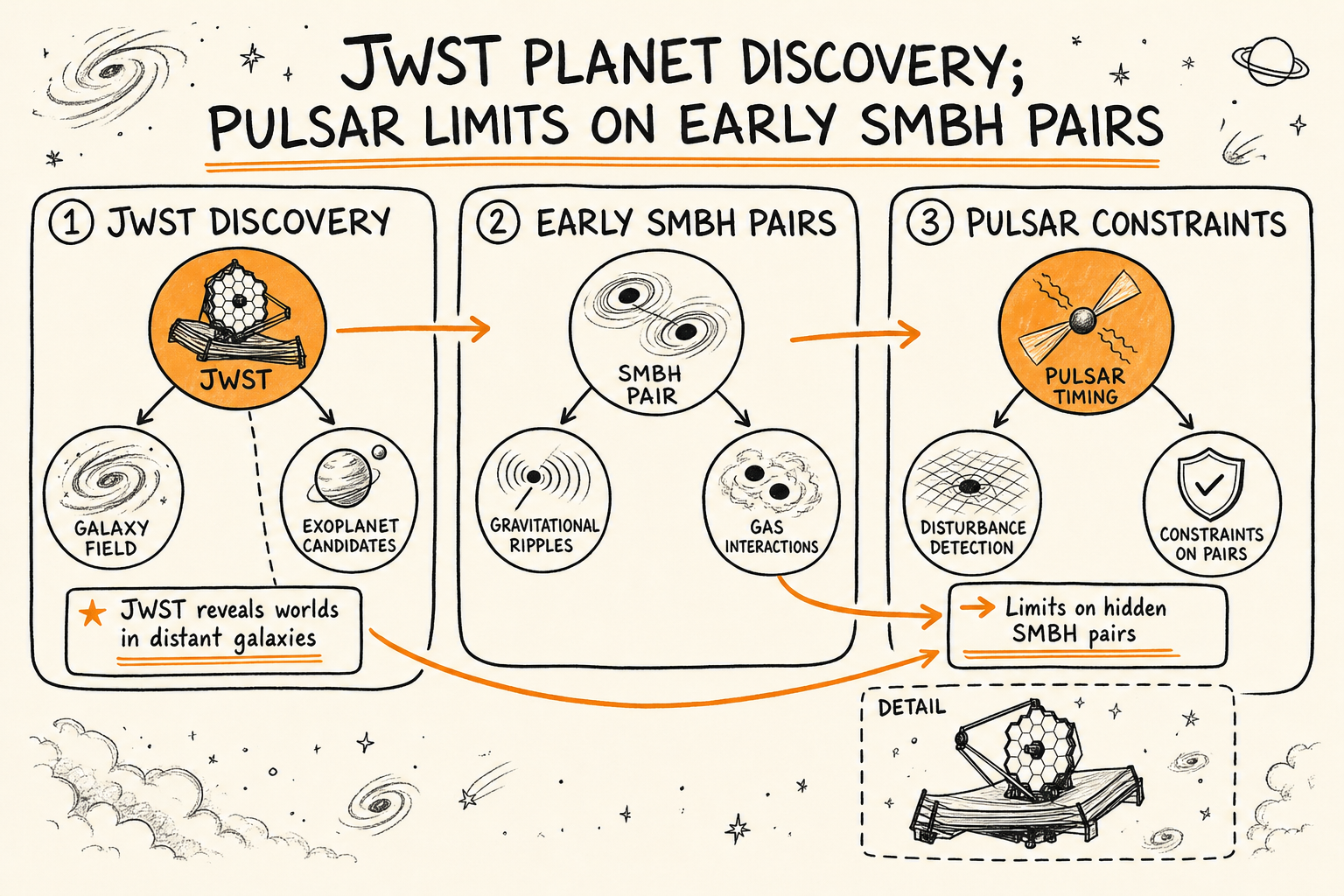
Pulsar timing arrays (PTAs) have matured into a tool for cosmological archaeology. By measuring the correlated timing residuals of millisecond pulsars across the sky, PTAs probe the nanohertz gravitational-wave background produced by supermassive black hole (SMBH) binaries. The latest analysis has used non-detections and marginal signatures to place the first mass limits on SMBH pairs in the early universe, trimming the parameter space for how billion-solar-mass holes could appear less than a billion years after the Big Bang.
Put simply, PTAs are telling us which heavy-seeding scenarios are improbable. If mergers of massive seed black holes were the dominant path to early SMBHs, PTAs should be hearing a louder background today. The constraints do not rule out rapid growth entirely but push the community toward rarer, more violent or more efficient formation channels.
How the pieces fit: seeds, collisions, and spin
The tension between early massive SMBHs and PTA limits invites synthesis. One plausible pathway is a hybrid: dense stellar clusters in the young Universe, much more common then, could produce repeated stellar collisions and create very massive stars that collapse into heavy seeds. Those seeds then grow rapidly by gas accretion in unusually massive halos, producing a minority population of billion-solar-mass black holes without creating a loud gravitational-wave background. This neatly connects recent theoretical emphasis on massive stellar collisions with PTA-constrained merger rates.
Complicating matters further are theoretical claims about black-hole microphysics. Two recent theoretical lines — proposals that black holes might leave Planck-scale remnants, and provocative calculations suggesting near-maximally spinning black holes could split into two — would, if borne out, rewrite late-stage black-hole evolution and gravitational-wave signatures. A universe where some extreme spins lead to fission could create unexpected populations of smaller holes; remnants would act as sinks of information and end-stage mass. These ideas remain speculative and highly model-dependent, but they highlight a crucial point: astrophysical inference about formation channels rests on both empirical constraints (PTAs, JWST) and the theoretical scaffolding for black-hole behavior.
Two counterintuitive takeaways
First: the objects that most convincingly look like the universe’s first galaxies can be foreground impostors — motion as small as a tiny positional shift over years can convert an alleged cosmological discovery into a local brown dwarf. Time-domain verification is therefore as essential as spectral characterization.
Second: stronger pulsar timing limits on early SMBH pairs do not necessarily mean fewer big black holes; they mean fewer mergers producing low-frequency gravitational waves. Rapid, gas-driven growth or rare, high-mass seeds remain viable and, paradoxically, some efficient formation routes would be quieter in the PTA band.
Implications and what to watch
Practically, the field should expect three near-term developments. One, JWST and ground-based facilities will increasingly pair advanced image-processing with scheduled revisits to separate moving foregrounds from static high-z sources. Two, PTA sensitivity will keep improving; upper limits will sharpen or yield a detection that isolates merger populations by redshift and mass. Three, theoretical work on black-hole endpoints — remnants and fission — will mature only if they produce observational fingerprints: altered gravitational-wave spectra, unexpected compact-object demographics, or high-energy transients.
Historically this is familiar territory: each leap in instrumentation (from radio arrays to optical telescopes to space observatories) has required commensurate leaps in analysis and theory. The present moment repeats that pattern. JWST’s images are richer than we first thought, pulsars are whispering cosmological constraints, and theorists are reminding us the fundamental rules might yet surprise. The next few years will tell whether massive black holes arrived by rare, quiet growth or by dramatic, noisy collisions — and whether our best telescopes and clocks are finally precise enough to decide.