Overview
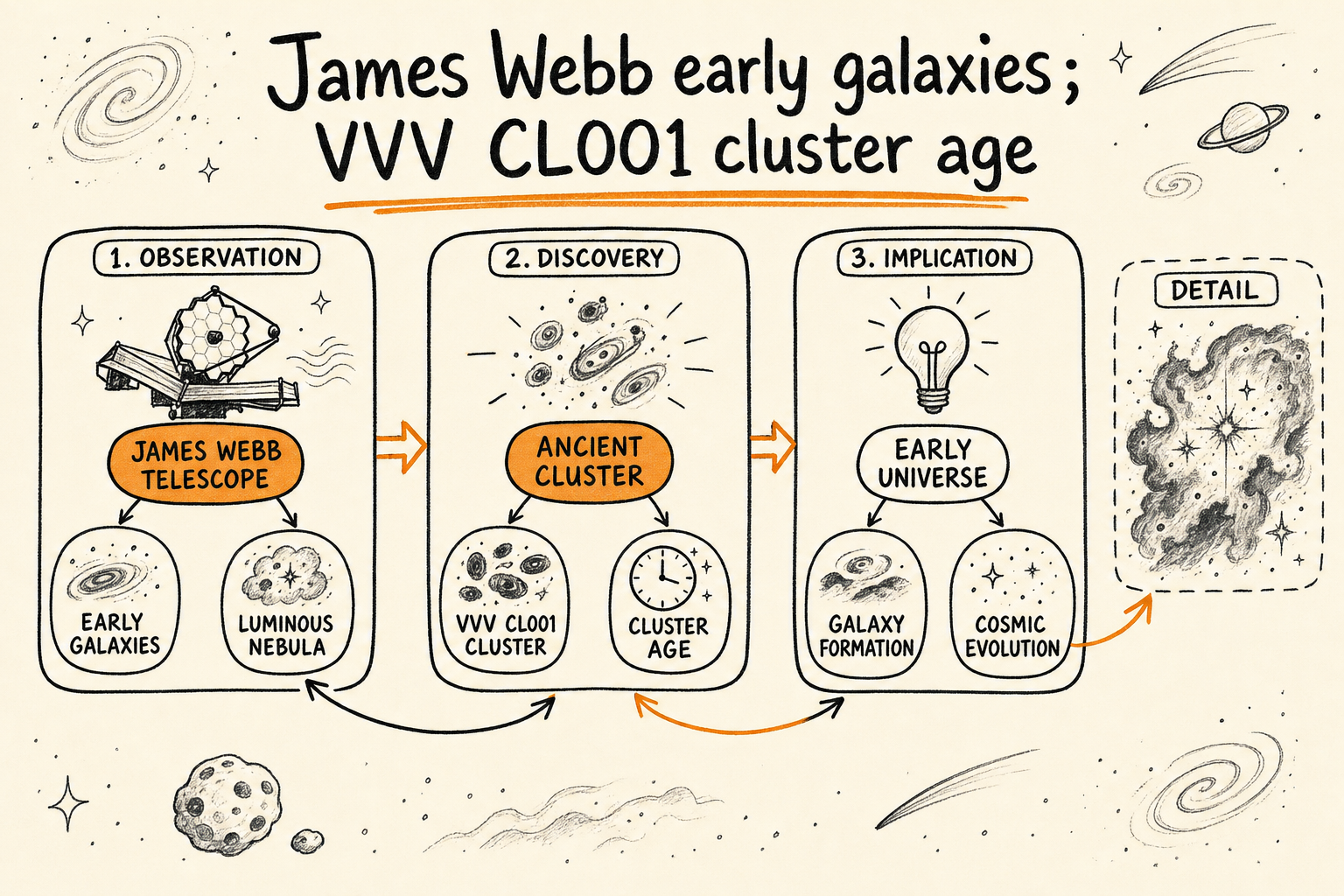
The past month has produced a cluster of results that, taken together, force a reassessment of how light, gas and metals moved through the universe from its first few hundred million years to present-day dwarf galaxies and the Milky Way’s center. James Webb Space Telescope (JWST) observations that revealed unexpectedly bright galaxies in the epoch shortly after the Big Bang have been complemented — and complicated — by Hubble findings showing that galactic winds may not have aided cosmic reionization the way theorists expected. Closer to home, Hubble studies of dwarf galaxies expose dramatic oxygen losses, and infrared surveys have finally age-dated a dust-shrouded globular cluster, VVV CL001, as nearly as old as the universe. Stitching these threads together points to a common theme: the microphysics of gas flows and the feedback of light and explosions are more subtle and environment-dependent than our simple models allow.
Bright early galaxies and a ‘cosmic leaf blower’
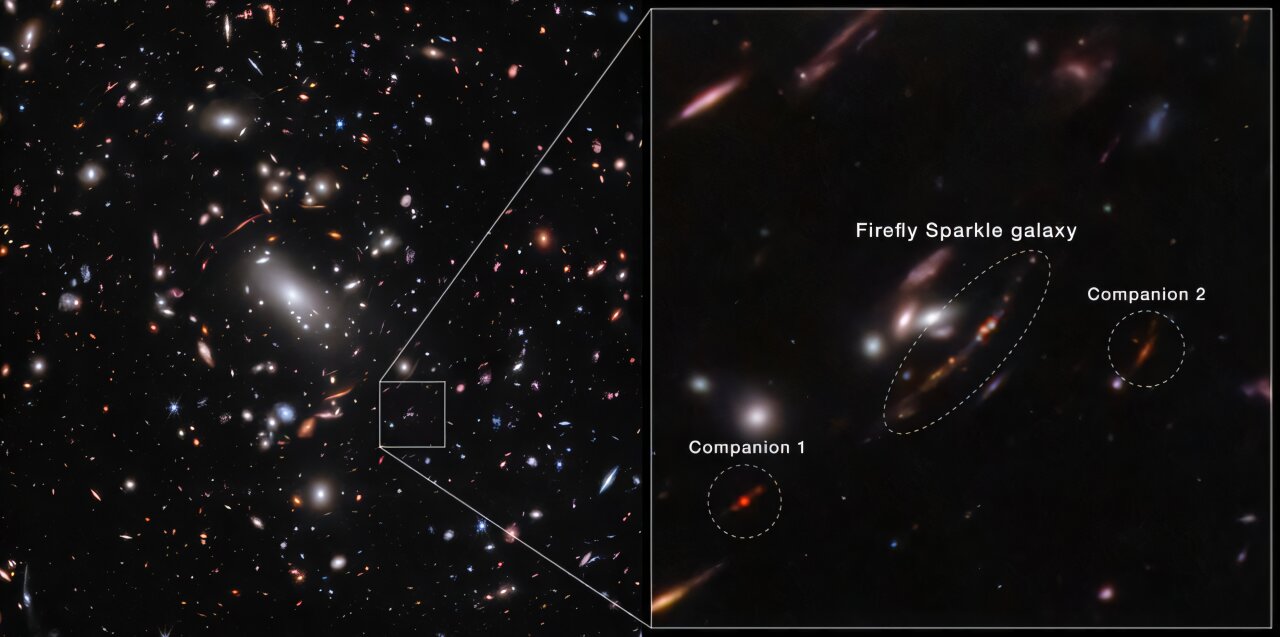
JWST surveys found an overabundance of luminous galaxies roughly 400–500 million years after the Big Bang — brighter and more common than standard models predicted. Two independent but related analyses propose a striking mechanism: intense ultraviolet (Lyman-alpha) radiation from dense star clusters can drive powerful, light-propelled winds that clear neutral hydrogen from galactic surroundings. These winds act like a cosmic leaf blower, lowering the column of opaque gas and allowing Lyman-alpha and ionizing photons to escape, making the galaxies appear unusually bright to JWST.
That explanation offers a valuable corrective to earlier narratives that relied mainly on mechanical winds from supernovae to punch holes in the interstellar medium. Rather than replacing explosion-driven feedback, the light-driven process augments it at the smallest scales and earliest times, especially in compact, metal-poor systems where radiation pressure and resonant scattering of Lyman-alpha photons are efficient.
Hubble complicates the wind story
But Hubble observations present a counterpoint. Studies aimed at establishing what allowed the universe’s neutral hydrogen fog to lift — the epoch of reionization — now show that supernova-driven winds in many galaxies actually trap radiation rather than help it escape. High-resolution Hubble spectroscopy and imaging indicate that dense shells and turbulent outflows can increase the path length of resonant photons, boosting internal absorption and recombination, and thereby suppressing the emission that would reionize intergalactic gas.
Reconciling the JWST ‘‘leaf blower’’ idea with Hubble’s cautionary results suggests a split: radiation-driven clearing may dominate in the most compact, intensely star-forming pockets (making them appear anomalously bright), while in more extended or dustier systems mechanical winds and supernova remnants create tangled structures that impede escape. Time matters: an early phase dominated by radiation pressure could be followed by a supernova-dominated era that behaves differently.
Local laboratories: dwarfs, oxygen loss, and the Galactic center
On kiloparsec scales, Hubble’s survey of nearby dwarf galaxies finds they retain only about 11% of the oxygen their stars should have produced. Most of the oxygen is missing, implying efficient ejection of metals by galactic winds into the circumgalactic medium or beyond. This is not merely an accounting curiosity: metal loss shapes cooling rates, future star formation, and observable signatures in absorption lines around galaxies.
Meanwhile, spectroscopic studies of gas near Sagittarius A* show modest metal enrichment likely seeded by supernovae in the Galactic center. That elevated metallicity and heat influence how gas accretes onto the Milky Way’s supermassive black hole, pointing to a feedback loop in which star formation and death regulate nuclear fueling in a way that mirrors — on a different scale — processes shaping early galaxies.
Finally, the age determination of the dust-obscured globular cluster VVV CL001 at roughly 13.4 billion years adds another piece: the Milky Way’s oldest components formed amid the same early-era physics that JWST now probes. Metal-poor clusters like VVV CL001 are fossil records of star formation and feedback in the infant universe; their survival and present-day metallicities constrain how violently early gas was expelled or retained.
Implications and the path forward
These results collectively emphasize that feedback is not monolithic. Radiation pressure, resonant scattering (Lyman-alpha), supernova explosions and dust each play roles that vary with galaxy mass, size, metallicity and evolutionary moment. For theorists, the demand is clear: models must capture multi-physics coupling — radiative transfer, hydrodynamics, dust physics and time-dependent feedback — at resolutions that resolve star clusters, not just whole galaxies.
Observationally, coordinated use of JWST (deep IR imaging and spectroscopy), Hubble (UV/optical lines and local analogs), and ground-based integral-field spectrographs will map where and when photons escape or are trapped. Tracing oxygen and other metals in the circumgalactic medium with future facilities will quantify the fates of elements produced by early stars.
In short, a picture is emerging in which pockets of the universe flashed brightly early on not because the average galaxy was different, but because the interplay of light and gas in specific, compact environments permitted unusually efficient escape of photons. At the same time, most systems — especially the many more numerous dwarfs — lost heavy elements and trapped light, shaping the long-term evolution of galaxies including our own.
Understanding these competing pathways is now the central challenge of cosmic dawn studies, and it will define what the next decade of facilities can and must measure.