Vera Rubin Observatory Finds Two New Milky Way Satellites: Aquarius IV and Rubin-GC1
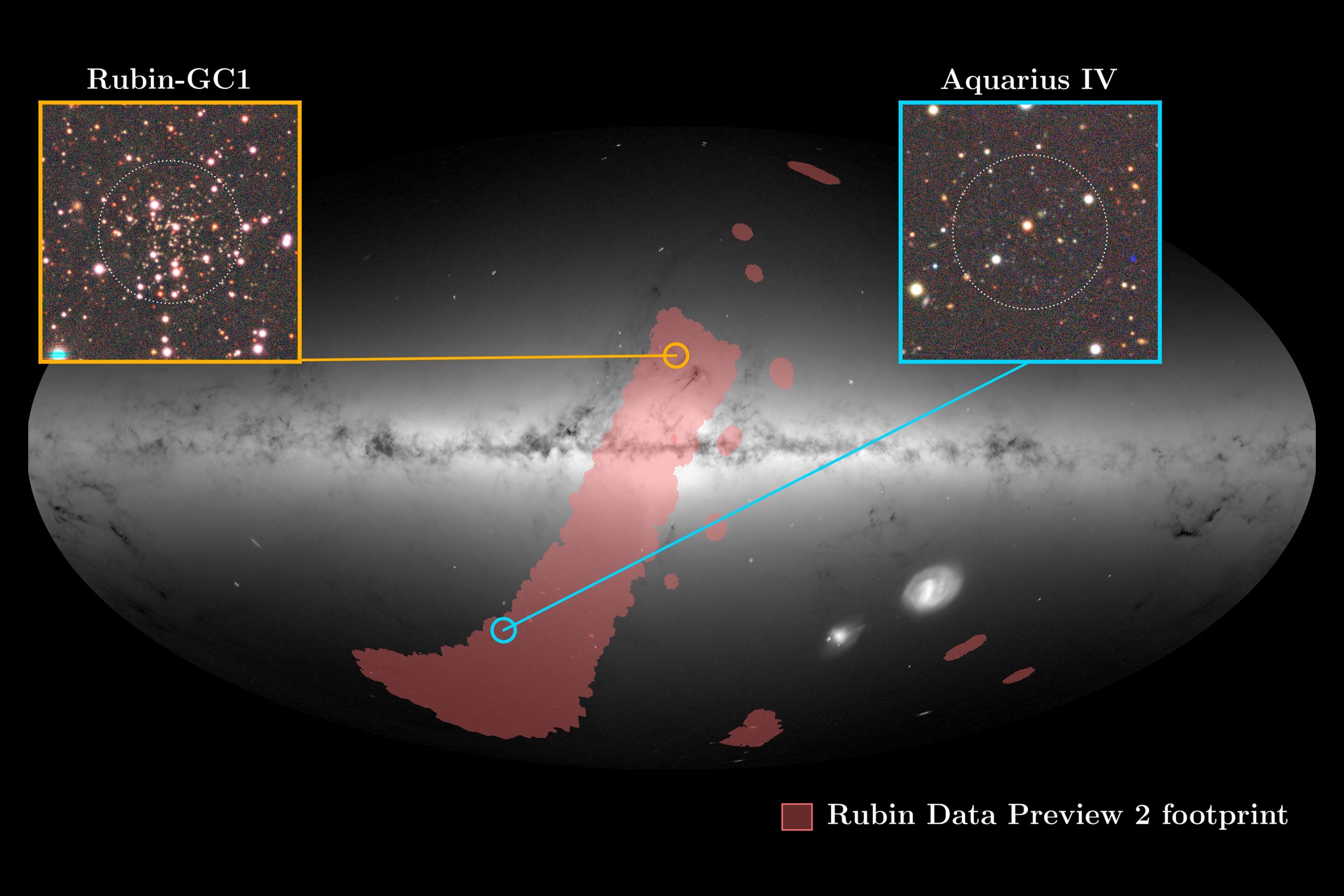
Preview data from the NSF-DOE Vera C. Rubin Observatory have produced two new detections of faint objects orbiting the Milky Way: an ultra-faint satellite candidate named Aquarius IV (Rubin J2201−0234) and a dust-obscured globular cluster designated Rubin-GC1 (Rubin J1628−1735). The discoveries appear in two separate papers using the observatory's Early Data Preview 2 (EDP2) released in July 2026.
The Aquarius IV discovery, reported in Research Notes of the American Astronomical Society with lead author William Cerny (Yale), identifies Rubin J2201−0234 as a low-luminosity, compact stellar system in the outer Galactic halo. Confirming images from the Dark Energy Camera support the detection. The published analysis describes Aquarius IV's stellar population as ancient and metal-poor, properties that closely resemble the smallest confirmed ultra-faint dwarf galaxies (UFDs), though the authors note a globular cluster classification is not yet ruled out.
Only a small number of Aquarius IV member stars have been detected so far, so the team stresses that deeper imaging and spectroscopy will be required to determine whether the system contains dark matter — the principal observational difference between UFDs and globular clusters. Phys.org reports that Aquarius IV lies roughly 355,000 light-years from Earth.
The second study, led by Aashay Pai (University of Chicago) and available as a preprint for The Astrophysical Journal Letters, presents Rubin-GC1, a faint star cluster located toward the Milky Way's bulge where high stellar density and thick dust make detections challenging. The authors find Rubin-GC1's stars have an intermediate age of about 9.2 billion years and are moderately metal-rich, leading them to conclude Rubin-GC1 is most likely a very faint globular cluster rather than a galaxy.
Comparisons in the Rubin-GC1 paper link the cluster to the Sagittarius dwarf spheroidal galaxy's leading arm, suggesting Rubin-GC1 was accreted onto the Milky Way as part of that system's tidal debris. The detection in a dust-shrouded bulge direction underlines the Rubin Observatory's ability to reveal faint, resolved satellites even in crowded and obscured regions.
Both studies analyze Rubin preview data taken between April 2025 and January 2026 that cover about 7% of the sky. The findings are being hailed by the papers' co-authors as an early indicator of the Rubin Observatory's power: the facility began its 10-year Legacy Survey of Space and Time (LSST) in June, employing its 8.4-meter Simonyi Survey Telescope and a 3.2-gigapixel camera to repeatedly image the southern sky.
"What I find especially exciting is that these discoveries are just the beginning for Rubin," said William Cerny in both reports. Marla Geha (Yale), a co-author on both studies, added that finding new satellites in Rubin data has been a long-anticipated prospect and that continued discoveries will help complete the census of the Milky Way's faint companions and inform models of galaxy formation and the nature of dark matter.
The teams include researchers from multiple institutions, among them the University of Chicago, University of Virginia, University of Washington, Dartmouth College, University of Tampa, NSF NOIRLab, Duke University, University of Toronto, Instituto de Astrofísica de Andalucía, University of Colorado-Boulder, and Lund University. The Aquarius IV paper is cited as William Cerny et al., Research Notes of the AAS (2026). The Rubin-GC1 study appears on arXiv and is listed as Aashay Pai et al., arXiv (2026).