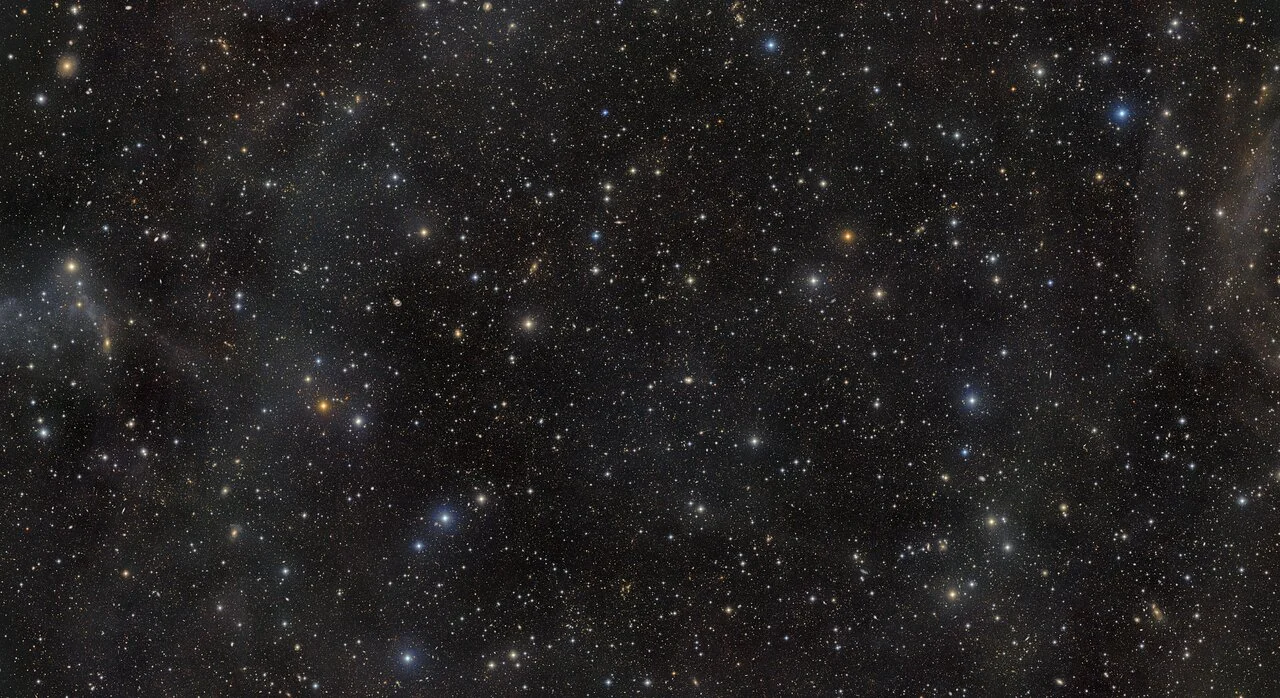
Rubin Observatory releases first scientific COSMOS image and catalog
The NSF–DOE Vera C. Rubin Observatory has produced its first scientific-quality image and catalog of the COSMOS field using the observatory's Legacy Survey of Space and Time (LSST) Camera, the project announced in conjunction with its Early Data Preview 2 (EDP2) release.
The image, released in September 2026, covers the well-studied COSMOS field (the Cosmic Evolution Survey Deep Field) in the constellation Sextans and represents the most detailed Rubin view to date of hundreds of thousands of galaxies, stars and other celestial sources in that region. The LSST Camera — described in the release as the most powerful digital camera in the world — produced both the deep image and an accompanying catalog that will be usable for scientific research.
Rubin’s EDP2 combines observations obtained during the observatory’s science validation period between April 2025 and January 2026. According to the press material, the COSMOS deep image was timed to coincide with that Early Data Preview 2 release and is one of Rubin’s earliest demonstrations of its planned survey capabilities.
Observers have used the COSMOS field as a reference for more than two decades. The field was originally imaged by the Hubble Space Telescope from 2003 to 2005 with its Advanced Camera for Surveys (ACS) and has since accumulated complementary observations across the electromagnetic spectrum. That extensive prior dataset is why Rubin targeted COSMOS during commissioning and plans to return to it repeatedly as one of LSST’s deep fields.
"The COSMOS field is a very important one for LSST science," said Phil Marshall, deputy director of Rubin Observatory at SLAC National Accelerator Laboratory, in the release. He emphasised the value of the field’s "wealth of prior observations" and its role as a testing ground for the science community preparing to work with Rubin survey data.
Bob Blum, director of the Rubin Observatory at NSF NOIRLab, added that "The COSMOS deep image is just the beginning for Rubin in this region." The observatory plans repeated visits over the coming years to build the temporal depth that is central to LSST’s design: wide-field repeated imaging that captures both faint static sources and changing or transient events.
Rubin’s combination of depth, wide-field coverage and repeated observations is intended to complement earlier datasets by adding a dynamic, time-domain dimension. The new image and catalog are expected to help astronomers study distant galaxies and to track how the universe changes over time, in part by identifying transients and variables that other surveys might miss.
Both Universe Today and Phys.org coverage highlighted that this COSMOS product represents the first time the LSST Camera produced an image and catalog intended for scientific research. The accounts emphasise Rubin’s sensitivity and resolution as key advances: the observatory’s camera is designed to produce deep images across a large portion of the sky with high cadence, enabling statistical studies of galaxy evolution, dark matter mapping, and time-domain astrophysics.
Historically, deep fields such as Hubble’s original COSMOS, GOODS and Hubble Ultra Deep Field have served as cornerstones of extragalactic astronomy by providing extremely deep, narrow views useful for studying galaxy morphology, star formation and early cosmic epochs. Rubin’s approach differs by offering both depth in selected deep fields and a wide-area survey that repeatedly images most of the southern sky. That strategy is intended to connect the detailed, small-area studies from space telescopes with population-scale analyses and transient discovery via repeated imaging.
EDP2, which incorporates Rubin data from April 2025 through January 2026, is part of a staged data preview program to give the science community early access to realistic Rubin products during validation. The COSMOS release provides a known benchmark field for testing pipelines, photometry, object classification and the creation of transient alerts, leveraging the long history of multiwavelength observations in that area.
Going forward, Rubin’s repeated visits to COSMOS will generate time-resolved datasets useful for transient and variable object studies and for refining calibration and analysis techniques ahead of full survey operations. The observatory’s leaders have framed the COSMOS deep image as a starting point: repeated imaging will demonstrate the power of Rubin’s survey design for discovery and for equipping the community to exploit the full LSST data stream.
As the Rubin Observatory continues its commissioning and science validation, the COSMOS release will serve both as a science product in its own right and as a practical testbed — combining the observatory’s technical capabilities with a richly characterized region of the sky to prepare the wider community for the forthcoming LSST era.