The week beginning 6 September 2026 looked, at a glance, like another brisk chapter in the steady expansion of human activity beyond Earth: telescopes launched and commissioned, rockets tested and booked, laboratories announced and discoveries teased. But beneath that steady hum a handful of events crystallized into something more consequential — a near-term recalibration of how governments, big commercial players and emerging powers choose to shape markets and rules in space. The story that dominated the week was not a launch but a diplomatic rupture: major U.S. commercial launch companies walked away from the European Space Summit in Paris after reported White House interventions over draft EU rules. That withdrawal — and the flurry of consequential industry and policy moves that clustered around it — signaled how geopolitical leverage, procurement muscle and national industrial policy are now being wielded to determine who wins in orbit.
Summit Fallout: When Policy Meets Market Power
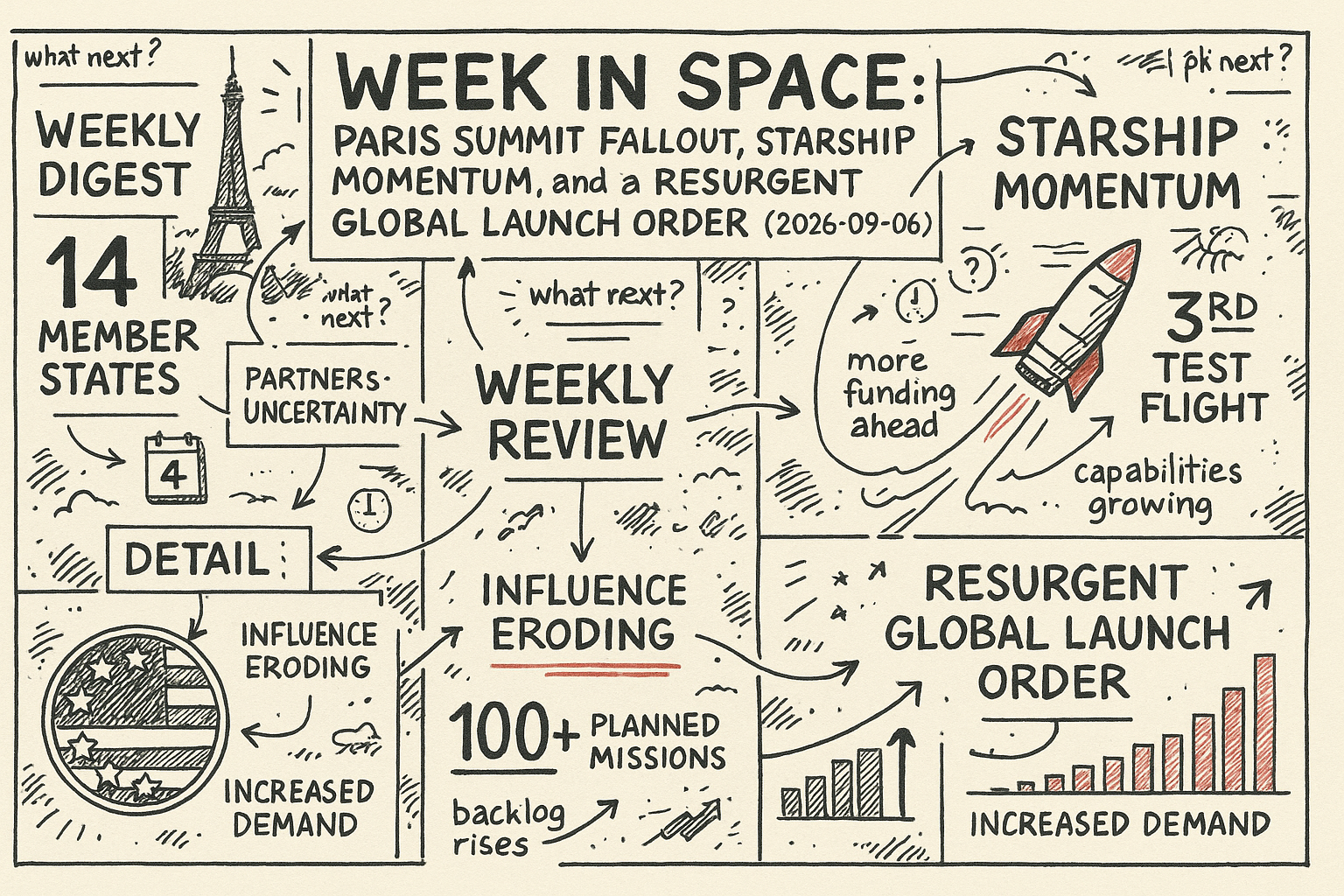
On 3 September, SpaceX, Blue Origin, Stoke Space and Starcloud abruptly withdrew from the International Space Summit in Paris, a high-profile row that quickly shifted from conference logistics to an emblem of the new era’s tensions. According to reporting during the week, the withdrawals followed White House interventions aimed at influencing proposed European Union rules covering spectrum allocation, procurement preferences and local-content measures. The result was an unmistakable public clash: U.S. firms, carrying enormous market influence and critical launch capacity, essentially used their participation as leverage in a regulatory debate. The message was blunt and consequential — commercial players will not sit quietly while national governments draft rules that could hamper their global competitiveness.
This episode was no isolated theatrical flourish. It sits at the intersection of several broader forces playing out across the week. Europe is actively trying to shore up its sovereign capabilities — witness Ariane 6’s steady ascent to operational reliability and the recent Arianespace deals that expanded Amazon’s Ariane 64 manifest to 24 launches and added six more Ariane 64 missions. The Exploration Company’s booking of Ariane 6 for a Nyx demo mission and Ariane 6’s GTO success delivering the Meteosat Third Generation imaging trio underline that Europe can credibly be a principal buyer and operator of strategic space infrastructure. At the same time, U.S. industry’s commercial heft, supported by policy wings in Washington, can pressure partners and competitors alike. The Paris walkout crystallized an uncomfortable truth: procurement is policy, and where nations choose to buy launch and space services will have strategic consequence.
For Europe the dilemma is acute. The continent wants to be both regulator and customer: to shape industrial outcomes with rules while also nurturing a domestic supply chain for critical capabilities. But this week’s reporting and analysis — including a NovΔ mAInd feature on Europe’s procurement gap — showed the tension plainly: Europe funds innovation through ESA and national programs but rarely takes the final step of buying at scale. If Europe becomes an active buyer, it will strengthen local industries; if it remains primarily regulator, it will risk renting its launch and satellite infrastructure from foreign suppliers. The summit standoff makes clear that how Europe resolves that choice will reverberate through supplier relationships, market access and alliance management for years to come.
Launch Activity: Starship, Ariane 6, Electron, and a Tightening Manifest
Parallel to the diplomatic drama were unmistakable signs of continued global launch momentum. SpaceX continued to prepare Ship 41 and Booster 21 for Starship Flight 14, including static-fire testing and infrastructure work at Starbase, while imagery and reporting revealed complementary build-out at a proposed Louisiana Starbase. Starship’s objective for Flight 14 — the first orbital insertion of Starlink payloads — is not merely operational; it is strategic. Success would lock in a new cadence and cost base for large-lift rides to LEO and cislunar trajectories, magnifying the bargaining power that U.S. commercial companies displayed in Paris.
Europe’s Ariane 6 doubled down on credibility. The late-August delivery of MTG-I2 to GTO marked Ariane 6’s first GTO mission and capped the Meteosat Third Generation imaging trio, underpinning Europe’s sovereign weather-monitoring capability. That launch, combined with new Ariane bookings for Amazon and for The Exploration Company’s Nyx demonstration, signals Arianespace’s emergence as a reliable counterweight in the heavy-lift and institutional markets. The practical effect is that major customers now have multiple credible avenues for GTO and LEO access — a diversification that complicates monopoly dynamics but also raises the stakes for intergovernmental buying decisions and alliance alignment.
Rocket Lab’s activity this week offered a different but complementary picture. The company’s high cadence — its 16th Electron flight of the year to a confidential 500 km orbit — and visible progress on Neutron show that mid-sized vehicles and flexible rideshares remain an essential part of the global launch tapestry. Smaller players, too, are locking in manifests: MaiaSpace’s Asia-Pacific agreement for SAR launches with Japan’s iQPS and Relativity Space’s Terran R inclusion on NASA’s Launch Services Contract both expand the roster of commercial vehicles available to national and institutional customers.
Collectively, these developments show a market maturing into multi-modal competition. Heavy-class vehicles like Starship and Ariane 6, medium-lift workhorses such as Terran R, and dedicated rideshare and small-launch providers like Rocket Lab all play complementary roles. Yet that multiplicity of capability is precisely what makes procurement policy so powerful: who buys what — and under what conditions — will determine which players prosper.
Exploration and Science: Telescopes, Mars Mysteries, and Lunar Tools for Tomorrow
While policy and industry jockeyed for position, scientific discovery and exploration advanced on multiple fronts. The U.S. scientific community celebrated the successful launch and initial commissioning of NASA’s Nancy Grace Roman Space Telescope, an instrument whose wide-field infrared sensitivity will reshape near-field cosmology, exoplanet demographics and time-domain astrophysics. Roman’s lift-off — referenced in NovΔ mAInd’s earlier digest for the opening of September — acts as a counterpoint to the week’s terrestrial policy contretemps: it is an unequivocal demonstration of science’s ability to transcend geopolitical theater, at least in aspiration.
On Mars, Curiosity returned photographs of shallow, unusually broad pits in sulfate-rich layers on Mount Sharp, rekindling debates about the planet’s environmental heterogeneity. Additional analysis from laboratories proposing salt-driven microhabitats married to Curiosity’s imagery has produced an intriguing hypothesis: salts could create tiny, transient microenvironments that concentrate brines and moderate temperature swings, potentially enabling short-lived habitable niches. While this is far from evidence for life, the hypothesis reframes how scientists prioritize sampling strategies and where landers and rovers might look for biosignatures. The University of Mississippi and Texas A&M’s lab result — a copper catalyst converting Martian-air CO2 into methane with high selectivity — further demonstrates how convincingly terrestrial laboratory advances can change mission architectures by simplifying in-situ resource utilization for return missions.
China’s deep-space ambitions also turned heads. The Deep Space Exploration Laboratory’s announcement of the International Cislunar CubeSat Constellation (C3) — 30 12U CubeSats by 2030 to study gamma-ray bursts, space weather and the cislunar environment — is an attempt to establish scientific and situational presence in proximate deep space. In parallel, CNSA’s progress report on Tianwen-3 and planned 2028 window Mars launches showed Beijing’s continuing commitment to planetary science and sample return, promising a multimodal competition in mission sophistication and scientific yield through the end of the decade.
Closer to the Moon, NASA and IBM’s release of a Lunar Foundation Model trained on 17 years of LRO data is a quiet but powerful enabler. Open-source tools like this accelerate mission planning, geological interpretation and landing-site selection for an expanding community of actors; they also lower the barrier to entry for universities and smaller companies, broadening the base of contributors to lunar science and exploration operations.
Industry, Capital and New Architectures: Funding, Constellations, and Edge Compute
Investment flows and commercial architectures added their own refrains to the week’s chorus. Stoke Space announced a $1 billion tranche in Series E financing to accelerate its Nova program and fund a 2027 Pathfinder test, signaling investor confidence in fully reusable vehicles that claim to push down the marginal cost of access to orbit. Besxar’s semiconductor fabship experiments on Falcon 9 boosters and Galaxia’s CAD 4.5M seed raise for in-orbit edge-compute hardware demonstrate how capital is following niches: semiconductor manufacturing, on-orbit compute and satellite-hosted AI racks are all being positioned as the next battlegrounds in space commerce.
Ambitious constellation plans continued to multiply. Orbital’s selection of Reflex Aerospace as platform partner for its Orbital-1 concept — a proposed fleet of up to 100,000 orbital data centers offering racks of Nvidia-class compute — might at first read as hyperbole, but it is emblematic of a deeper shift. Companies now imagine space as not merely a communications conduit but as a distributed processing layer for AI, data analytics and latency-sensitive applications. That vision brings strategic customers into play: defense ministries, large cloud providers and sovereign space agencies may all view spaceborne compute as part of national digital infrastructure, not merely an engineering novelty.
These architectural ambitions, however, will collide with supply-chain politics. The walkout in Paris and Europe’s concern about procurement show that governments will assert control over how and where these capabilities are sourced. Contracts for Amazon’s LEO launch needs, Arianespace’s growing manifest and NASA’s procurement inclusion of Terran R all illustrate how institutional demand is already shaping commercial viability. For investors and founders, the takeaway is stark: technological promise remains necessary but insufficient; winning requires matching product to predictable institutional demand and navigating political risk.
Cross-Cutting Technical Stories: From Black Holes to Mercurial Shrinkage
Beyond industry and policy, the science beat produced noteworthy findings that will influence research agendas. INAF’s identification of jets from the black hole candidate 4U 1543-47 traveling at over 97% of light speed stretches models of jet launching and mass-energy conversion. JWST-based transit studies ruled out large moons around LP 890-9 c, reinforcing how high-precision time-domain observations are maturing into a robust tool for exomoon science. BepiColombo’s arrival and new data indicating Mercury’s greater-than-expected shrinkage will force planetary scientists to revisit interior-thermal histories and the timelines of planetary differentiation in the inner Solar System.
These discoveries form the connective tissue of decades-long research programs. Repeatedly, the week underscored how incremental technical and observational advances aggregate into paradigm shifts — whether that is a new model for planetary cooling, a refined metric for jet acceleration physics, or a practical chemistry for producing return fuel on Mars.
Operational Space: ISS Logistics and the Quiet Work of Sustaining Presence
Amid heady debates and flashy launches, the pragmatic work of sustaining low-Earth orbit infrastructure continued. A routine cargo swap on the International Space Station — Progress 94’s departure and Progress 96’s imminent launch preparations — reminded readers that the everyday choreography of supply, maintenance and crew support underpins all other ambitions. Expedition 75’s EVAs, including Sophie Adenot’s record-extending third spacewalk and an all-female EVA with Jessica Meir, highlighted both the human dimension of station operations and ongoing upgrades in navigation, communications and scientific apparatus. These are the quiet but consequential activities that enable science, test technologies and maintain international cooperation even as political skirmishes erupt elsewhere.
Looking Ahead: What to Watch Next Week
The coming week promises to be consequential on several fronts. First, clarity will be needed on whether the Paris walkout produces tangible policy reversals or hardened stances; the answer will influence procurement timelines and the posture of major commercial players. Second, SpaceX’s preparations for Starship Flight 14 merit close attention: regulatory approvals, environmental compliance at Starbase, and the readiness of Ship 41 and Booster 21 will determine whether Starship can deliver on its promise to transform LEO economics. Third, the international cislunar landscape will keep warming: China’s C3 CubeSat constellation concept and NASA’s continuing lunar data releases will accelerate discussions about norms, traffic management and science priorities in proximate deep space.
On the market side, watch for additional launch manifest announcements and procurement deals. Arianespace’s growing book suggests more large-customer commitments may follow, and any NASA, military or large-commercial orders for Terran R, Neutron or Starship will quickly redraw the industrial map. Finally, expect more science results from Curiosity and BepiColombo to filter through peer review and workshops; such findings often have outsized effect on mission planning and technology roadmaps, particularly when they speak directly to habitability or planetary formation.
What tied this week together was less a single headline than a pattern: governments and their commercial partners are negotiating, sometimes abrasively, over who sets the terms of access, who pays for infrastructure and who will ultimately capture the economic upside from space. Scientific breakthroughs and launch successes provide the fuel for ambition; procurement policy, international diplomacy and capital flows determine its path. The interplay of these forces — technical capability, market demand and political strategy — will shape the next decade of space activity, and the coming weeks will show whether stakeholders can convert a messy, politically charged week into durable rules and predictable markets that let science and commerce advance together.
Expect turbulence, strategic bargaining and, with luck, the occasional breathtaking discovery. That is the new normal in space: an arena where telescopes and rockets, regulations and private chequebooks, laboratories and launchpads all compete in the same gravitational field. This week made clear that who pays and who sets the rules matters as much as who can build the next rocket.