Lede
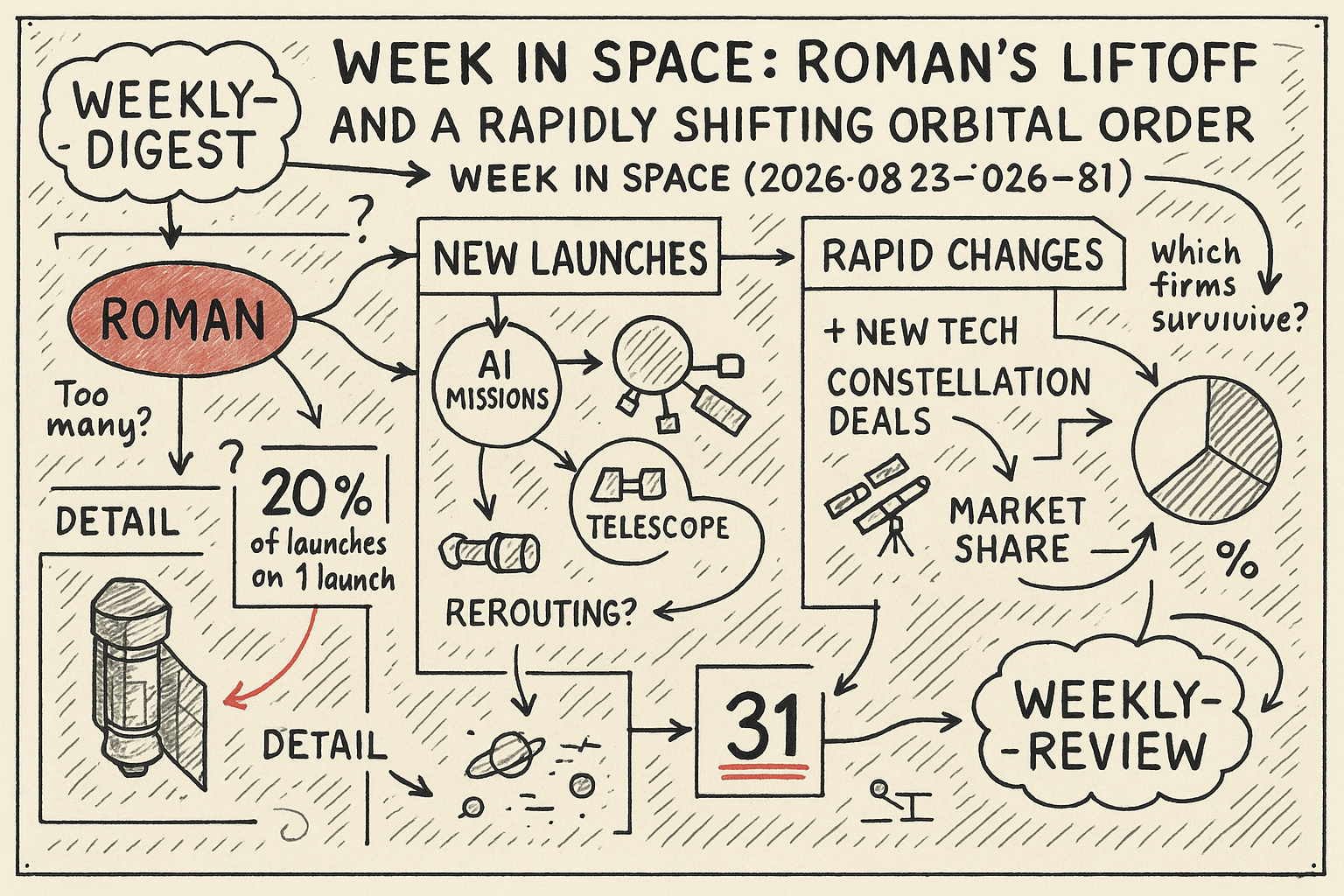
The week ending 31 August 2026 felt, in miniature, like a turning point for modern spacefaring: a flagship observatory cleared its path to deep space and a cascade of operational, commercial and geopolitical moves revealed how quickly the architecture of Earth orbit and beyond is evolving. At center stage was NASA’s Nancy Grace Roman Space Telescope — from steady prelaunch coverage to liftoff on 30 August — a mission that promises to reframe wide-field astronomy even as industry pushes to meet surging demand for launches, communications and new orbital services. Around Roman’s arrival came reminders that exploration remains contestable and complex: China’s Chang’e-7 lunar campaign hit delays, ESA advanced plans to adapt Ariane 6 for nuclear-capable lunar logistics, and a bevy of startups and incumbents saw fresh capital and contracts that reflect a market still in disruptive transition.
Launch Activity: Roman’s Moment and the New Launch Landscape
Nothing this week captured international attention like the Roman Space Telescope’s push to orbit. After years of fits and starts — and a long public debate about cost and scope — Roman went through final countdowns, was launched on 30 August on a Falcon Heavy, and began its cruise toward Sun–Earth L2. The mission’s combination of a wide field of view, infrared sensitivity and survey-driven program positions it to complement Hubble and Webb rather than replace them: Roman will map large swathes of sky to push forward studies of dark energy, dark matter and exoplanet demographics. Coverage across our reporting emphasized how Roman’s design choices make it uniquely suited to systemic surveys, not pixel-by-pixel deep-field work, and that will define its scientific niche for years.
Roman’s liftoff also highlighted the interconnectedness of launch capability, mission timelines and national ambition. Europe marked a milestone of its own: Ariane 6 is preparing to carry Meteosat Third Generation Imager 2 (MTG-I2) to geostationary orbit — a reminder that government-backed launch and payload programs remain foundational for national infrastructure. At the same time, ESA’s decision to adapt Ariane 6 for future Argonaut lunar missions — explicitly to enable architectures that will eventually host nuclear power systems for surface operations — signaled a strategic pivot. Europe is not merely preserving access to space; it is actively reshaping launch vehicles to meet the mission profiles that will define the next era of lunar logistics.
Commercial launch dynamics were equally vivid. SpaceX’s relentless Starlink deployments continued their record-setting cadence, and smaller launch companies benefited from ESA’s over-€500 million contracts aimed at bolstering a European launcher ecosystem. Those awards to PLD Space, Isar Aerospace and Rocket Factory Augsburg are more than industrial subsidies: they are an attempt by ESA to reduce dependence on a narrow set of providers and to seed a domestic capability that can support European security and government service needs. Yet even as Europe spends to broaden options, the aggregate market reality remains one of intense competition, technology maturation pains, and a growing mismatch between orbital demand and immediate launch availability — the “space access crunch” industry players referenced this week.
Exploration & Science: From Roman’s Panoramas to Mercury and Meteorites
Science news this week threaded Roman’s arrival through a broader tapestry of discovery. Multiple articles explored how Roman’s surveys will interlock with existing facilities: Webb’s deep-target precision and Hubble’s historical baseline will be augmented by Roman’s wide-field capability, enabling statistically robust studies of galaxy evolution, gravitational lensing and exoplanet occurrence. Reporting emphasized that Roman’s capability is not incremental but structural: by surveying enormous sky areas deeply and quickly, Roman changes which scientific questions are tractable in the coming decade.
Beyond Roman, planetary science made major strides. ESA/JAXA’s BepiColombo entered its Mercury Arrival Phase, with the Mercury Transfer Module scheduled for separation on 3 September; after eight years cruising, the mission is poised to deliver long-awaited close-up studies of the innermost planet’s composition and magnetic environment. In meteoritics, new work on calcium-aluminum inclusions in an Antarctic meteorite documented magnetic signatures from the first 200,000 years of the solar system, pointing to a nebular magnetic field substantially stronger than Earth’s today. That result ripples through models of early disk dynamics and planet formation: if nebular magnetism influenced accretion flows and proto-planet migration, some canonical models will need refinement.
At the Moon, the picture remains mixed. China’s Chang’e-7, the high-profile mission aimed at prospecting water ice in the lunar south pole, encountered delays and technical setbacks during the week. The mission’s postponement is a reminder that polar lunar operations are operationally unforgiving — thermally harsh, communication-challenging and dependent on precise timelines. Meanwhile, Artemis IV planners continued to press forward toward a crewed south pole landing by 2028, a schedule that depends on a chain of launch and on-orbit milestones. The juxtaposition of China’s delay and the U.S.-led Artemis schedule demonstrates that lunar leadership will be decided in the details: reliability, on-time delivery, and incremental capability building matter as much as grand ambitions.
Industry & Policy: Money, Markets, and the Geopolitics of Infrastructure
Financial flows and procurement choices defined another key theme of the week. Investment surged into orbital technologies, driven by both private capital and public contracts. The European Launch Challenge funding is emblematic of a policy posture that now ties industrial policy to strategic independence in space transport. Simultaneously, the U.S. pursued a technological approach to resilience in navigation and timing: a TrustPoint–NovAtel demonstration of resilient C-band GNSS technology for U.S. Naval Air Systems Command showcased anti-interference capabilities that are increasingly critical as contested-spectrum scenarios become part of planning assumptions for military and commercial services alike.
Commercial activity at the payload layer also accelerated. Exolaunch’s contract to deploy 68 payloads across SpaceX’s upcoming Transporter-18 and Bandwagon-5 missions is a concrete sign that secondary-payload logistics are scaling up even as launch windows are compressed. NOAA’s TMATE partnerships with Muon Space, Weather Stream and Spire for advanced microwave sounding instruments point to a future where commercial constellations participate directly in national weather systems. These collaborations are more than vendor selection; they reflect a strategic recalibration where governments view commercial players both as partners and as critical infrastructure — a shift that forces new regulatory frameworks, procurement norms and interoperability standards.
That recalibration extends to the orbital services market. Aerospace Corp’s DiskSats, with their unusual pancake-like form factor, were profiled for the innovation they represent and the technical growing pains they’ve experienced. Novel form factors and operational basing in very low Earth orbit may unlock new capabilities — from low-latency communications to novel Earth-observation geometries — but they will also strain space traffic management, debris mitigation norms and spectrum allocation frameworks. Policy and industry are racing to catch up.
Cross-Cutting Threads and Deeper Analysis
Taking the week’s events together, several cross-cutting themes emerge. First is the changing balance between big, government-led flagship missions and distributed, commercialized infrastructure. Roman typifies the large observatory that only a national space agency could field, delivering unique science that transforms entire subfields. At the same time, a thriving commercial sector — from launch providers to data services — is moving rapidly into domains that were once the exclusive province of governments: weather forecasting, PNT resilience, and even Earth observation at operational resolutions.
Second is the strategic orientation of procurement. Europe’s multi-hundred-million-euro bets on domestic launch startups are explicitly geopolitical; they aim to reduce dependency, preserve sovereign access and keep critical mission payloads under regional control. The U.S. posture, meanwhile, blends investment with capability hardening — exemplified by C-band GNSS resilience demonstrations for naval aviation and the continuing investment in Artemis lunar infrastructure.
Third, technological complementarity is becoming a planning mantra. Roman’s science will only reach full value when its data are combined with Webb, Hubble, ground-based surveys and follow-up instrumentation. Likewise, NOAA’s weather strategy presumes linkages between new microwave sounders in commercial constellations and traditional meteorological assets. The space community increasingly recognizes that transformative science and resilient services arise from networks of heterogeneous systems rather than single, monolithic platforms.
Finally, risk and contingency matter. China’s Chang’e-7 delay and DiskSats’ early challenges remind us that innovation carries operational risk. Delays ripple through international schedules, collaborative plans and political narratives. They also underscore the value of redundancy, diverse supply chains and modular mission architectures that can absorb setbacks without collapsing timelines for scientific discovery or national priorities.
What to Watch Next Week
The immediate horizon is busy. Roman will begin early commissioning activities at Sun–Earth L2; the first wave of Roman engineering telemetry and commissioning milestones will be scrutinized by scientists and engineers alike, because how quickly Roman reaches nominal performance will shape its initial science program. BepiColombo’s scheduled MTM separation on 3 September is another high-stakes event: successful separation and subsequent Mercury orbital insertion maneuvers will reopen a long-anticipated window into Mercury’s magnetosphere and surface composition.
On the operational front, attention will focus on the ripple effects of China’s Chang’e-7 delays: are they short-term weather- and technical-induced slips, or do they reveal deeper programmatic pressures? Europe’s FLEX fuelling and scheduled 15 September Vega‑C launch will be closely watched as a test of Europe’s Earth-observation cadence and multi-mission operational tempo. Contract awards and capital movements announced this week will likely have near-term follow-ups; expect announcements from startups in the ESA-funded cohort on development milestones, and more procurement decisions from agencies seeking commercial microwave sounders or resilient GNSS receivers.
Finally, the industry will be listening for signs that the launch market’s supply-demand imbalance eases: new vehicle test flights, schedule confirmations for Ariane 6 and Vega‑C, and detailed manifests for rideshare missions will be early indicators. The policy domain will continue to press the difficult questions too: how to harmonize commercial agility with the need for space traffic management, deconfliction and long-term sustainability in increasingly crowded orbits.
In short, last week stitched together the promise of a new scientific eye on the sky with the practical realities of infrastructure, industry and geopolitics. Roman’s voyage outward and BepiColombo’s arrival inward framed the week’s arc: space exploration simultaneously broadens our vision and narrows the margin for error. Expect the coming days to clarify which innovations mature into reliable services and which remain aspirational. The next week will reveal as much about the coordination of an increasingly pluralistic space ecosystem as about the singular achievements of individual missions.