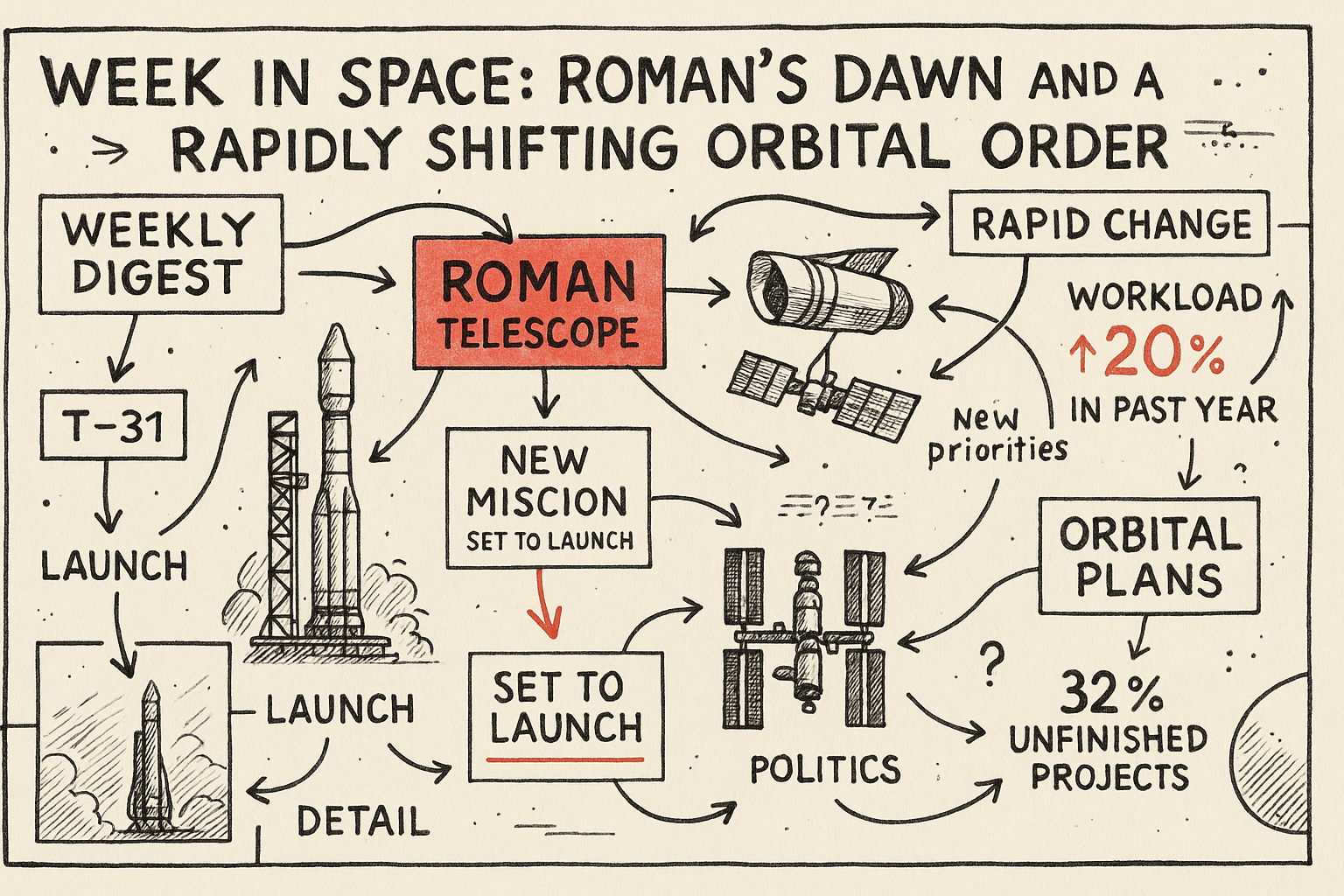
On 31 August 2026, the sky changed in a way that will be measured for decades. NASA’s Nancy Grace Roman Space Telescope — a Hubble-class, wide-field infrared observatory — cleared the launch pad and began its journey to expand our map of the cosmos. Roman’s liftoff is the unmistakable headline of this week’s space story, but it is also a hinge: a technological achievement whose implications radiate into science, industry, strategy and the economics of space operations. As Roman unfurls its instruments in the months ahead, a swirl of launches, contracts, scientific firsts and geopolitical maneuvering this week made clear that the space enterprise is accelerating into a more crowded, more commercial, and more contested era.
Roman’s launch: a new wide field of view and unexpected provenance
Roman’s arrival was both historic and oddly familiar. The telescope carries a 2.4‑meter primary mirror — the same aperture class as Hubble — but pairs that optic with a field of view roughly 100 times larger than Hubble’s near‑infrared camera. The result is a survey engine: Hubble‑quality imaging across swaths of sky that previously would have taken generations of Hubble time.
New reporting this week provided fresh texture to Roman’s back story. The mirror’s provenance and the scale of international hardware contributions were highlighted in ways that expand the narrative beyond the launch sequence. The donated Hubble‑class mirror, combined with European instruments and engineering, underlines how modern flagship missions are composite enterprises, blending repurposed assets, multinational industrial partnerships and an appetite for data volume that will challenge legacy archives. Roman’s data stream will dwarf precedents; astronomers and data engineers now face the practical work of designing pipelines, archival strategies and community access models at a scale closer to ground‑survey projects than to classical space observatories.
For the scientific community, Roman is a leap forward in survey astronomy and in the hunt for exoplanets, infrared transients, and cosmological probes of dark energy. For the space ecosystem, it is a reminder that big science remains possible through creative reuse, international cooperation and a steady pipeline of managerial competence. For the public, it is an invitation to expect discovery at a rate Hubble could not sustain.
Launch activity: from Spectrum’s continental first to Crew‑13 pauses and cadence records
Roman dominated headlines, but the week’s launch activity sketched a fuller portrait of a marketplace in motion. Isar Aerospace’s Spectrum achieved two high‑visibility milestones: a successful orbital launch on 5 September from Andøya carrying five CubeSats, and a high‑profile contract to launch Astroscale Japan’s ADRAS‑J2 debris‑removal demonstration. Isar’s successful flight marked the first privately funded European orbital launch and the first orbital mission from continental Europe; beyond the symbolic achievement, it signals a maturing European small‑launcher sector capable of fielding services to regional and international customers.
Spectrum’s return to flight also illuminates the modern cadence of rocket operations: even as new entrants fly, legacy and commercial heavyweights maintain hectic tempo. SpaceX reached a blistering operational pace in 2026, and this week’s reporting on its record‑breaking cadence explained how reuse, coast‑to‑coast launch choreography and Starlink demand pushed an already high‑throughput model into unprecedented territory. At the same time, programmatic hiccups remind us of enduring risks: SpaceX and NASA postponed Crew‑13 after an oxidizer leak was detected in the Dragon propulsion system during prelaunch checks, underscoring that human spaceflight remains intolerant of even modest uncertainty.
That mix — first flights, frequent launches, and necessary delays — is normal for an industry scaling rapidly. The wave of smallsat deployments (evident in Electron’s Synspective mission placing another StriX SAR platform) and the delivery of Boeing’s final O3b mPOWER satellites for SES highlight the parallel tracks of mass‑market constellations and mission‑specific infrastructure. The week also carried strategic pauses: ESA’s decision to freeze Ariane 6 Block 3 evolution threads caution into Europe’s launcher trajectory, a reminder that political choices and budget constraints can ground technical ambition.
Science & exploration: new windows from radio to X‑ray, and a nearer Moon under study
Science stories this week moved across scale: from deep cosmology to particle physics. MeerKAT’s direct detection of the faint 21‑cm hydrogen signal from gas four to five billion years ago represents a technical and conceptual advance in hydrogen intensity mapping, offering a complementary probe of large‑scale structure and the evolution of gas in the universe. On the high‑energy end, nearly two decades of X‑ray monitoring with Swift led to a record X‑ray flare from NGC 1275; the delayed radio jet flare that followed by about 300 days provides concrete evidence of coupling between accretion disk variability and relativistic jets in a brightest‑cluster galaxy, informing models of feedback that regulate galaxy evolution.
Closer to home, Hubble continued to surprise. New imaging revealed a ten‑sided wave — a decagonal atmospheric structure — encircling Saturn’s south pole. These atmospheric puzzles remind us that planetary dynamics can produce structures more intricate than initial models predict, and that our solar system still holds laboratory settings for understanding fluid dynamics and meteorology under exotic conditions. On the exoplanet front, NASA data added new candidates — including super‑Earths and Neptune‑like worlds — further populating the zoo of planetary architectures and nudging theories of planet formation and migration.
Meanwhile, the Moon remained central to planning and technique. A stochastic model from the University of Hawaii addressed “impact gardening” — how meteoroid bombardment mixes regolith and obscures ancient deposits, including potential supernova signatures. This model is not academic: as agencies and partners plan core sampling and long‑duration operations on the lunar surface, improving site selection will be critical to preserve scientific value and to avoid misleading stratigraphies when reconstructing solar system and galactic histories.
In particle physics and cosmology, the opening of SuperCDMS SNOLAB and an unexplained interaction recorded at a South Dakota lab keep the dark matter question active. While isolated signals rarely deliver definitive discovery, the cluster of new experiments, improved sensitivity, and surprising noise signatures underscore that the hunt for dark matter remains scientifically productive and technically relentless.
Industry & policy: contracts, capability trade‑offs, and a contested communications backbone
The business of space progressed in pragmatic, strategic steps. NASA selected Blue Origin for a Mars telecommunications network contract, a politically and operationally loaded decision that ties a major commercial actor to planetary infrastructure. Blue Origin’s role in telecommunications on Mars raises questions about standards, interoperability, and the long timeline of in‑planet communications architectures; it also reflects NASA’s broader strategy of leveraging commercial partners to de‑risk operations and scale capabilities.
Commercial satellite manufacturing motifs appeared in other stories: Teledyne crossing 1,000 orbital imaging sensors is a marker of industrial scale, and Boeing’s delivery of the last O3b mPOWER satellites represents the tail end of a program whose customers will demand guaranteed capacity and service levels. In Europe, the freeze on Ariane 6 Block 3 evolution forces mission planners to consider Block 2 or non‑European launchers for higher‑performance needs, a strategic inflection point that will shape trans‑Atlantic and intra‑European procurement choices.
Communications and navigation became flashpoints for future operations. MIT Lincoln Laboratory’s LightHOUSE concept proposes a laser‑satellite navigation backbone at about 1.6 million kilometres to support cislunar traffic — a technical antidote to Deep Space Network limitations that could enable rapid, precise positioning for lunar landers and habitation modules. The concept raises trade‑offs: optical links promise exquisite precision and speed but introduce radio‑quiet zone complications at the lunar far side and depend on resilient pointing, brightness budgets and cross‑agency coordination. At the same time, Telesat’s adoption of optical terminals and KSAT testing hybrid relays point to an industry shifting toward mixed optical/RF architectures that will be vital as bandwidth and latency demands grow in cislunar and interplanetary contexts.
Defense and sovereign considerations also surfaced. Hungary’s 4iG Group agreed with SpaceX to deploy Starlink Mobile and a Sovereign Solutions package across parts of Central and Southeastern Europe, signaling how commercial constellations increasingly interface with national security and sovereign communications needs. Concurrently, Kymeta’s DoD award and DIU’s backing of a secure terminal initiative suggest that militaries are willing to buy innovative commercial technologies that meet specific operational requirements, pushing the industry toward certified, hardened product lines.
Cross‑cutting themes: scale, reuse, and the architecture of access
Reading across the week, three themes bind the stories together. First, scale: whether in Roman’s data torrents, Teledyne’s sensor production, or SpaceX’s launch cadence, scale is reshaping visibility and decision making. Scale changes incentives — it shortens the timeline for discovery, raises the threshold for data management, and increases the economic returns for firms that can harvest recurring revenue streams from satellites, gateways and services.
Second, reuse and reallocation: Roman’s Hubble‑class mirror is a vivid example of how reuse — of hardware, of software, of operational practices — can compress costs and make flagship science achievable. The same principle is evident in booster reuse, in the repurposing of commercial ground segments for sovereign needs, and in the constant recycling of engineering lessons across new entrants.
Third, architecture: whether for navigation, communications, or planetary infrastructure, the week’s most consequential decisions are not about single vehicles but about networks. LightHOUSE imagines a navigation mesh beyond Earth orbit; Blue Origin’s Mars communications contract and the Starlink Sovereign Solutions deals reveal how networks, not standalone satellites, are the strategic assets. Designing those networks requires technical foresight, legal frameworks and international diplomacy — and it will define winners over the coming decade.
What to watch next week
The weeks ahead will test and extend many of these threads. Roman’s instrument commissioning and the first images and spectra will be scrutinized not just for science but for data quality and pipeline throughput. Crew‑13’s revised launch date and outcome will be a human‑spaceflight inflection, and any change in the timeline for Artemis hardware — including the narrowed lunar suit requirements tied to Axiom and NASA negotiations — will have reverberations across contractors and mission planners.
On the industrial side, keep an eye on the manifesting of Boeing’s final O3b mPOWER trio on a Falcon 9 this month and on the ADRAS‑J2 mission cadence as Isar and Astroscale refine rendezvous and capture demonstrations; both will advance commercial orbital servicing and spectrum of launch options. ESA’s decision to freeze an Ariane evolution should provoke policy conversation in Europe about strategic autonomy and procurement that may lead to new bilateral or multinational arrangements. Finally, technical concept maturation — notably LightHOUSE and optical relays — will be important: which agencies and companies commit funds, which technical trade‑offs get resolved, and whether radio‑quiet controversies at the lunar far side prompt early standards discussions.
This was a week when a flagship telescope lifted off, when first flights and enduring operational tempos coexisted, and when scientific advances across the electromagnetic spectrum pushed at the boundaries of knowledge. The common denominator is momentum: more data, more launches, more commercial choices and more strategic questions to answer. The next week will not slow that momentum; it will add new data points that will help turn this era of space activity into a stable architecture rather than a series of flashes. For scientists, engineers, policymakers and citizens, the job now is to steer scale toward sustainable discovery, resilient infrastructure and fair access — and to do so before the next launch window opens.