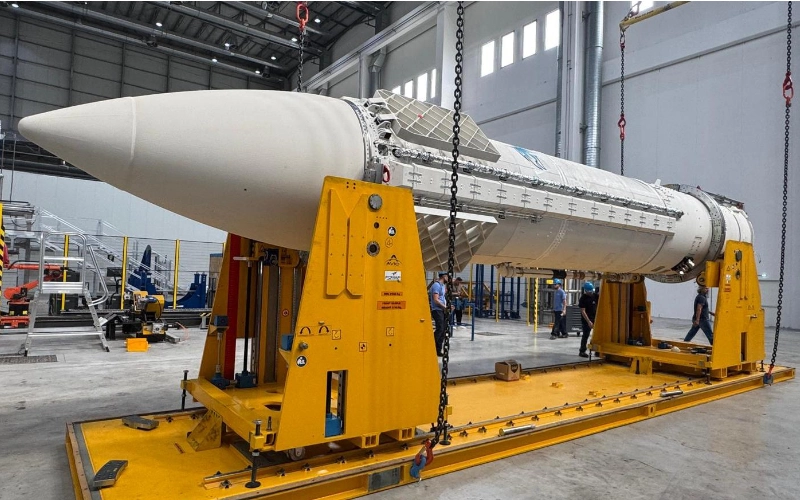
Avio finishes integration of FD1 flight demonstrator
Avio announced on 10 September 2026 that it has completed integration of its FD1 flight demonstrator, a 6.3‑tonne single‑stage vehicle powered by a single MR10 liquid oxygen–methane (methalox) engine. The work was reported as part of the company’s first‑half 2026 financial results. Ground testing is expected to be completed by the end of the year, and the demonstrator is planned to launch from the Salto di Quirra test range on the Italian island of Sardinia.
The FD1 demonstrator is being developed under a €181.6 million contract funded through Italy’s National Recovery and Resilience Plan. According to environmental filings Avio submitted to Sardinia’s regional authority in March, the vehicle will lift off from a temporary launchpad being built on the test‑range grounds.
Flight profiles described in those filings call for the demonstrator to reach an altitude of approximately 40 kilometres under powered flight, then coast to a maximum altitude around 70 kilometres. A key objective of the mission is to demonstrate the MR10 engine’s ability to restart in flight; Avio plans a short 8.5‑second burn during descent to validate reignition. Afterward the vehicle will descend unpowered and is planned to splash down roughly 20 kilometres from the launch site, with Avio intending to recover the demonstrator for post‑flight analysis.
The FD1 programme has two stated technical aims: to validate technologies for a future post‑Vega E launch vehicle and to demonstrate in‑flight performance of the MR10 engine. Within Avio’s planned Vega E architecture the MR10 is expected to initially power the upper stage, replacing the current solid third stage and the liquid upper stage with a single methalox upper stage while retaining the P160C first‑stage upgrade and the Zefiro 40 second stage.
Avio did not provide a launch date when announcing completion of integration. The company said it expects ground testing to finish by the end of 2026. The regulatory filings and the company statement indicate the launch will operate from a temporary pad at Salto di Quirra, using the island range’s facilities under Italian Ministry of Defence control.
Liquid oxygen–methane propulsion has become a focus for many developers because methalox offers a compromise of performance, storability and lower environmental impact compared with some hydrocarbons and the high performance of hydrogen. Avio’s MR10 engine is therefore central to the company’s road map: by proving in‑flight restart and sea‑recovery of a demonstrator, Avio seeks flight heritage for the motor before pairing it with Vega E.
Operationally, the FD1 mission is a suborbital, demonstrator test rather than a satellite launcher. The flight envelope—reaching ~70 kilometres altitude and testing an in‑flight reignition—assigns the demonstrator a role similar to other single‑engine testbeds used worldwide to validate new propulsion cycles and restart capability in realistic conditions while limiting cost and complexity.
The €181.6 million contract places FD1 among the better‑funded national demonstrator efforts in Europe. The Italian National Recovery and Resilience Plan provided the funding line, linking the demonstrator to broader national industrial and technological investment priorities. Avio’s statement and the environmental filings present FD1 as an intermediate step toward a next‑generation Vega E, not the final production configuration.
Looking ahead, successful ground testing, a validated in‑flight restart and recovery would clear technical risk for MR10 integration into the upper stage envisaged for Vega E. Avio’s financial update did not specify a schedule for integration of MR10 into operational Vega E hardware; it confined public detail to the FD1 demonstrator and its immediate test objectives.
For the Salto di Quirra range, temporary launch infrastructure for FD1 underlines the site’s ongoing role for Italian missile and space testing. Avio’s filings and disclosure of recovery procedures indicate planning for post‑flight retrieval will be part of mission operations.
As of the integration announcement, the next visible milestones are completion of ground testing by the end of 2026 and a subsequent flight campaign from Sardinia. Avio’s public materials identify the MR10 in‑flight reignition test as one of the mission’s chief technical goals and frame FD1 as a technology validation step on the pathway to Vega E’s methalox upper stage.
Sources: Avio press materials and regulatory filings reported 10–11 September 2026 by European Spaceflight.