Overview
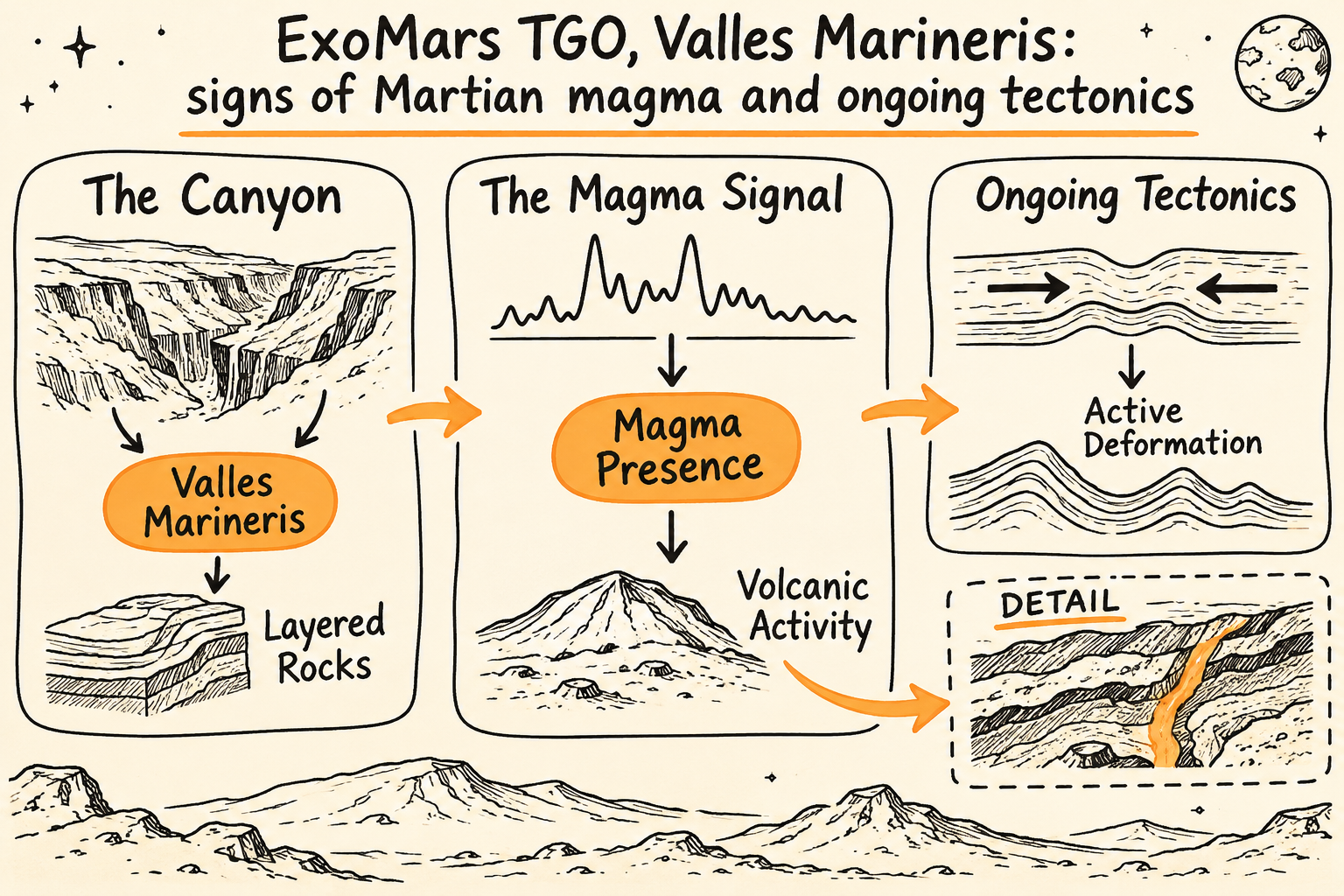
For decades planetary scientists treated Mars as a largely dead world—an arid, cooling planet whose internal furnace had long since run low. That consensus is now being challenged on two fronts. The ExoMars Trace Gas Orbiter (TGO) has detected spatially and seasonally constrained plumes of hydrogen chloride (HCl), a gas most plausibly tied to magmatic degassing. Independently, geophysical analyses of Valles Marineris and adjacent tectonic systems reveal ongoing fault motion and seismicity to depths of tens of kilometres. Together these findings suggest Mars is not uniformly geologically dead but retains pockets of magmatic and tectonic activity with important implications for planetary evolution and human exploration.
What the data say
Late-2026 publications and press releases describing TGO observations report HCl above the northern flanks of Alba Mons and along nearby fissure systems. HCl is chemically linked to volatiles exsolved from cooling magma; its detection at a season and location inconsistent with alternative sources (photochemistry or surface salts) points to subsurface magmatic sources. Complementary remote imaging has identified fresh-appearing fractures and fissures in the Alba Mons region that could act as pathways for deep gases to reach the atmosphere.
Separately, teams at Imperial College London and Columbia University used a mixture of orbital imagery, structural mapping and seismic modeling to show that Valles Marineris—the solar system's largest canyon—exhibits measurable tectonic strain today. Fault slip and deep-seated deformation down to ~40 km depth imply a lithosphere still capable of brittle failure and stress redistribution, features incompatible with an utterly cold, inactive interior.
Connecting the dots: localized heat, not a global revival
These lines of evidence point to a coherent, if nuanced, picture: Mars is not reawakening as a volcanically vigorous Earth analogue. Rather, it appears to host localized magmatic reservoirs and active tectonic structures. The planet’s smaller size and rapid early cooling produced a largely stagnant interior, but residual heat and heterogeneities—thicker crust, compositional buoyancy, tidal stresses from past orbital evolution, and concentration of radiogenic elements—can sustain isolated magma chambers and faulting over billion-year timescales.
Two surprisingly compatible observations emerge. First, HCl emissions are intermittent and spatially restricted, consistent with degassing from small, perhaps ephemeral magma pockets rather than large-scale eruptions. Second, active tectonics along Valles Marineris do not require wholesale mantle convection; lithospheric flexure, unloading and reactivation of ancient structures can produce modern seismicity and open conduits for deep gases.
Why this matters
Scientific: Active or recently active magmatism reshapes interpretations of Mars’ thermal history and crustal evolution. It implies that basaltic differentiation, volatile cycling and hydrothermal systems may have persisted late into Mars’ history, prolonging chemically habitable niches. Hydrothermal environments are prime astrobiological targets because they concentrate energy and nutrients and can shield organics from harsh surface radiation.
Exploration: Localized magma and tectonics alter hazards and opportunities for future missions. Fresh fissures and seismically active zones change landing risk assessments and engineering requirements. Conversely, hydrothermal alteration zones could offer accessible mineral resources (e.g., sulfates, chlorides) and subsurface water reservoirs—practical considerations for in-situ resource utilization (ISRU).
Policy and programmatic: The ExoMars TGO results emphasize the value of long-lived, high-resolution orbital assets for detecting transient phenomena. They argue for integrated approaches combining orbiters, surface seismometers, and targeted rovers or penetrators near Alba Mons and Valles Marineris to sample gases, measure heat flow and map subsurface structure.
Two counterintuitive insights
1) A geologically "alive" Mars needn't be globally hot. Localized magma and tectonic activity can persist for billions of years without a convecting mantle—small, residual pockets of melt and stressed ancient faults suffice.
2) Detecting a single trace gas can outpace visual geology. TGO’s HCl detection preceded unambiguous surface evidence of fresh eruptions; gas-phase chemistry can thus be the most sensitive early warning of subsurface activity on air-thin planets.
What to watch next
Immediate priorities are confirmatory: repeat HCl monitoring with TGO and other spectrometers; high-resolution imaging of Alba Mons fissures over time to track change; targeted seismic deployments in Valles Marineris to localize slip and assess hazard. Longer term, sample-return or subsurface probes to altered rocks near candidate vents would test whether recent hydrothermal systems existed and whether they preserved biosignatures.
These developments transform Mars from a static backdrop into a dynamic, evolving world whose remaining internal processes may hold the key to understanding habitability’s longevity on small planets—and to practical decisions about where humans should go and what they might find.