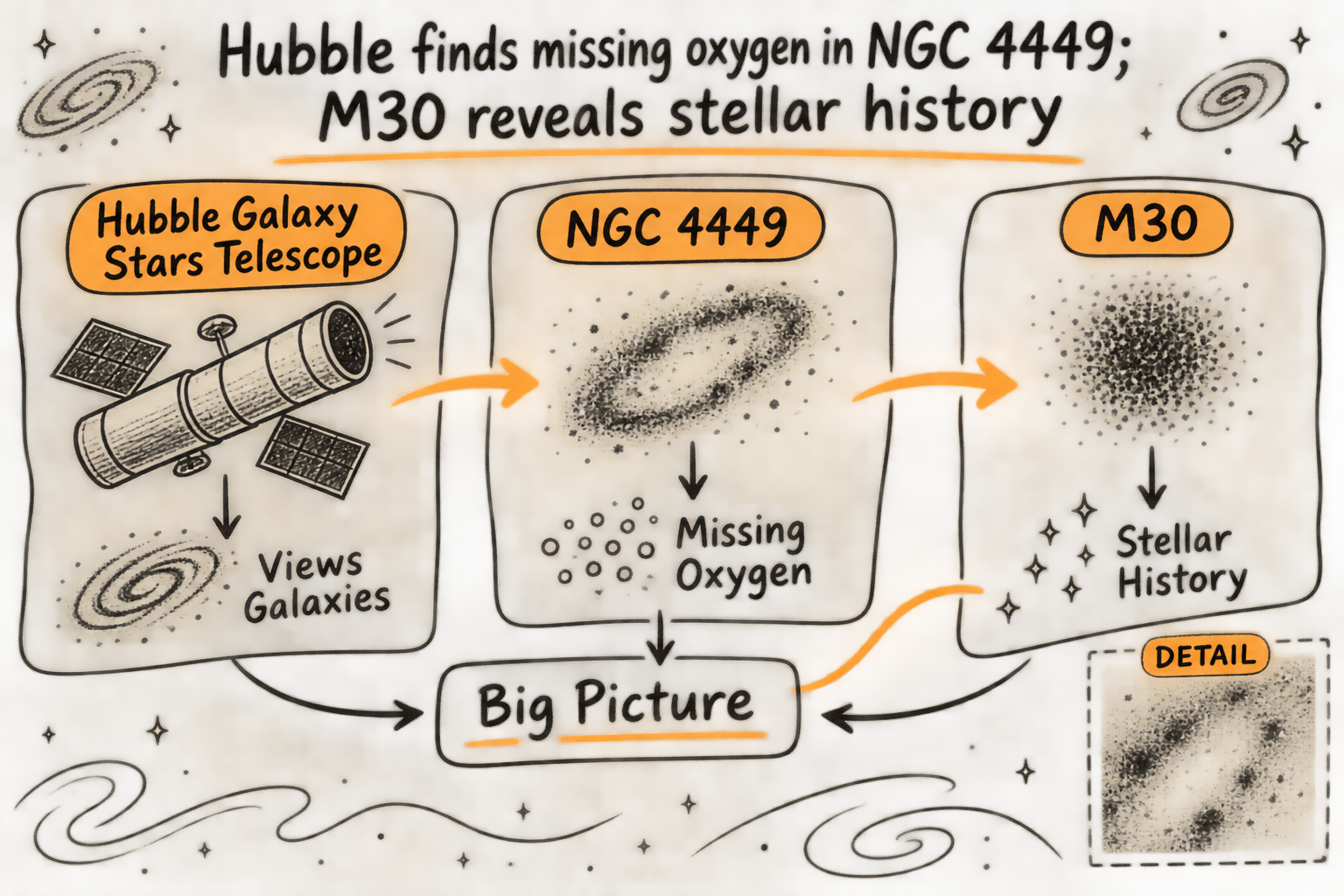
Overview. Two recent Hubble results — a study showing severe oxygen deficits in 37 nearby dwarf galaxies highlighted by NGC 4449, and fresh imaging of the globular cluster Messier 30 (M30) that teases apart a star-by-star history — together force a reappraisal of how small stellar systems keep (or lose) the elements forged inside them. Taken together, these papers are less about pretty pictures and more about the physics that shapes the chemical lifecycles of galaxies.
What Hubble found. The first result, released in early November 2026, reports that dwarf galaxies such as NGC 4449 contain far less oxygen than theoretical models predict. The team measured gas-phase oxygen abundances across 37 dwarfs and found a systematic shortfall: much of the oxygen produced by generations of stars is missing from the interstellar medium. The second release — a high-resolution Hubble portrait of M30 (NGC 7099) — uses resolved-star photometry to reconstruct formation epochs and dynamical evolution for a compact, old stellar system.
Why these two seemingly separate stories belong together. At first glance, oxygen-poor dwarf irregulars and glittering globular clusters are distinct research programs. But both probe the same fundamental problem: how baryons and heavy elements are retained or expelled by shallow gravitational wells. Dwarf galaxies are laboratories for contemporary star formation and feedback; globular clusters are preserved records of early stellar populations and their internal dynamics. Put them side by side, and you get a fuller picture of the small-scale end of cosmic structure formation.
Context and history. The puzzle of missing heavy elements is not new. In the 1980s and 1990s, observations showed that low-mass galaxies have lower metallicities than massive ones, a relation interpreted as the result of energetic stellar feedback (winds and supernovae) that drive metals out of weak gravitational wells. But Hubble’s new, spatially resolved spectroscopy and imaging push this further: the deficit is larger and more systematic than many contemporary models predict, suggesting either much more efficient metal loss, significant mixing into a hot or diffuse phase that eludes optical detection, or episodic accretion of pristine gas that dilutes the metal content.
Key implications. First, if dwarfs routinely lose a large fraction of their metals to circumgalactic or intergalactic space, they become significant contributors to the chemical enrichment of the cosmic web — a role previously attributed mainly to more massive galaxies and AGN-driven outflows. Second, the internal histories visible in M30 demonstrate that even tightly bound systems can undergo complex mass segregation, dynamical interactions, and multiple stellar populations that redistribute elements internally. This underscores that retention vs. loss is not a simple function of mass alone; internal dynamics and the timing of energetic events matter.
Two counterintuitive insights. One: dwarf galaxies with active star formation can nonetheless be chronically oxygen-poor — ongoing star birth does not guarantee local metal enrichment because freshly produced oxygen may be expelled or hidden immediately. Two: globular clusters, often treated as chemically simple fossils, display layered histories that can mimic or mask the signatures we use to infer enrichment efficiency in larger galaxies. In other words, small systems are both leakier and more internally complex than conventional wisdom suggests.
What this means for models and observations. The Hubble findings demand adjustments on multiple fronts. Galaxy-evolution simulations must incorporate more efficient, perhaps anisotropic, metal ejection channels and better modeling of hot circumgalactic reservoirs that trap metals invisibly. Observationally, the results sharpen the case for multiwavelength campaigns: X-ray and UV absorption-line studies are required to search for the missing oxygen in hot gas halos; radio and millimeter observations can test for dilution via cold gas inflows. Likewise, deeper, time-resolved studies of globular clusters will refine how internal dynamics redistribute heavy elements.
Future implications. The missing-oxygen problem touches practical questions beyond theory: the metal budget affects cooling rates, star-formation efficiency, and the interpretability of emission-line diagnostics used to estimate star-formation rates and masses in distant galaxies. If dwarf systems export a larger metal fraction than expected, early-universe enrichment pathways and the formation of the first low-metallicity stars may need revision. Upcoming facilities — JWST follow-ups, next-generation X-ray telescopes, and 30-meter class ground observatories — will play pivotal roles in hunting for the displaced oxygen and in resolving faint stellar populations in nearby systems.
Conclusion. Hubble’s dual contributions — a survey-scale chemical surprise in NGC 4449-class dwarfs and a high-fidelity chronicle of M30’s stars — reframe how astronomers should think about small systems. Dwarfs are not mere scaled-down big galaxies; they are dynamic, sometimes leaky, and chemically opaque in ways that complicate simple scaling laws. Conversely, compact clusters hold detailed archives of dynamical processes that can inform, and at times confound, our interpretations of galactic chemical evolution. Together, they argue for an integrated approach: combine resolved stellar archaeology with multiwavelength searches for the missing baryons and metals to close the bookkeeping of cosmic element production.