Overview
The past month brought a cluster of transactions, awards and program wins that together reveal a maturing satellite ecosystem: large commercial capital raises, defence and civil contracts for terminals and space relays, and investments in both ground infrastructure and very-low Earth orbit (VLEO) experimentation. Taken together, the moves by Viasat, CesiumAstro, Northwood Space, ALL.SPACE, MDA Space and Redwire trace a single story: the industry is shifting from single-purpose, vertically integrated players toward a layered, interoperable market where hardware, software and services are separately financed and monetized.
Commercial capital flows are underwriting capability, not just growth
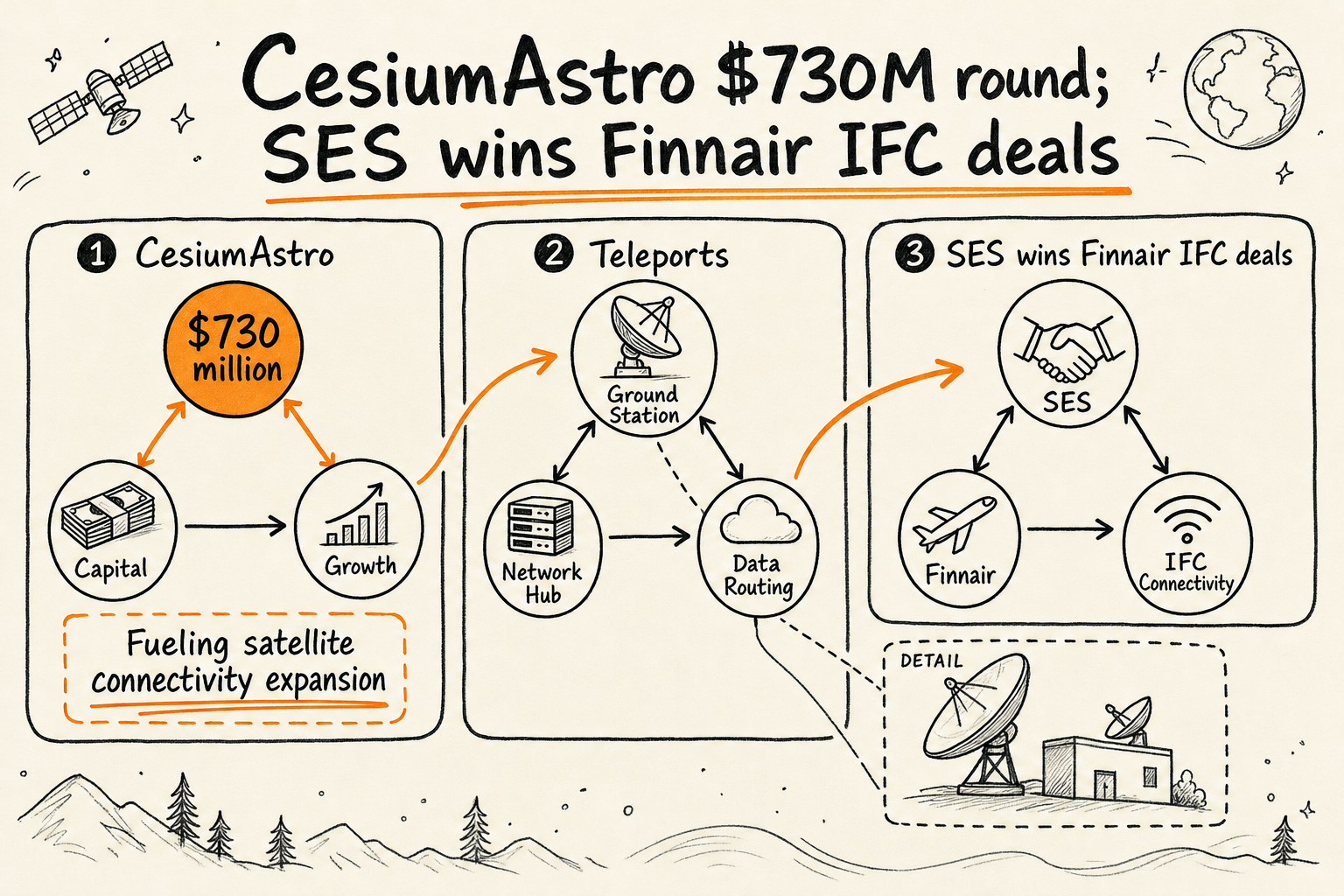
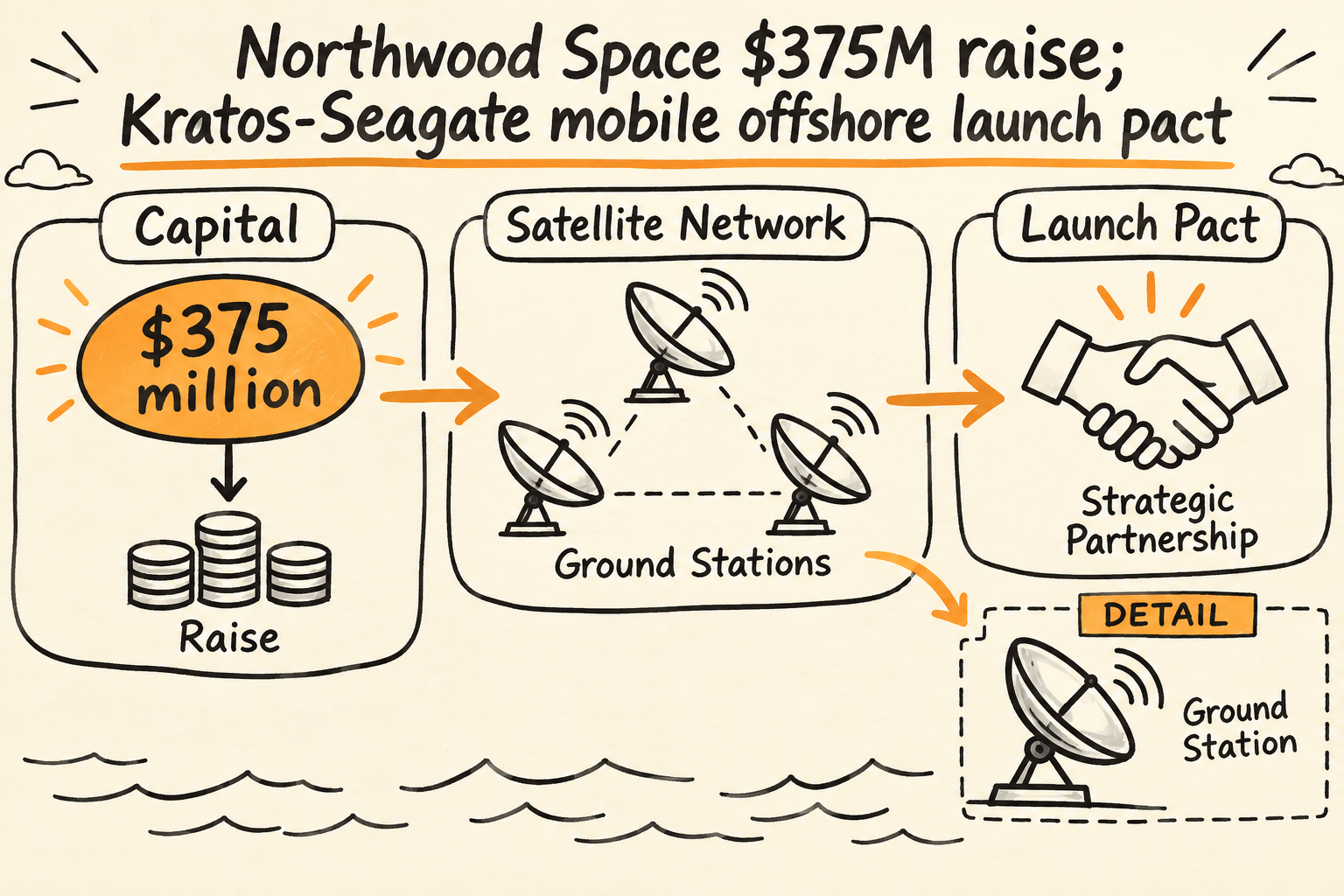
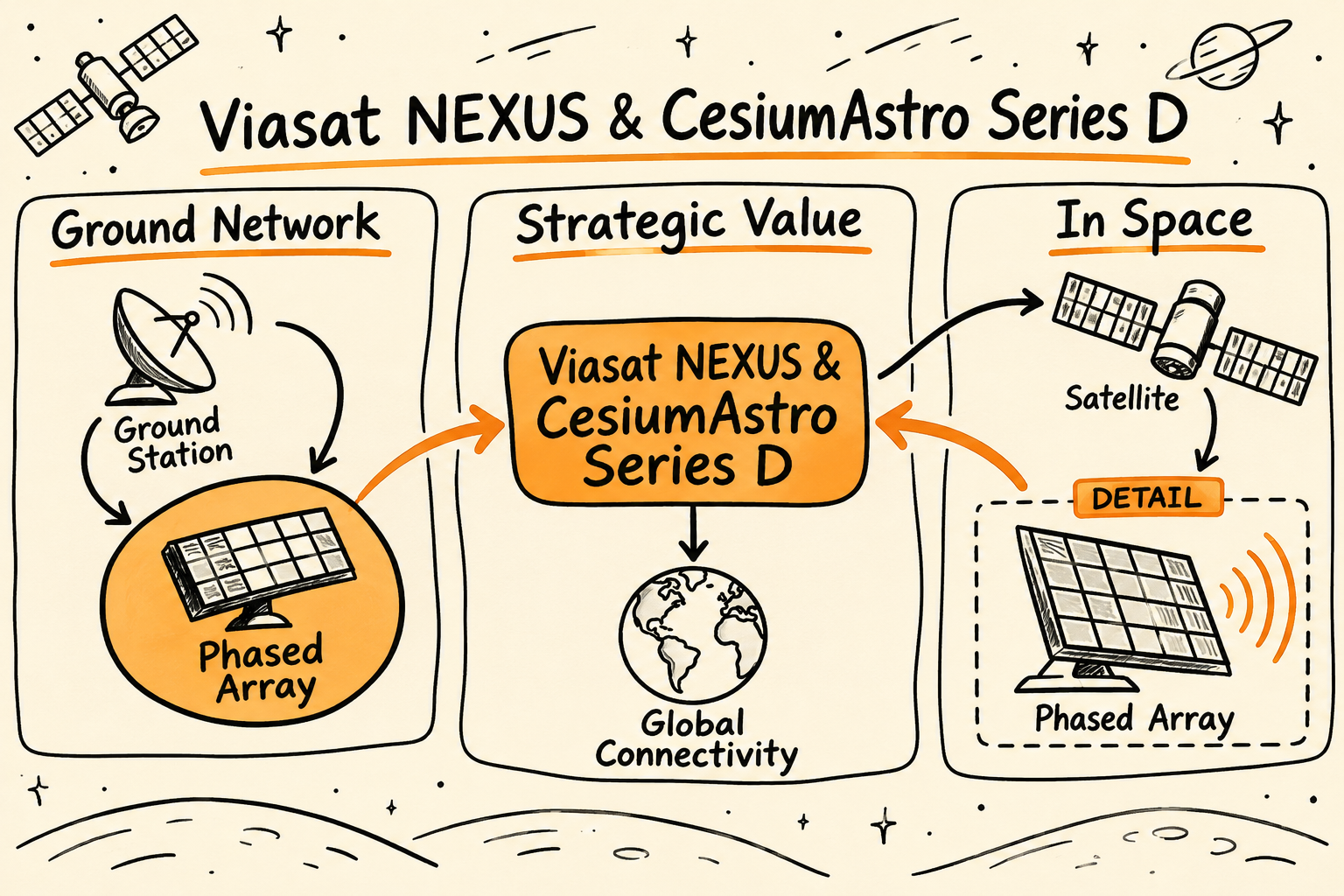
Two headline financings — CesiumAstro’s $730 million Series D at a $4.5 billion valuation and Northwood Space’s $375 million Series C at a $2 billion valuation — are emblematic of a broader investor thesis. Rather than funding rapid launch-and-populate strategies alone, investors are targeting differentiated technology stacks: phased-array digital payloads (CesiumAstro) and shared ground-station networks (Northwood). Those are the plumbing that makes large constellations commercially viable at scale.
Counterintuitively, this means capital is now chasing precision and interoperability more than sheer satellite count. Launching thousands of cheaply made satellites remains important, but the real value is shifting to beamforming, software-defined radios, groundsite orchestration and integration with military-grade terminals. In short: quality of connectivity is becoming as important as geographic coverage.
Defense and civil demand are anchoring commercial supply chains
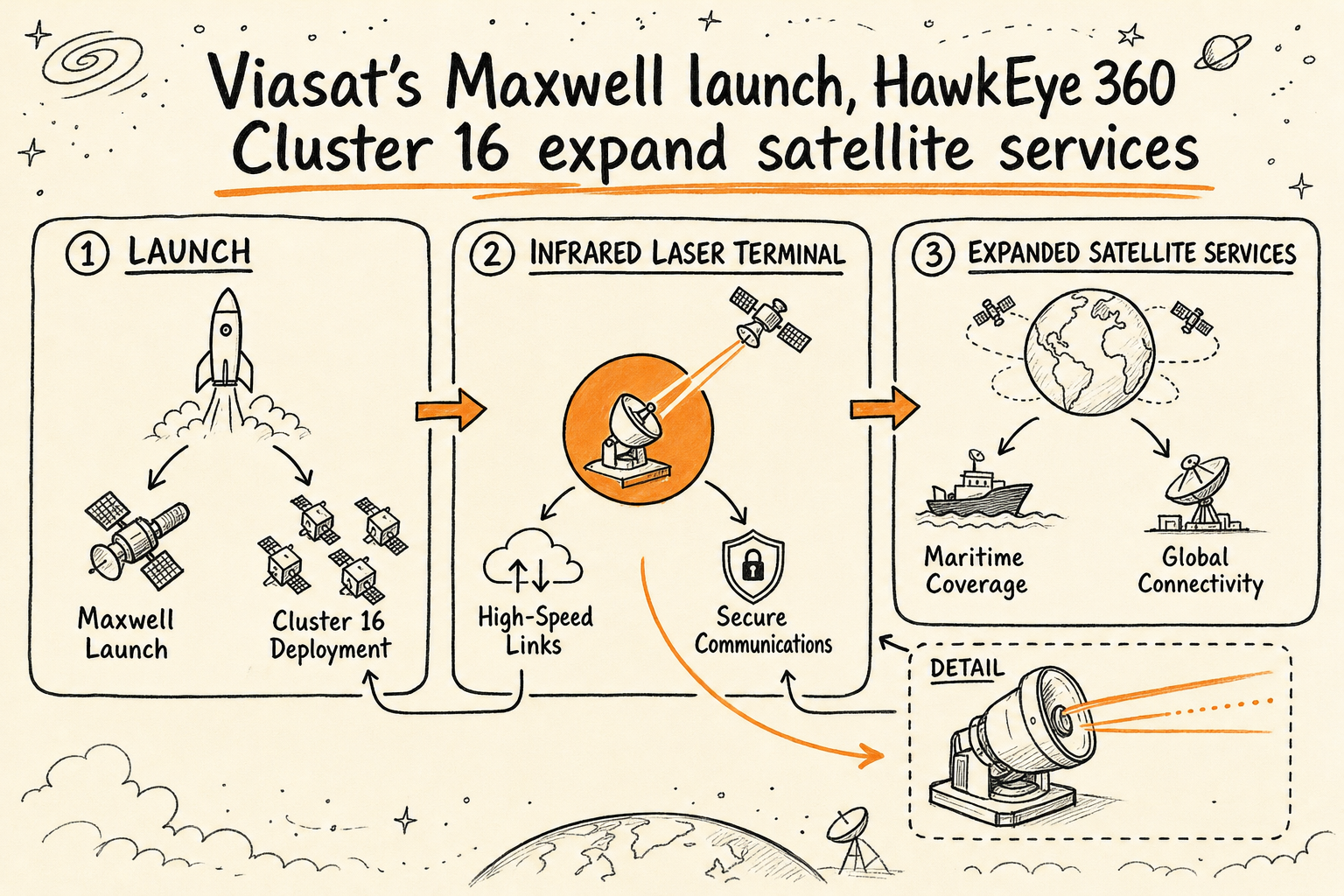
Contract awards underline that government customers remain critical demand anchors. Viasat’s Phase 1 NASA NEXUS contract valued up to $460.9 million positions a commercial operator as a civil space relay provider — a formal recognition of commercial SATCOM’s role in mission continuity. The U.S. Navy’s follow-on order for 59 Hydra MAX 2 terminals from ALL.SPACE, expanding the fleet to 108 units, shows how military procurement is scaling to tap commercial constellations while buying hardened, field-ready terminals.
These procurement patterns reduce commercial risk. A constellation or ground network that can demonstrate civil and defense contracts achieves a more stable revenue stream and justifies larger, later-stage raises — which helps explain the lofty valuations we observed.
Regulation and partnerships still shape strategic moves
Viasat’s partner Space42 and their Equatys D2D joint venture clearing a regulatory hurdle for a 2,800-satellite direct-to-device plan is a reminder that spectrum and licensing remain gatekeepers. Regulatory wins are now as consequential as launch manifest updates: they turn investor promise into addressable markets. Conversely, any regulatory delay can chill investor appetite or force technological pivots toward other bands or architectures.
Partnerships between operators, manufacturers and integrators — exemplified by Thales Alenia Space’s engagement with MDA Space to deliver the first 66 IRIS² satellites’ digital payloads — signal a modular supply chain model. Primes increasingly assemble heterogeneous stacks: national and multinational programmes want suppliers who can plug in digital payloads, software orchestration and ground services, not just deliver monoscale buses.
Experimentation at the edges: VLEO and new paradigms
Mixing curiosity-driven R&D and pragmatic procurement, DARPA’s award to Redwire for a Scaled SabreSat VLEO precursor flight reflects interest in leveraging atmospheric drag and proximity to enable higher-throughput, lower-latency services or novel sensing. VLEO is not yet a commercial panacea — it brings rapid decay and fuel demands — but agencies are investing to learn operating models and materials science. If these tests succeed, expect hybrid constellations that combine VLEO’s performance with LEO/MEO persistence.
What this means for the industry
First, expect more capital to chase verticals that add measurable service value: digital beamforming, secure terminals, and elastic ground networks. Second, public-sector contracts will remain decisive in underwriting expensive, early-mover technology risks. Third, regulatory clearances — not just launch capacity — will determine which business models scale. In practice this will favor firms that can assemble end-to-end offerings or broker them through partnerships.
Finally, the industry’s center of gravity is shifting from satellite count headlines to systems integration. That is subtle but consequential: profit pools will consolidate around those who control software-defined payloads, cross-domain interoperability and the ground-cloud orchestration layers that customers actually pay for.
Looking ahead
Over the next 12–24 months watch three indicators closely: (1) follow-on government procurements for terminals and space relays (which signal sustained demand), (2) regulatory outcomes for D2D and spectrum grants (which expand addressable markets), and (3) VLEO flight results (which could rewrite latency and revisit trade-offs). The constellation race is no longer just about numbers; it’s about the economics of connectivity, and whether new entrants can sell reliability and integration, not just coverage.
NovΔ mAInd will continue tracking how these financial and contractual commitments translate into launches, on-orbit capability and service availability.