Introduction
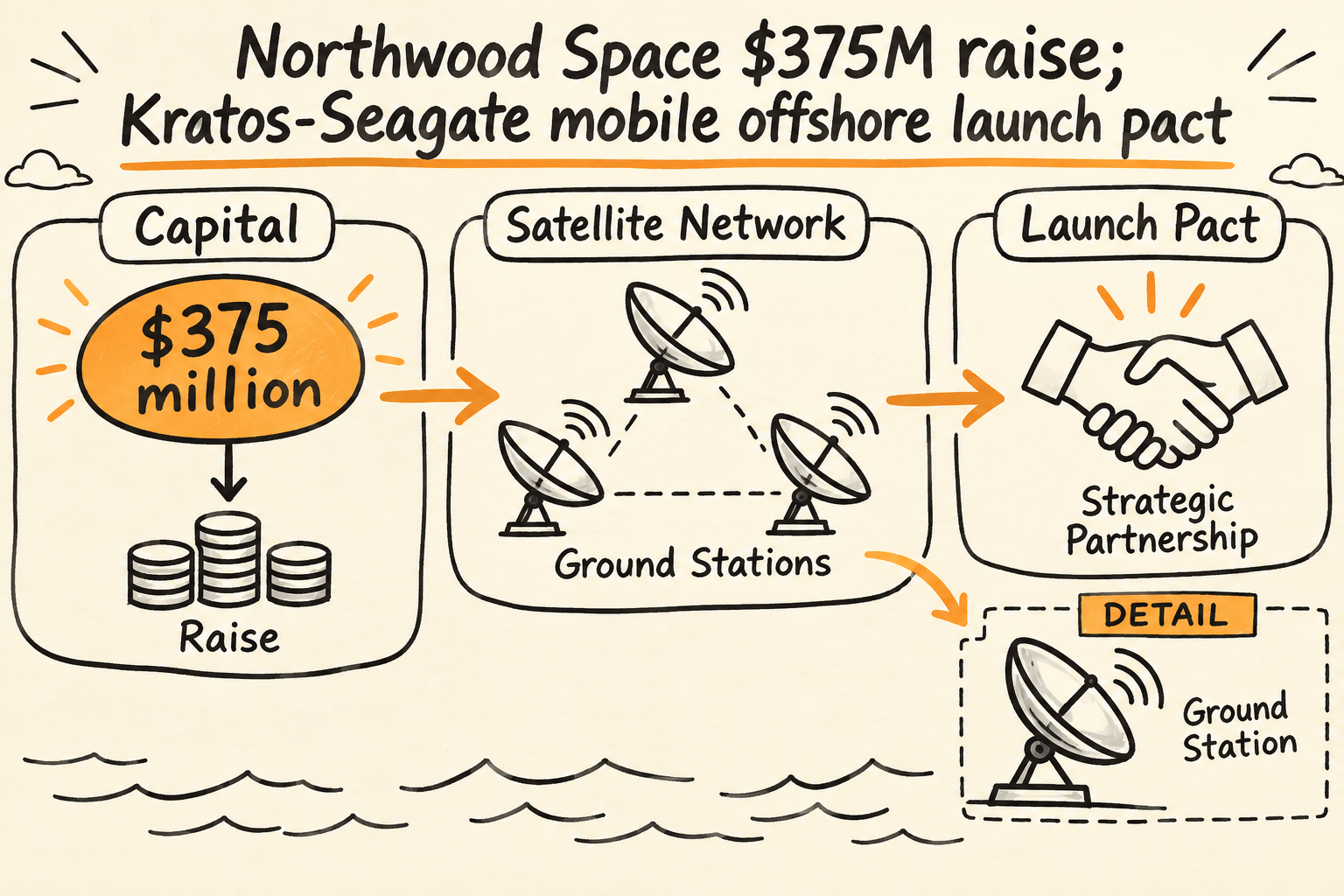
The recent flurry of announcements — from Northwood Space's $375 million Series C to Kratos's partnership with Seagate Space, plus a string of terminal, sensing, and unmanned-systems moves — marks a structural inflection in the space economy. Where the last decade was dominated by rocket-centric narratives and constellation hardware, the next phase will be decided on the ground and at sea: who builds resilient networks, who services military customers, and which companies knit together heterogeneous constellations and launch architectures into reliable, revenue-generating systems.
Ground networks and the capture of recurring revenue
Northwood Space's $375M raise is emblematic. The capital will accelerate antenna production and add 400 staff, reflecting investor appetite for ground infrastructure that enables LEO and MEO connectivity. Historically, ground networks were commoditized support functions, but as LEO constellations scale, low-latency services and multi-network aggregation become the bottleneck for enterprise and defense customers — and the source of durable recurring revenue.
That shift creates winners and losers. Antenna factories, operations centers, and network orchestration platforms capture margins previously trapped in launch and satellite manufacture. It's why Intellian's diversification from maritime terminals into aviation and military markets is strategic: terminals that can operate across multiple environments and vendors become sticky customer endpoints.
Defense partnerships and offshore launch as strategic leverage
Kratos and Seagate Space's long-term agreement to develop mobile offshore launch capabilities crystallizes another trend: militaries and national-security customers are buying launch resiliency, not just access. Mobile sea-based platforms reduce vulnerability to fixed-site attack and provide geographic flexibility for time-critical missions. For defense contractors like Kratos, partnering with commercial launch providers translates to productizing mobility — a capability that adjacent markets (intelligence, logistics, tactical ISR) will pay a premium to access.
Combined with Shield AI's teased 'snowball' of X-BAT fighter-drone deals in Europe and York Space's acquisition of Outlook Industries to enter unmanned ground systems, the defense market is converging around integrated, cross-domain systems. Satellites supply global awareness; unmanned systems and mobile launch provide localized action; ground networks and terminals bind them into operational loops.
Terminal ecosystems, multi-LEO aggregation, and the paradox of complexity
Technologies that appear incremental — Lite Coms' GT3 that connects simultaneously to multiple LEO networks, Intellian's aviation and military terminals, Hydrosat's tactical thermal ISR — are actually manifestations of a deeper economic logic. As constellations proliferate, customers will not bet on a single provider. They will demand multi-network interoperability, automated handoffs, and resilient routing. That multiplies technical complexity but concentrates economic value in orchestration layers: terminal firmware, ground routing, spectrum management, and service-level guarantees.
Counterintuitively, more satellites and more launch capability can increase the value of comparatively low-tech components like antennas and thermal imagers. They become the gateways to a fragmented but always-on set of services.
Execution risk and the reality of rollouts
Not all firms will capture the upside. Gilat's downgrade after launch delays and slow IFC rollouts is a cautionary tale: timing matters. When satellite and launch schedules slip, revenue tied to installs and service activation stalls. Capital-intensive ground plays need reliable upstream execution. The difference between a strong year and a disappointing one is often the cadence of launches and the speed at which terminals are installed and certified.
Investors who funded Northwood are implicitly betting on improved launch cadence and faster certification cycles; Gilat's setback reminds the market that that assumption can be challenged.
Implications and what to watch
First, expect consolidation among terminal makers and ground-network integrators. Companies that can certify terminals across commercial constellations and defense bands will command higher multiples. Second, national-security customers will accelerate procurement of flexible launch options — including mobile offshore platforms — as strategic insurance. Third, multispectral sensing and tactical ISR (Hydrosat) combined with unmanned systems (York Space/Outlook) create bundled offerings that defense buyers will value because they shorten sensor-to-shooter timelines.
Longer term, the economic geography of space will shift: value accrues less to single-launch winners and more to platform integrators, orchestration software vendors, and terminal manufacturers that lock in end users. That will change hiring patterns (more antenna engineers, firmware, and systems integrators) and capital flows (big rounds for ground stacks, steady defense contracts for mobility solutions).
Conclusion
The takeaways are both practical and surprising. Practical: scale in ground infrastructure and multi-network terminals will underpin the next wave of commercial growth. Surprising: the more distributed the orbital ecosystem becomes, the more concentrated the economic power in seemingly mundane terrestrial hardware and orchestration layers. In this emerging economy, the tidy center of gravity sits not in the rocket hangar but in the antenna factory, the operations center, and the deck of a mobile launch barge.