United Launch Alliance's Vulcan rocket carrying 40 Amazon Leo broadband satellites suffered an anomaly about 10 minutes into flight on Sunday, Nov. 15, and failed to deliver the payload to low Earth orbit, ULA said in a statement. It was the first outright failure of a ULA rocket since the company, a partnership between Boeing and Lockheed Martin, was formed in 2006.
It was only the fifth Vulcan flight, and the first in nine months, after ULA and booster supplier Northrop Grumman spent that time working on nozzle problems with the strap-on solid boosters.
What happened on Sunday's flight
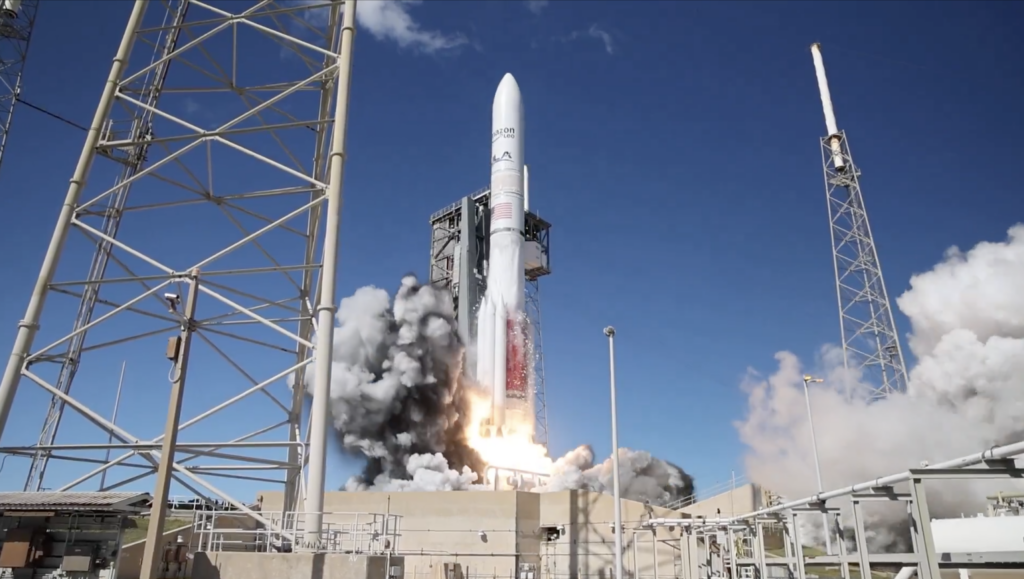
The 214-foot-tall (65 m) Vulcan lifted off from Space Launch Complex 41 at Cape Canaveral Space Force Station at 12:40 p.m. EST (17:40 UTC) on a northeasterly trajectory. It flew as a VC6L, the most powerful Vulcan configuration, with six GEM-63XL solid rocket boosters, two Blue Origin BE-4 first-stage engines burning liquid oxygen and methane, an extended payload fairing and a low-Earth-orbit-optimized Centaur V upper stage. Together the boosters and engines produced 17.2 MN of thrust (about 3.8 million pounds). Source 3 lists the rocket's capacity as up to 27,200 kg to LEO.
About a minute and 40 seconds after liftoff the solids burned out and fell away normally, and the two BE-4s continued first-stage flight. The first stage appeared to burn longer than called for in ULA's pre-launch timeline. It also appeared to separate from the Centaur later than expected, and telemetry-driven animation showed the Centaur making unusual orientation adjustments early in its burn. ULA has not confirmed any of those details. Its launch commentators did not mention problems, and the broadcast ended without confirming whether the Centaur's first planned burn, scheduled for 12 minutes 15 seconds, ran its full length.
About 50 minutes after liftoff, ULA issued its statement: "Based on data received by our Launch Director, we confirm that the Vulcan vehicle launched from Space Launch Complex 41 suffered an anomaly 10 minutes into the flight and failed to deliver the Amazon mission to orbit." The company added: "We will work closely with our customer and other appropriate organizations to find the cause, determine the appropriate corrective action and return to flight as quickly as possible." It also said "ULA is committed to full transparency with our customers, and they will have visibility into the investigation process, which utilizes rigorous methodology and corrective action."
The anomaly came on the first flight of the LEO-optimized Centaur V. ULA has not named a root cause, and it is not yet known whether the BE-4 engines, the modified GEM-63XL nozzles or the new Centaur configuration contributed. The BE-4s used Sunday had been retrofitted by Blue Origin with a fix for the oxygen-valve problem behind May's New Glenn on-pad explosion.
The countdown was rocky. After scrubs on Friday, when a gaseous nitrogen plant serving multiple launch providers was knocked out, and on Saturday, for network problems between the vehicle and ground systems, the first Sunday attempt at 12:11 p.m. EST held at T-20 seconds. The cause was a pressure-reducing valve anomaly. ULA resolved it and launched at the end of the 29-minute window. It is not known whether that problem played any role in the failure. As NovΔ mAInd reported in our earlier coverage, the nitrogen plant, operated by Air Liquide, lost high-pressure pumps in a power interruption.
What the lost mission was meant to do
LV-01 was the first of up to 38 Vulcan launches Amazon has booked with ULA for its Leo constellation, a competitor to Starlink. It carried the most satellites of any Amazon Leo mission to date. The plan called for a 450 km circular parking orbit inclined 51.9 degrees, with 21 deployment events. The first would have come about 1 hour 17 minutes after liftoff, and the full sequence would have taken about 25 minutes 40 seconds. After a further 219-second coast, the Centaur V would have performed its deorbit burn nearly two hours after liftoff. ULA has already flown eight Leo missions on Atlas 5 rockets.
Had the satellites been deployed, the constellation would have had 432 satellites in orbit. As of early November, 368 were in their operational orbit and six had reentered the atmosphere. Amazon Leo needs 578 satellites at 630 km to start initial regional service, and the first-generation network is planned at up to 3,236 satellites. Amazon's FCC waiver, granted June 5, extends the deadline for completing the constellation to July 30, 2029. If the constellation is not complete by then, the FCC could limit Amazon to the satellites already launched. Customers already signed include Delta Air Lines, JetBlue Airways, Crane Worldwide Logistics and Hunt Energy.
Amazon has also booked 24 launches on Blue Origin's New Glenn, 24 on Ariane 6 and 13 on Falcon 9. It now waits both on ULA's investigation and on New Glenn's return to flight after the May on-pad explosion.
A booster record that had already cost ULA months
The GEM-63XL, a stretched version of the GEM-63 flown on Delta IV Medium and Atlas V, has had a mixed record. On Vulcan's second flight in October 2024, a nozzle "liberation" event 37 seconds after liftoff hit one of two boosters. The rocket compensated and reached orbit with an inert demonstration payload. Then-ULA CEO Tory Bruno said the failure originated in insulators bonded to the inside of the shell that later became the nozzle. Northrop Grumman tested a modified motor at its Promontory, Utah, facility in February 2025, and Vulcan returned to flight in August 2025 with USSF-106. That VC4S mission was fully successful, with no "observations" on the boosters.
On Feb. 12, 2026, the USSF-87 mission saw another nozzle "observation" 69 seconds after liftoff, with a similar loss of thrust and asymmetry. The rocket still reached orbit. ULA was free to continue commercial flights, but the U.S. Space Force put national security launches on hold pending further analysis. As NovΔ mAInd reported in our report on the return-to-flight plan, ULA said an integrated team of ULA, Northrop Grumman and the Space Force had identified several potential contributors and mitigated them with design and process changes. LV-01 flew with the improved nozzle and was closely watched for any repeat. Instead, the anomaly came on the upper stage.
NASA offers help; ULA's record
NASA Administrator Jared Isaacman promised assistance if needed. "Appreciate you quickly keeping the public and your partners informed," he wrote on X. "The team at @NASA is available to assist in all matters related to the investigation and remediation effort. Artemis, Moon Base, and the nation need ULA. We are in your corner and here to help." ULA said it will provide further updates when new information becomes available.
NovΔ mAInd's launch database tracks 11 ULA launches with a 100% success rate, the most recent dated 2026-07-02. That record predates Sunday's flight and does not include this failure.