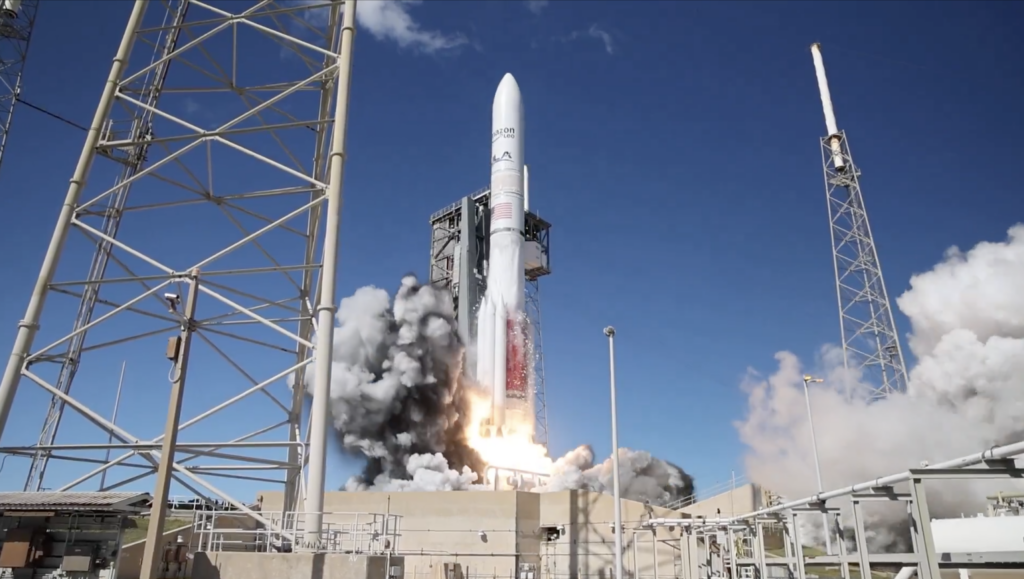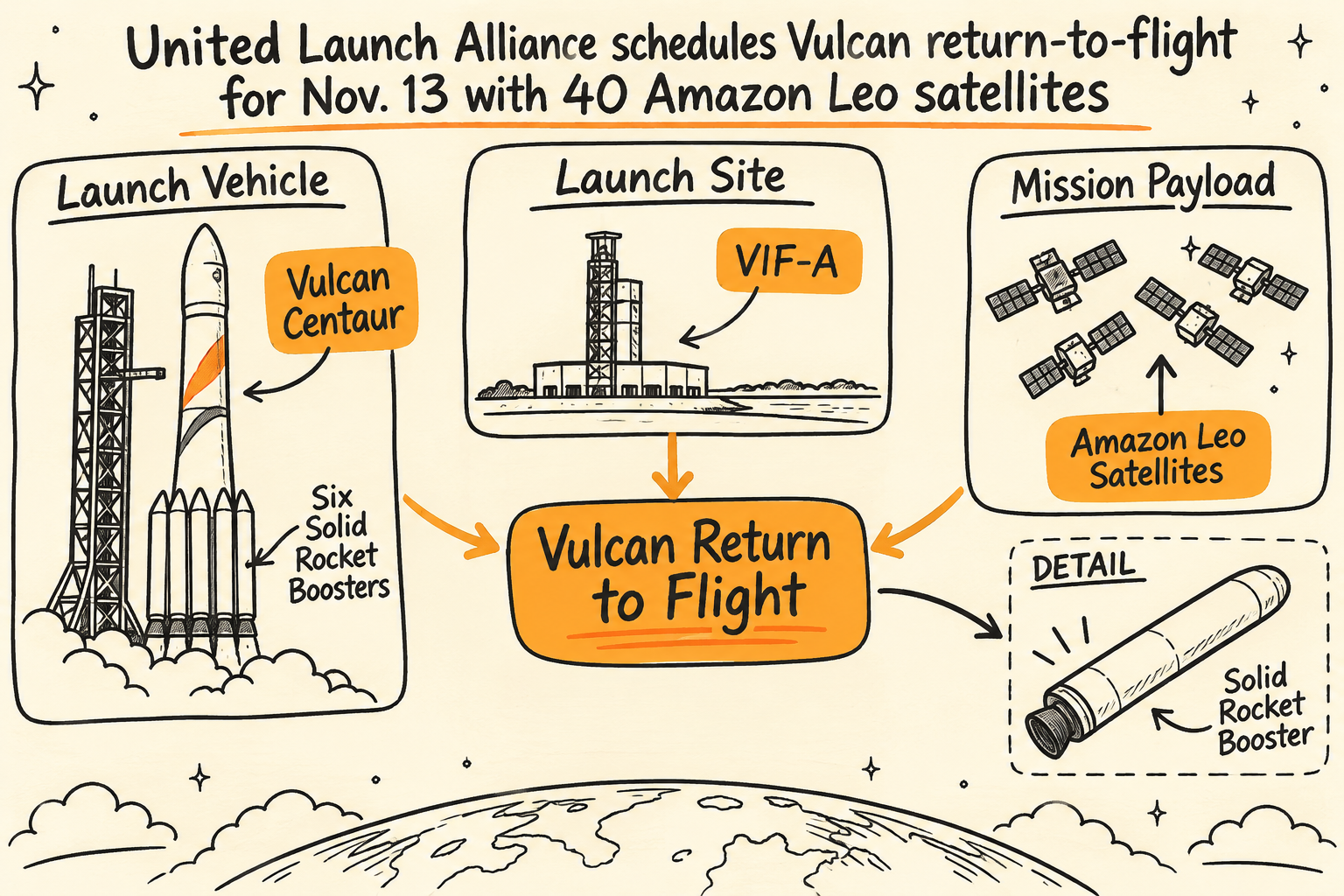
United Launch Alliance's Vulcan Centaur rocket suffered an anomaly about 10 minutes after liftoff on Nov. 15 and failed to deliver 40 Amazon Leo satellites to orbit, ULA said in a statement posted on X at 1:30 p.m. ET. Spaceflight Now, whose reporting is cited by several outlets, places the anomaly during the burn of the Centaur upper stage. The mission, LV-01 for Amazon Leo, launched from Space Launch Complex 41 at Cape Canaveral Space Force Station. It was the first of 38 Vulcan flights Amazon has purchased.
ULA's statement read: "Based on data received by our Launch Director, we confirm that the Vulcan vehicle launched from Space Launch Complex 41 suffered an anomaly 10 minutes into the flight and failed to deliver the Amazon mission to orbit." The company said it had no specific data yet on what happened. It said it would work with its customer and other appropriate organizations to find the cause, determine corrective action and return to flight as quickly as possible, and that customers would have visibility into the investigation. "Today, we did not meet that standard," ULA said of its commitment to mission success.
A nominal start, then trouble during the Centaur burn
Liftoff came at 12:40:30 p.m. ET, and everything appeared nominal at first. All six Northrop Grumman solid rocket boosters appeared to perform as planned and separated as expected, burning out less than two minutes after liftoff, according to Space.com and Spaceflight Now. The first stage, powered by two BE-4 engines from Blue Origin, kept firing until it separated from the Centaur. The Centaur, which carries the payload the rest of the way to orbit, is powered by two RL10 engines made by L3Harris.
Spaceflight Now also reported that the first stage appeared to burn longer than planned, and that a telemetry-driven animation showed the Centaur making unusual orientation adjustments early in its burn. ULA has not confirmed these details and has not identified a cause. As NovΔ mAInd reported in its account of the flight, ULA's commentators did not mention problems, and the broadcast ended without confirming whether the Centaur's first planned burn, scheduled for 12 minutes 15 seconds, ran its full length.
Vulcan flew as a VC6L, the first time it had flown with six solid boosters, and carried an extended payload fairing and a Centaur V upper stage optimized for low Earth orbit.
The countdown was already troubled. Friday's attempt was scrubbed after a pump failure at an Air Liquide gaseous nitrogen plant. Saturday's was postponed because of a network communication issue between ground equipment and the vehicle. On Sunday, the 12:11 p.m. ET liftoff slipped to the end of the 29-minute window because of oscillations in a liquid hydrogen pressure relief valve. GeekWire reported a further hold with 20 seconds left on the clock to resolve a technical issue, and said it is not known whether that issue played any role.
Two earlier booster failures and a nine-month grounding
This is the first total mission failure in ULA's history since the Boeing–Lockheed Martin joint venture was formed in 2006. It was the fifth Vulcan launch since the rocket debuted in January 2024, and the first in nine months. Nozzles on the Northrop Grumman boosters malfunctioned on the second flight in October 2024 and on the fourth, a national security mission in February 2026. Both flights reached orbit because the core stage compensated for the underperformance, but the Space Force has been hesitant to use Vulcan for its most precious satellites. It paused Vulcan national security launches after February, and several launches have been shifted to SpaceX.
As NovΔ mAInd reported when ULA scheduled the return to flight, an integrated team of ULA, Northrop Grumman and the U.S. Space Force had identified several potential contributors to the nozzle anomaly and mitigated them through design and process changes. ULA said that flying the improved nozzle would give it flight data validating those changes. In a pre-flight interview reported by CBS News, ULA CEO Mark Peller said the BE-4 engines had also been retrofitted to fix the oxygen valve problem behind the May New Glenn explosion.
ULA's leadership is new. Longtime CEO Tory Bruno left last December for Blue Origin, and Peller, who led Vulcan's development, was named CEO in August. Our launch tracker lists 11 ULA launches with a 100% success rate, the most recent on 2026-07-02. That record predates Sunday's failure.
Vulcan is replacing ULA's Delta and Atlas V rockets. The final Delta IV launched in 2024, and the six remaining Atlas Vs are under contract to Boeing for Starliner. Atlas V has a 100 percent mission success record. Delta IV Heavy's one failure in 16 launches was a partial failure on its 2004 debut, when the payload reached orbit but lower than planned.
What the loss means for Amazon Leo
Amazon Leo posted on X that "there is risk with any launch, and that's especially true for inaugural missions like LV-01. ULA has been a trusted partner for Amazon, and we believe they'll learn from this mission and deliver on their long-term plans for Vulcan."
Before Sunday, Amazon had launched 396 satellites for the network, formerly known as Project Kuiper, on 14 missions since April 2025. Its last successful launch was in July, when ULA flew the last of eight Leo missions on the Atlas V. Vulcan carried 40 satellites on Sunday, against 29 on that last Atlas V flight, and is slated to carry more than 1,500 of Amazon's first-generation satellites, more than any other rocket in the program. Melissa Wuerl, Amazon Leo's director of launch systems, had called it the program's "primary workhorse over the next several years." Amazon had said the second Vulcan mission could fly within weeks of the first, but that flight now has to wait for ULA's investigation.
Amazon's other options are limited for now. It has 24 launches reserved on Blue Origin's New Glenn, which has been grounded since a May ground-test explosion, and has booked others on Arianespace's Ariane 6 and SpaceX's Falcon 9. Its next scheduled Leo launch is an Ariane 6 mission carrying 36 satellites, targeted for Nov. 23 at the earliest.
The regulatory clock is also running. In June, the Federal Communications Commission allowed Amazon to keep deploying satellites even if it missed its July 30 deadline to put 1,616 into service. Satellites not operational by then temporarily lose priority in key spectrum bands. Amazon has until July 30, 2029, to deploy and operate all 3,232 first-generation satellites, and has said it plans an initial rollout of commercial internet service this year.