Summary
In the last weeks, disparate advances—from NASA's fleet on Mars to the first fully autonomous construction in orbit—have converged around two themes: rediscovery of the very old and the birth of new operational paradigms. Curiosity's expanding archive of drill holes, Perseverance's potentially 3.9-billion-year-old "Singita" sample, fresh evidence for subsurface activity, and discoveries of glacial relics combine to recast Mars as a place with prolonged, complex habitability potential. At the same time, an autonomous robot assembling a structure in space signals a step change in how we build and maintain infrastructure off Earth. Together these developments force us to update timelines for planetary evolution and for the economics and architecture of in-space work.
Putting the new Martian puzzle pieces together
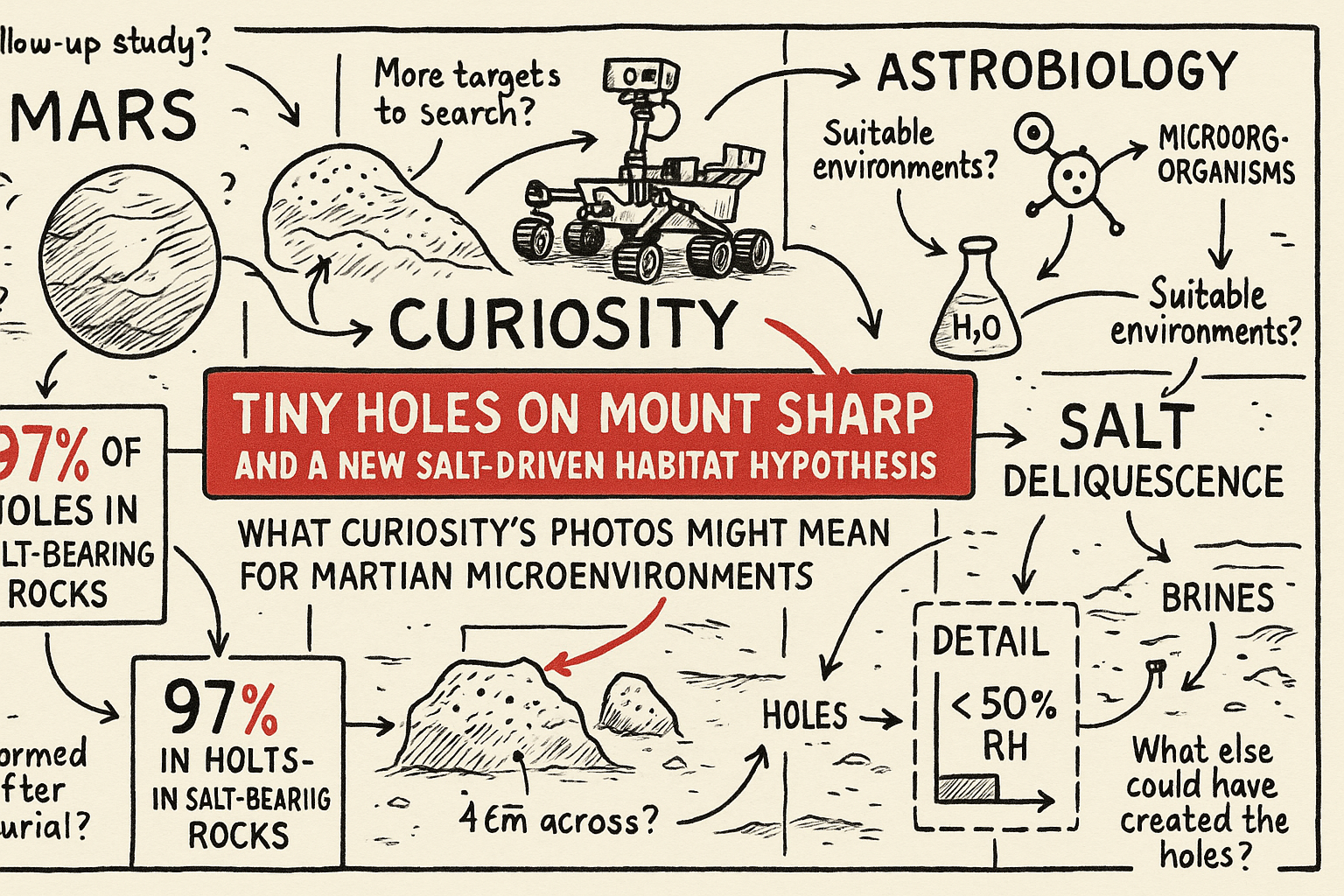
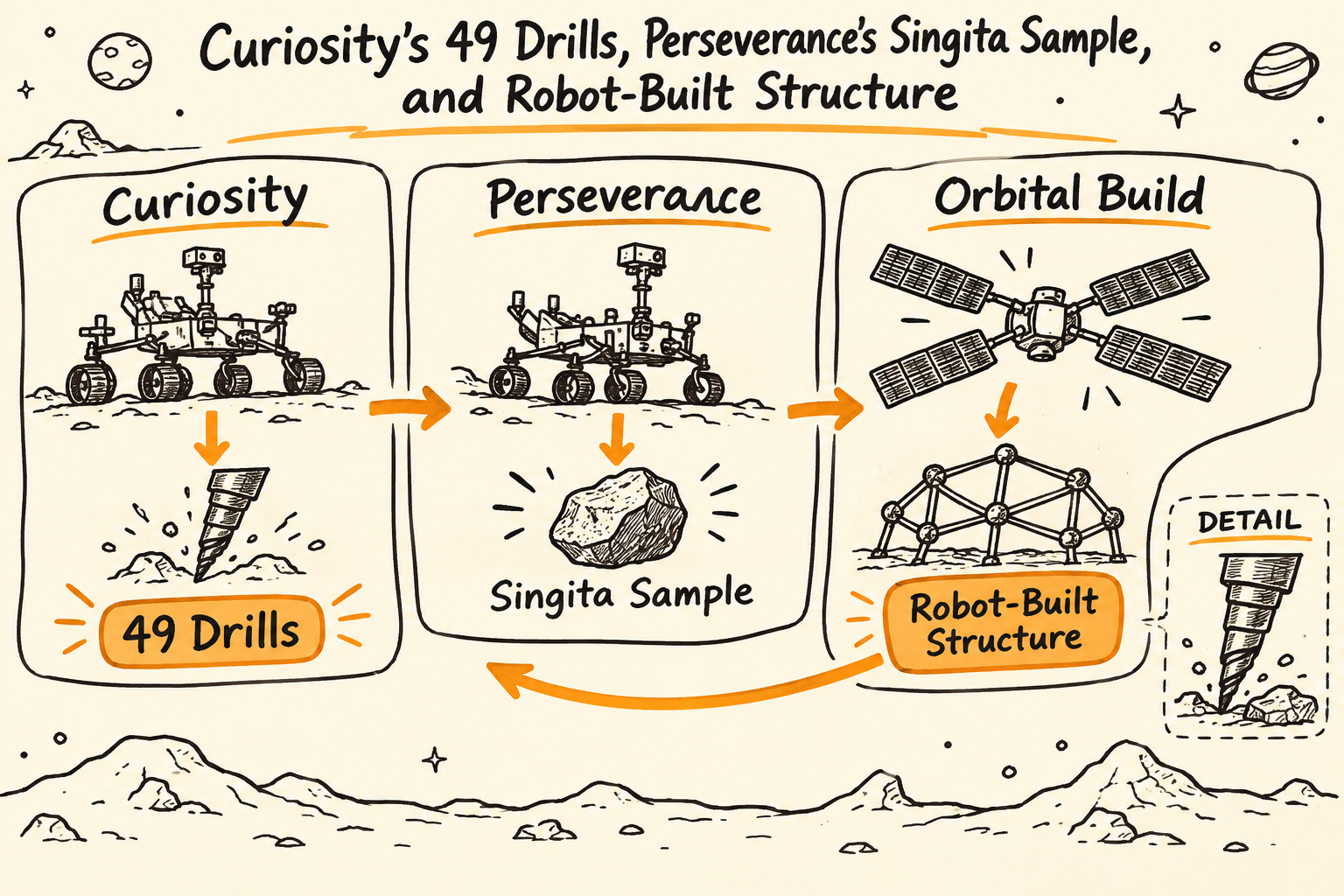
Curiosity's mosaic of 49 drill holes is not just a tally; it's a map of how we have sampled a Martian environment over a decade-plus campaign. Each hole represents targeted choices about geology, chemistry and habitability. That dataset now sits alongside Perseverance's Singita, a sample possibly older than 3.9 billion years — a window into the Hesperian and Noachian epochs when Mars' surface chemistry and climate were far different.
Independently, instruments have sensed trace gases—sulfur-bearing molecules—and orbital and surface imagery reveal towering cliffs of glacier ice tucked inside craters. These disparate signs point to sustained internal and surface processes: inland ice reservoirs that preserve climate records, and volatile emissions that may be linked to deep thermal sources.
Why this matters: Ancient igneous and sedimentary rocks capture environmental conditions when life arose on Earth. A 3.9-billion-year-old Martian sample suggests that Mars preserved a record from the same epoch of early terrestrial biology. If subsurface volatiles and warming events occurred intermittently over geological time, niches suitable for life could have been episodically available long after the planet's surface became hostile.
Counterintuitive implications about Mars' activity
First surprise: younger Mars may be less "dead" than assumed. The detection of sulfurous gases on present-day Mars often triggers biological speculation, but there is a simpler, geologic explanation: ongoing low-level volcanism or hydrothermal release from insulated pockets. Active internal processes on a planet that lost most of its atmosphere early complicates models of atmospheric evolution and the survivability of subsurface habitats.
Second surprise: ancient surface ice concentrated inside craters could act as a long-lived archive for climate and possibly organics, contradicting notions that Martian ice is either globally thin or uniformly buried. The cliffs inside craters expose stratigraphy—layered records—potentially preserving episodic climate swings that surface weathering would otherwise erase.
From rocks to robots: what in-orbit construction changes
Meanwhile, a robot autonomously constructing a structure in orbit is a practical bookend to Mars' deep-time revelations. If we are to exploit Martian resources, maintain orbital infrastructure, and return samples safely, autonomous assembly reduces costs and risk. The milestone shows not just a technological proof-of-concept but an operational pivot: human presence in space can be supported increasingly by robotic factories, assembly platforms and logistics chains that do not demand real-time human control.
The coupling of these trends is crucial. Sample-return, human missions and sustained exploration rely on logistics: launch cadence, in-space assembly, orbital servicing and resource utilization. Autonomous construction reduces the dependency on Earth-to-orbit crewed sorties and enables distributed mission architectures—bases assembled from modular components built or joined in space.
Historical context and the long arc
Mariner 9's 1971 arrival at Mars established the planet as a complex world with valleys, volcanoes and layered materials. Fifty-five years on, robotic explorers are filling in details: not just surface morphology but deep-time chemistry and active processes. Similarly, the evolution from astronaut-tended extravehicular assembly (Mir, ISS) to autonomous robotic fabrication marks a transition akin to the shift from sail to steam in maritime history—operational transformation that enables different scales and tempos of activity.
What comes next
On Mars, coordinated campaigns that integrate orbital reconnaissance, in-situ sampling and targeted drilling will be essential to resolve whether sulfurous emissions are local geology or signs of deeper habitability. Priorities should include further dating of ancient units, cross-referencing ice cliff stratigraphy with retrieved samples like Singita, and deploying small, long-lived geophysical stations to monitor present-day activity.
In orbit, the next steps are standardization and scale-up: modular hardware designs, verified autonomous assembly protocols, and economic studies that compare in-space construction to traditional launch-and-deploy models. If autonomous systems can reliably build large, radiation-shielded habitats or telescopes, the cost curve shifts in favor of more ambitious architectures.
Conclusion
Two parallel narratives are unfolding. Martian science is revealing a world whose habitable epochs and cryospheric archives are more nuanced and extended than once thought. At the same time, robotic autonomy in orbit is remaking how we will reach, study and eventually inhabit those worlds. Together, they nudge the entire enterprise of space exploration toward a future where deep-time questions and immediate operational innovations advance in lockstep.