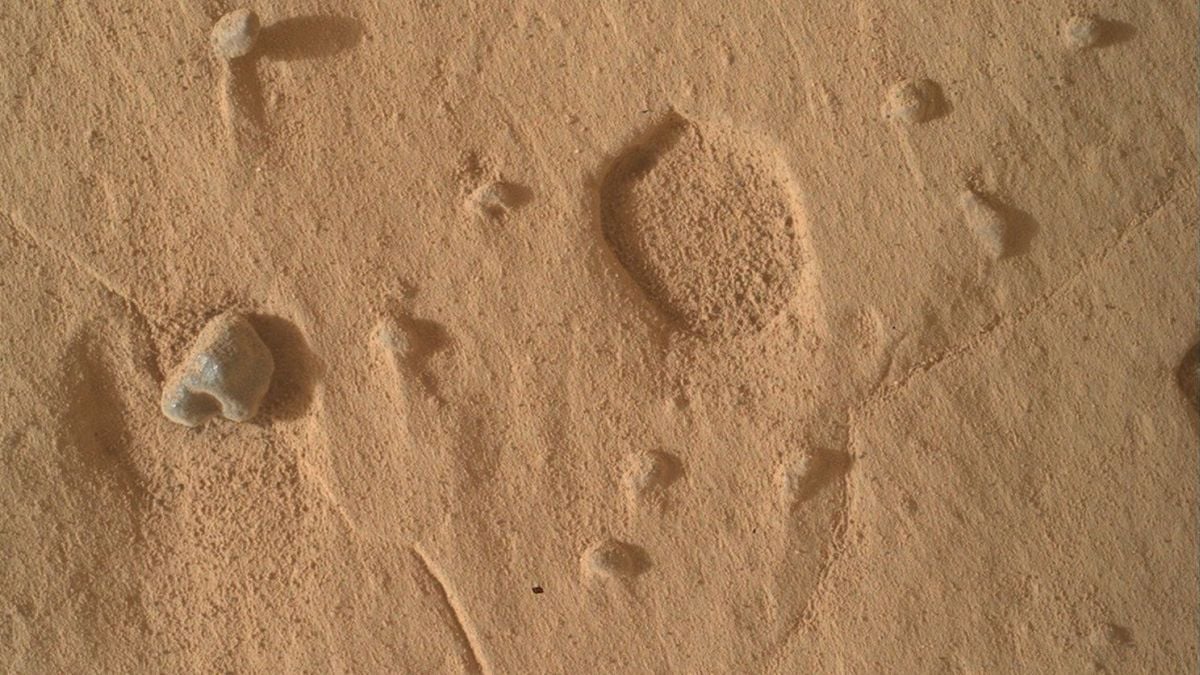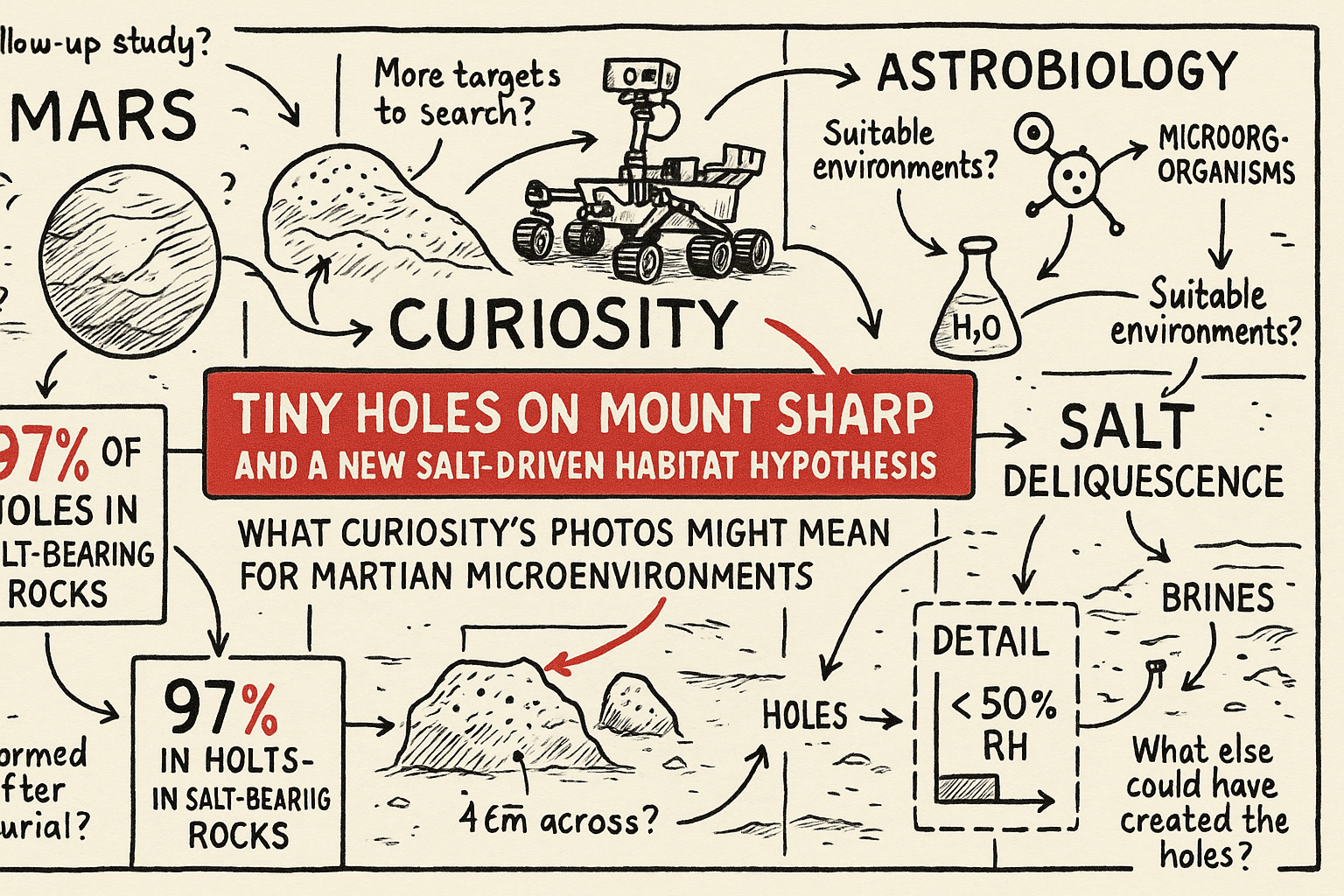
In August 2026 NASA's Curiosity rover photographed unusual tiny, circular holes in rock exposures on Mount Sharp in Gale Crater. The holes drew attention because they are visually distinct from typical sedimentary features and because, as ScienceAlert noted, scientists do not yet have a definitive explanation for what made them.
Those Curiosity images sit alongside a separate line of research that does not directly explain the holes but may offer new context for their potential significance. Two independent outlets covered a recent paper led by Anna Bognar of ELTE Eötvös Loránd University and the Konkoly Observatory describing how salts on Mars could form microenvironments that transiently provide both liquid water and milder temperatures—conditions otherwise rarely coincident on Mars.
What Curiosity saw
Curiosity’s image set includes at least one clear photograph of a small circular depression taken on 19 August 2026, and media coverage highlighted the oddity as a feature that scientists are still trying to understand. Coverage by ScienceAlert emphasized that Curiosity has been exploring Gale Crater for 14 years and continues to encounter surprising minerals and textures, and that many oddities eventually receive geologic explanations—but these particular holes remain enigmatic.
The salt microhabitat hypothesis
Separately, the new paper reported in Phys.org and Universe Today explores how salts might help resolve a long-standing ‘Catch-22’ for life on Mars: liquid water tends to appear when temperatures are far too cold for metabolism, while daytime temperatures that could support metabolism coincide with extremely low relative humidity that removes liquid water.
Bognar and colleagues describe a process in which salts on the Martian surface absorb atmospheric water vapor by deliquescence during the cold, humid nights. The salts can trap water as brines. During the warmer daytime, those salt-bearing microcrevices can modestly retain heat and moisture, potentially creating miniature “greenhouse-like” niches where both liquid water and more temperate conditions briefly overlap. Coverage summarized the core idea: salts can take up water vapor at night, and a small geometrical or material refuge around salt crystals could keep moisture and heat together long enough to alter local conditions.
Why these threads matter together
Neither the Curiosity images nor the salt-microhabitat paper directly proves a biological connection, and none of the sources claim that the tiny Mount Sharp holes are inhabited or caused by life. But juxtaposing the two lines of evidence—unexplained small-scale depressions imaged in situ and laboratory/observational work showing how salts can create transient habitable microenvironments—helps refine where scientists might look for processes that concentrate water and moderate temperature on Mars.
The salt hypothesis also underscores why small-scale surface textures and features deserve careful attention. If salts preferentially accumulate in tiny crevices or along grain boundaries, those locations could be where deliquescent brines form and where thermal buffering is most effective. That makes poorly understood microfeatures like the Mount Sharp holes interesting targets for follow-up analysis, even if the holes ultimately have an abiotic origin.
The cautious path forward
Coverage of both topics stresses caution: Curiosity’s holes remain unexplained, and the salt work is a hypothesis supported by modeling and laboratory reasoning as presented in press reports. As ScienceAlert noted, many Martian oddities are eventually attributable to geological processes. The new salt-microhabitat framework does not identify specific features in Curiosity’s images as salt-created shelters, but it does expand the suite of environmental mechanisms planetary scientists consider when interpreting tiny surface features.
In short, Curiosity’s tiny holes are a fresh observational puzzle, and contemporaneous work on salts offers a plausible mechanism for creating microscale niches where liquid water and workable temperatures briefly coincide—an idea that will shape how scientists prioritize and interpret small-scale Martian surface features going forward.