NASA Curiosity Photographs Unusual Tiny Holes in Gale Crater’s Mount Sharp
NASA's Curiosity rover photographed a set of unusually broad, shallow holes in the sulfate-rich layers of Mount Sharp while traversing Valle Grande, and scientists currently do not have a definitive explanation for how they formed.
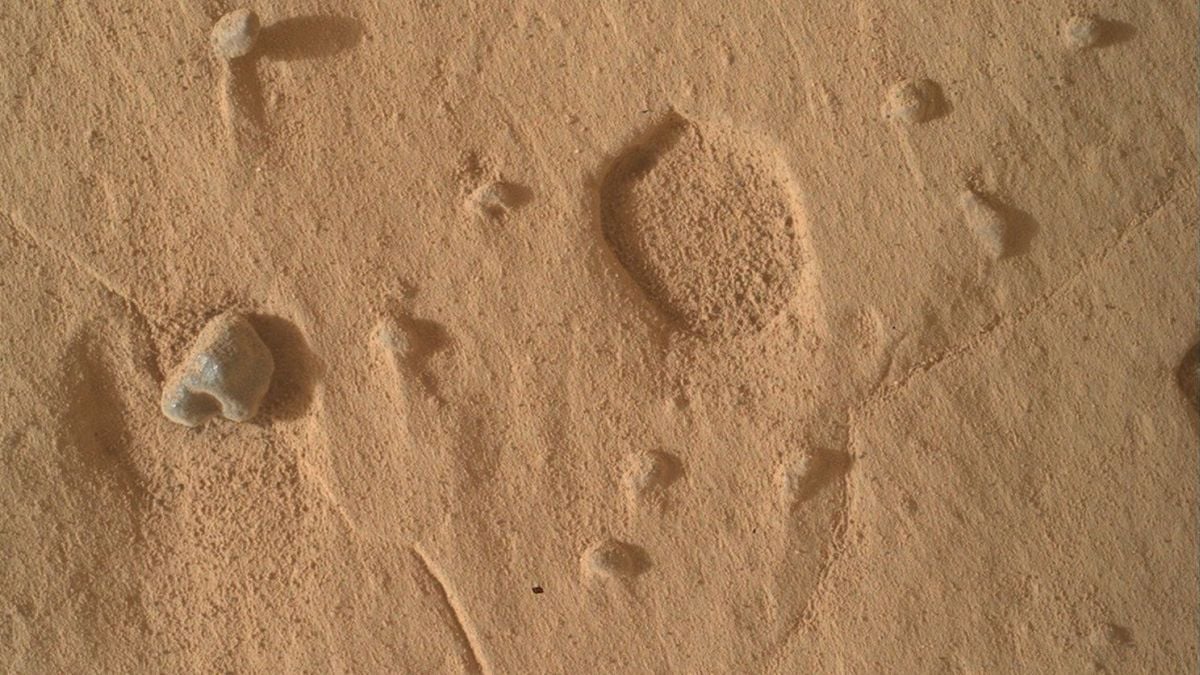
The images were taken as Curiosity climbed through Valle Grande, a broad valley cutting through the sulfate-bearing strata that rise within Gale Crater. One close-up image taken on 19 August 2026 shows a hole measuring about 1 centimetre (0.4 inches) across (NASA/JPL-Caltech/MSSS). The rover used its Mars Hand Lens Imager (MAHLI) for close-range photography and its Mastcam system to acquire overlapping stereo images that can be combined into three-dimensional surface models.
Small pits and pitted ground are familiar sights on Mars, particularly in terrains shaped by impacts and erosion. However, the features Curiosity discovered are distinct: they are unusually broad and shallow compared with typical pits, and there are no obvious pebbles or mineral nodules nearby that might once have occupied those cavities and subsequently weathered out. Those differences led Curiosity's science team to photograph the features more closely and to build stereo-derived 3D models to measure the pits' shapes and depths for clues to their origin.
Curiosity has been operating in Gale Crater for 14 years, investigating Mount Sharp's layered rocks to reconstruct the basin's environmental history. Earlier in 2026 the rover left behind an area of "boxwork" terrain — described as web-like resistant mineralized ridges interpreted as products of ancient groundwater activity — and has been ascending into the layered sulfate rocks above that feature. The new pits were found in what the mission describes as relatively fresh territory along Curiosity's current route through Mount Sharp.
Standard explanations for small cavities in bedrock on Mars include differential erosion around pebbles or mineral nodules embedded in softer host rock; such clasts resist erosion and later weather out, leaving small pits. The holes photographed by Curiosity do not show clear evidence of such former occupants, and their shallow, broad morphology differs from typical erosion pits. Because of these morphological differences and the relative freshness of the surrounding terrain, the science team has flagged the features as unusual and is using MAHLI and Mastcam stereo imaging to obtain measurements that might help discriminate among formation hypotheses.
The use of MAHLI for close-range imaging is a deliberate step: MAHLI can reveal fine-scale textures and grain relationships at centimetre-to-submillimetre scales, while Mastcam stereo pairs can be combined into 3D models that quantify depth, slope and volume. Those measurements are essential for constraining possible formation mechanisms, whether they be a form of weathering, small-scale collapse of a near-surface layer, gas escape features, or another process. At present, the Curiosity team has not published a confirmed interpretation in the public reporting available on these observations.
These observations arrive late in Curiosity's long mission in Gale Crater. Since landing in 2012, the rover has documented diverse mineralogies, sedimentary textures and atmospheric phenomena that have helped reconstruct ancient habitable environments on Mars. The discovery of these small, enigmatic pits underscores that even well-explored terrains can continue to yield geomorphic surprises requiring careful in-situ measurement and analysis.
Maintaining a cautious distinction between observation and interpretation, the mission team is treating hypotheses about the pits' origin as provisional until more data are analyzed. The images and 3D models provide a pathway toward testing ideas about mechanical weathering, diagenetic processes that might create voids, or volatile-driven surface modification. Any proposed mechanism must account for the pits' breadth, shallowness and the absence of clear former clast material at the sites.
Looking forward, Curiosity's ongoing traverse through Mount Sharp and continued acquisition of MAHLI and Mastcam imaging will allow the team to compare these pits with nearby rock textures and stratigraphic relationships. Those comparisons should help place the features in the broader context of the sulfate-rich layers that overlie the boxwork terrain and refine models of near-surface processes on ancient Mars. For now, the tiny holes remain an open question recorded in high-resolution images from a rover that continues to add unexpected detail to our picture of Gale Crater.
Image credit: NASA/JPL-Caltech/MSSS