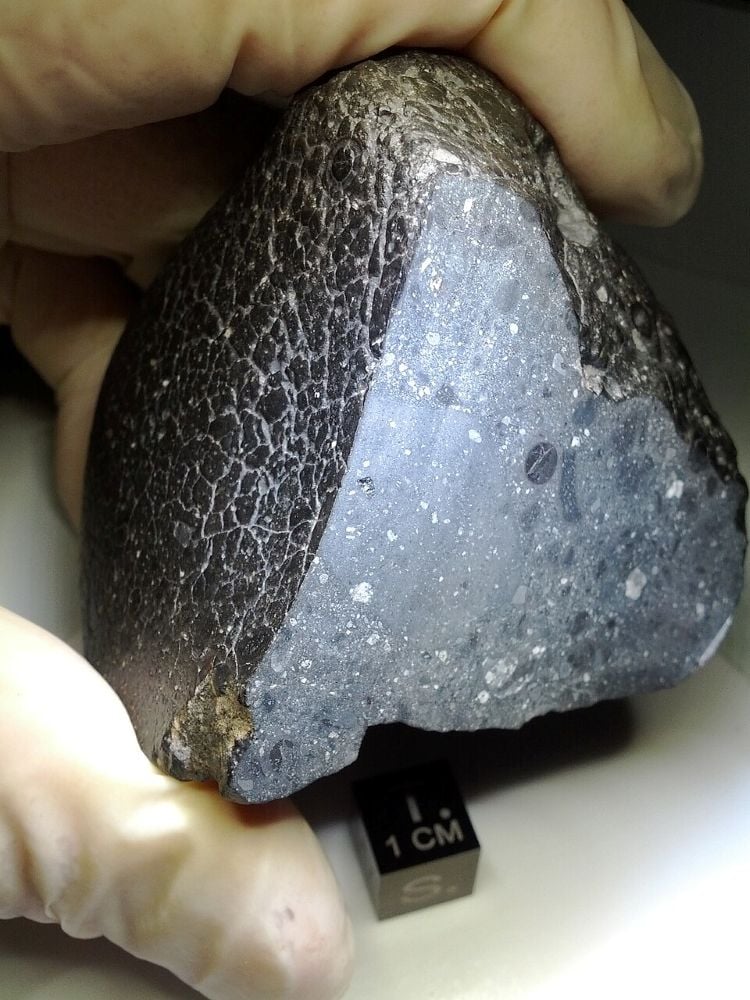
In a groundbreaking study, an international team of scientists has provided compelling evidence about Mars's ancient watery past by examining a unique meteorite known as Northwest Africa 7034, or Black Beauty. This meteorite, estimated to be around 4.4 to 4.5 billion years old, is the only known sample that originated from the Martian crust, offering a rare glimpse into the Red Planet's geological history.
Black Beauty's journey to Earth began with a colossal impact event on Mars that sent fragments of its crust hurtling into space, eventually landing on our planet. The meteorite has since become a valuable asset in understanding the history of water on Mars, a topic of intense interest given the implications for past habitability and the potential for life.
The study, published in the Geophysical Research Letters, involved a collaborative effort led by researchers from the Technical University of Denmark. They employed advanced analytical techniques, including X-ray and neutron tomography, to uncover the presence of hydrous materials in the meteorite. These techniques allowed the team to identify and visualize macroscopic hydrogen deposits within Black Beauty, a breakthrough in the study of Martian meteorites.
X-ray tomography was used to examine the densest parts of the meteorite, focusing on iron and silicon components. Meanwhile, neutron tomography, which is particularly sensitive to hydrogen, revealed that areas previously perceived as voids by X-rays were, in fact, rich in hydrous materials. Dr. David Mannes of the Paul Scherrer Institute (PSI), a co-author of the study, highlighted the significance of these findings. The combination of X-ray and neutron tomography not only detected tiny hydrated minerals but also visualized larger hydrogen deposits for the first time.
These findings suggest that early Mars harbored a substantial water reservoir that interacted with the planet's surface and crust. This interaction led to the incorporation of water into crustal rocks, such as those that became Black Beauty. The presence of similar materials has also been detected by NASA's Perseverance rover in the Jezero Crater, reinforcing the hypothesis of a wetter and warmer ancient Mars.
The implications of this research extend beyond understanding Mars's past climate. They offer insights into the planet's potential for habitability billions of years ago when conditions may have been conducive to life. While current missions, such as the Perseverance rover, continue to explore Martian terrain for signs of ancient life, meteorites like Black Beauty provide crucial data that complement these efforts.
The study of Martian meteorites has been a focal point of planetary science due to the challenges of obtaining direct samples from Mars itself. These meteorites serve as natural probes of the Martian crust, offering information about the planet's composition, geological processes, and, now, its hydrological history.
Looking to the future, the study of Black Beauty and other meteorites will likely continue to yield insights into Mars's evolution. As technology advances, new analytical methods may uncover additional details about the planet's past, helping scientists piece together the complex history of water on Mars and its implications for the potential habitability of other planets in our solar system.
In conclusion, the research on Black Beauty not only enhances our understanding of Mars's ancient environment but also underscores the importance of meteorites as key tools in planetary exploration. As scientists continue to unravel the mysteries of the Red Planet, each discovery brings us closer to answering fundamental questions about the history of water and life in our solar system.