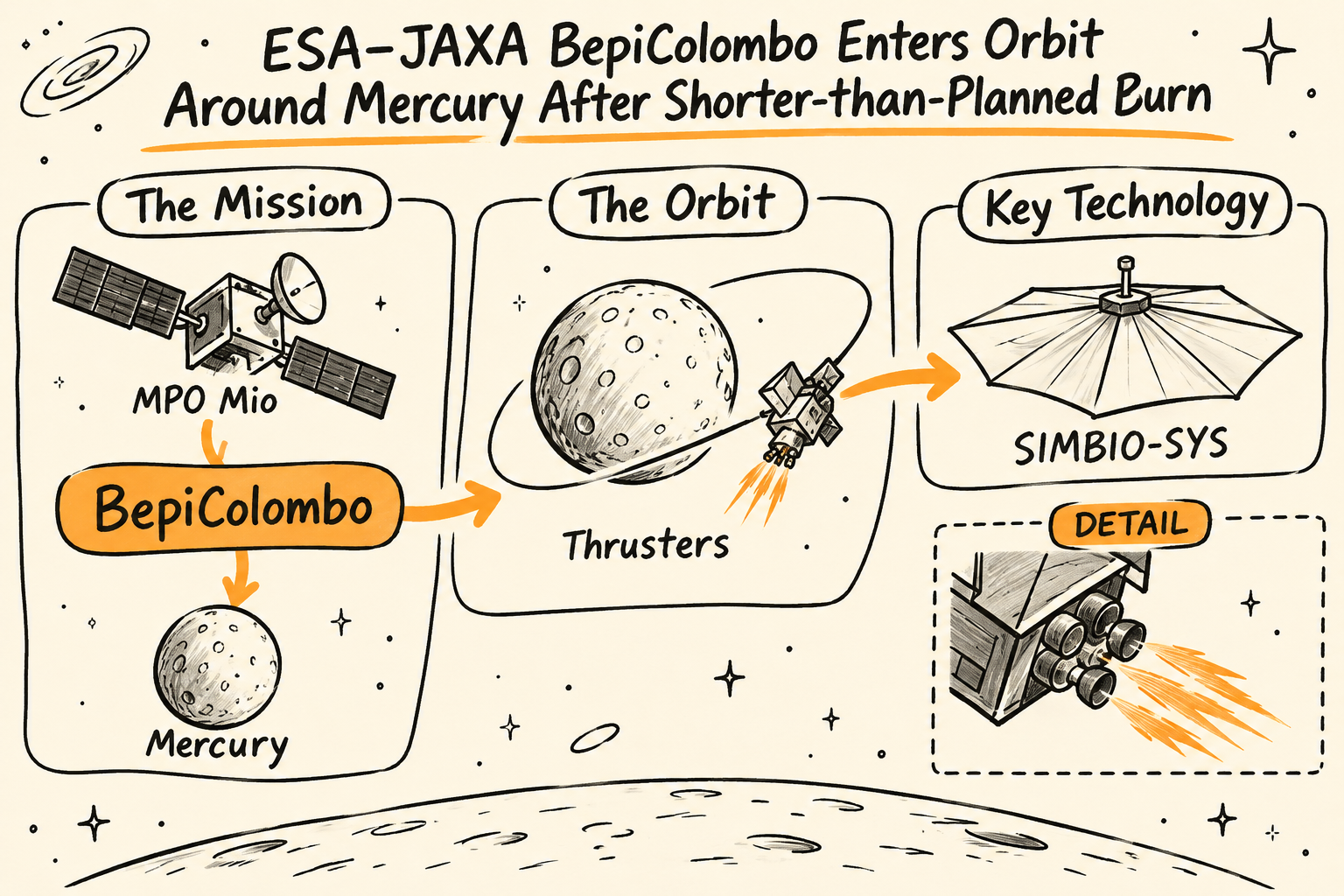
ESA and JAXA’s BepiColombo enters Mercury orbit despite software glitch
The European Space Agency (ESA) and the Japan Aerospace Exploration Agency’s (JAXA) BepiColombo mission achieved orbital capture at Mercury on 21 November 2026 after a 37-minute chemical thruster burn that was shorter than planned due to a software issue.
The insertion sequence began at 19:24 Central European Time (CET) on 21 November, when the four chemical thrusters of ESA’s Mercury Planetary Orbiter (MPO) fired as the stacked spacecraft passed about 635 kilometres above Mercury’s surface. Communications with Earth were intentionally lost during the manoeuvre; ESA confirmed reception of the spacecraft’s signal at 01:02–03:02 CET on 22 November after teams at ESA’s European Space Operations Centre (ESOC) assessed telemetry.
Mission controllers found that the burn had delivered roughly 77% of the intended delta-v, producing an orbit with about a 75-hour period instead of the planned 58-hour orbit. According to ESA and reporting by mission teams and industry partners, the reduced burn resulted from a software anomaly affecting the spacecraft’s orientation and thruster control. Ignacio Tanco, ESA’s BepiColombo flight operations director, described the moment teams discovered the spacecraft in safe mode as "like flipping a switch," and investigators from ESA and manufacturer Airbus traced the anomaly to software affecting attitude and thruster commands. The agencies say investigations are ongoing.
Despite the shorter burn, BepiColombo lost sufficient kinetic energy to be captured by Mercury’s gravity. Flight dynamics confirmed orbital capture without the need for additional thruster burns, and teams have adjusted the mission timeline and planned manoeuvres to accommodate the new orbit geometry.
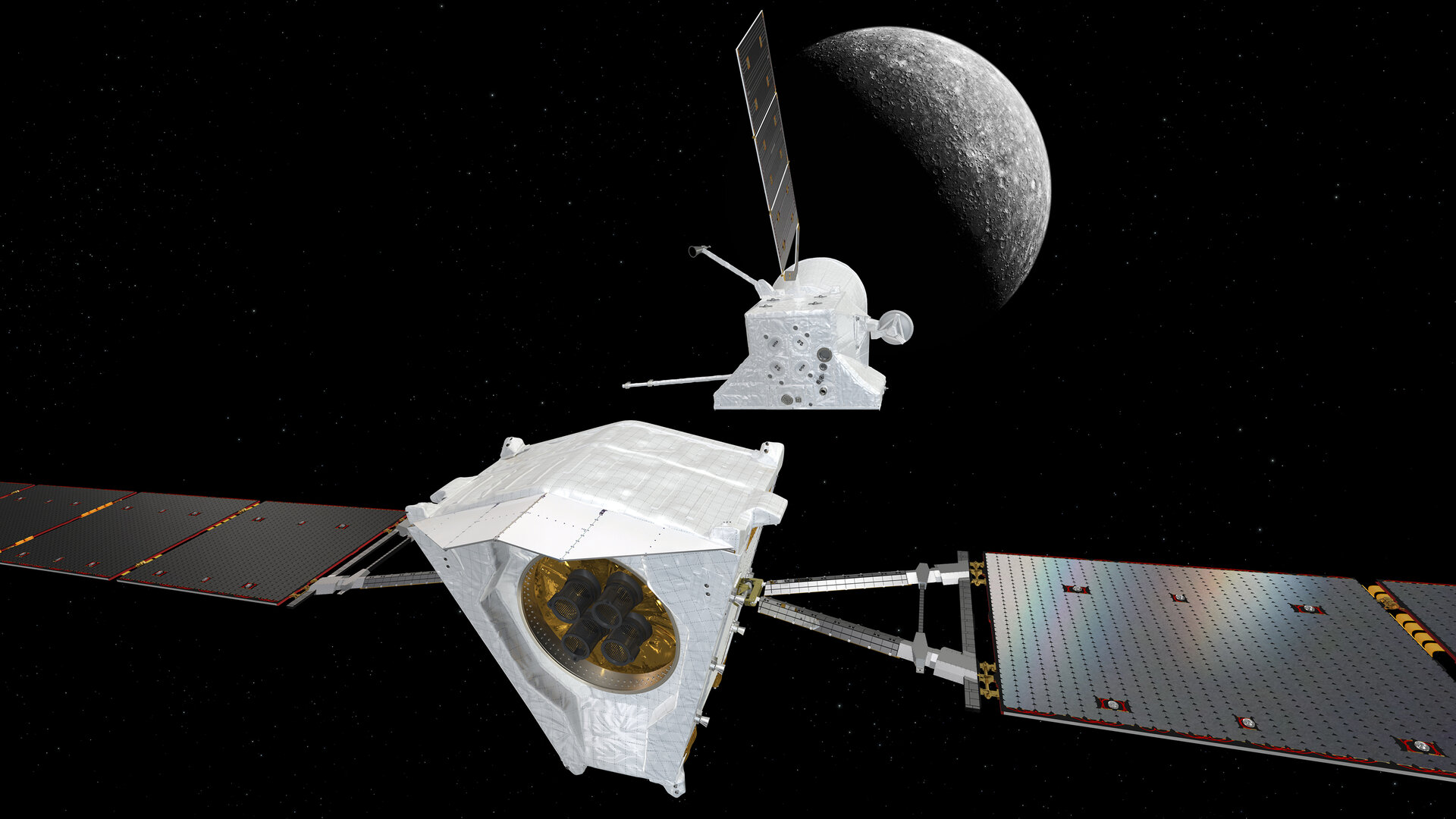
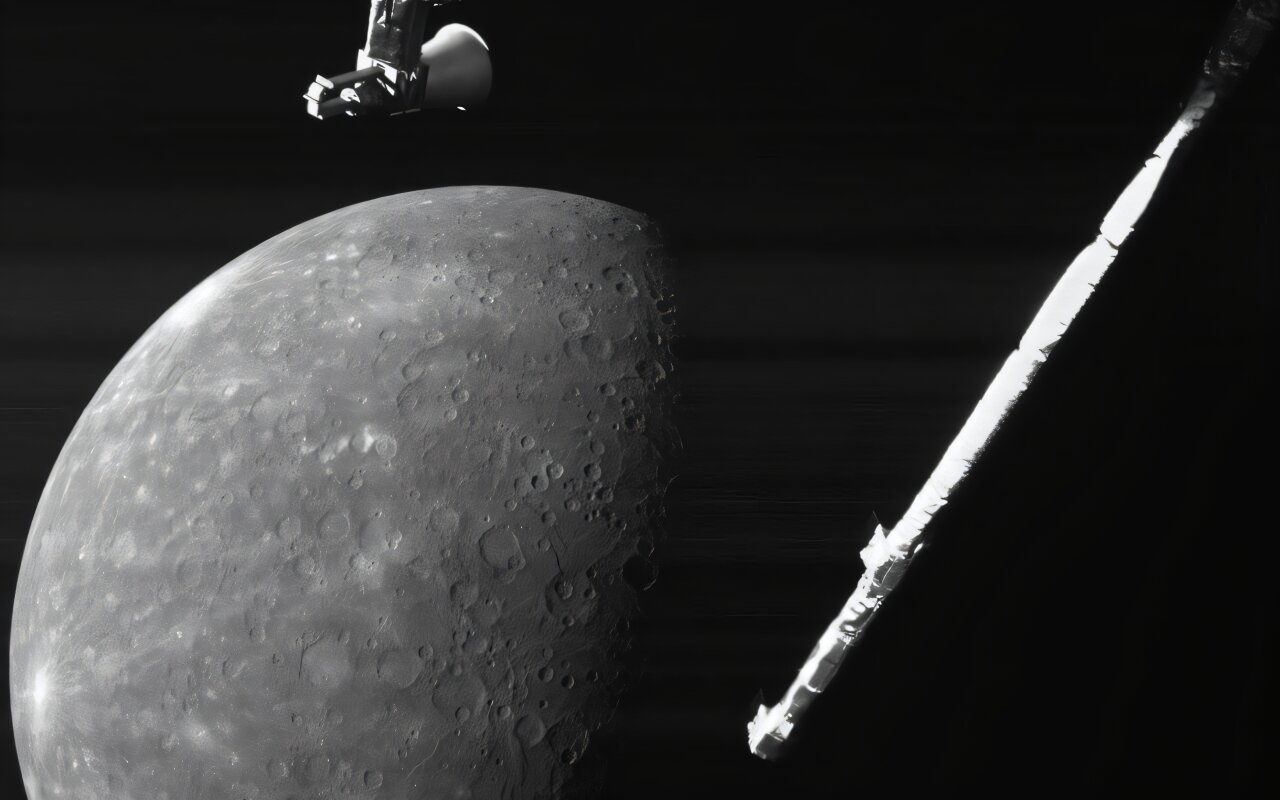
BepiColombo launched on 20 October 2018 aboard an Ariane 5 and reached Mercury after more than eight years and nine gravity-assist flybys — one at Earth, two at Venus and six at Mercury — and a transfer phase during which the Mercury Transfer Module (MTM) provided electric propulsion. The MTM separated on 3 September 2026, leaving the two science orbiters stacked for the orbital-insertion manoeuvre.
The two orbiters remain attached: ESA’s MPO and JAXA’s Mercury Magnetospheric Orbiter (MMO), called Mio, protected by a sunshield. Separation is scheduled for 9–10 December, with Mio entering a wider orbit to study Mercury’s magnetosphere and the MPO planning to remove the sunshield on 16 December. Both spacecraft will then perform further manoeuvres to reach their operational configurations; ESA expects primary science operations for both spacecraft to begin in April 2027.
MPO carries instruments including the SIMBIO-SYS imaging and spectrometry system developed with contributions from the Italian Space Agency (ASI), CNES, INAF and industry partner Leonardo. SIMBIO-SYS has already been tested in its final configuration and will map Mercury’s surface and composition, study its interior and investigate its tenuous exosphere. Mio will focus on Mercury’s magnetosphere and its interaction with the solar wind. Together the twin orbiters aim to address questions such as why Mercury’s core is unusually large, how it sustains a magnetic field, and how water ice persists in permanently shadowed polar craters.
Mission teams emphasise that the software anomaly did not prevent orbital capture and that the spacecraft are safe while engineers continue to analyse telemetry and refine plans for the coming separation and commissioning activities.