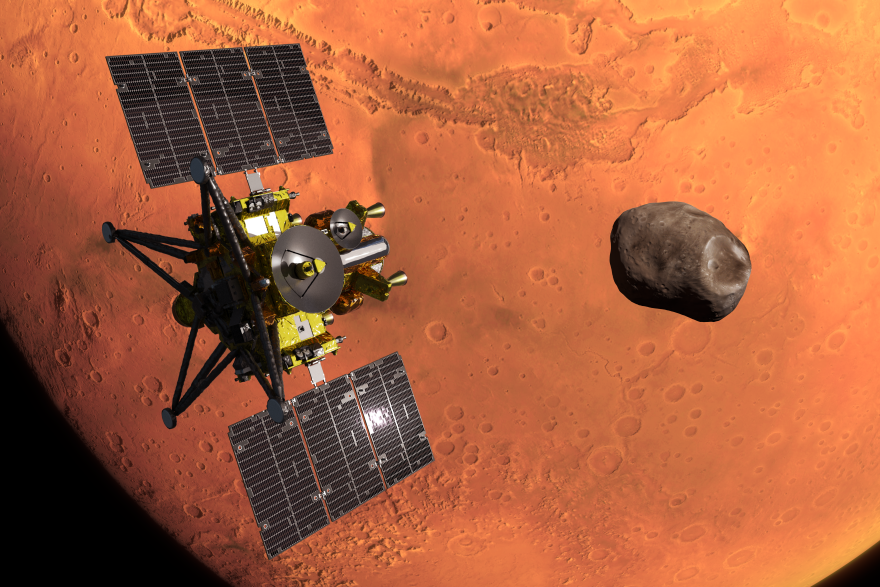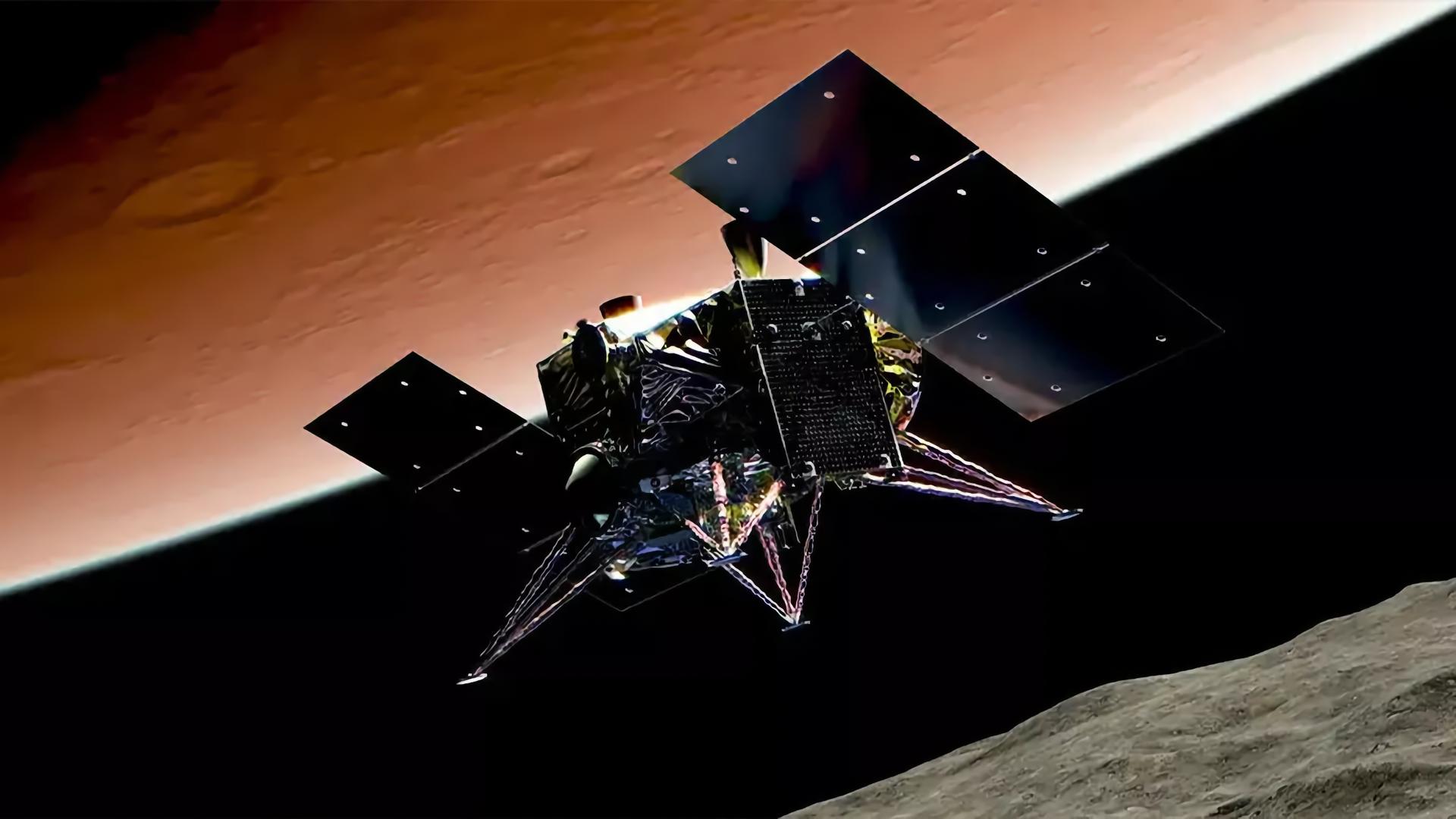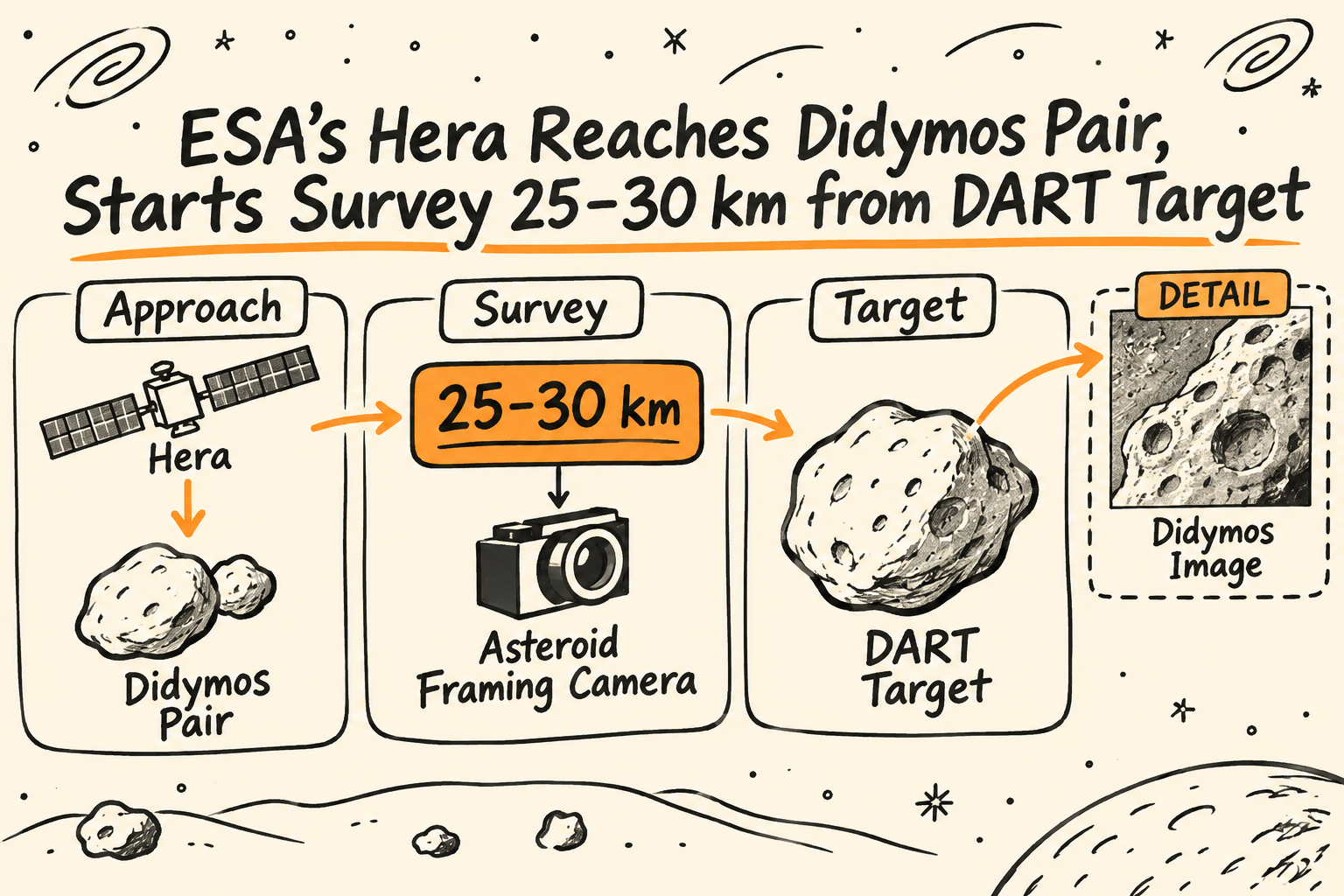
ESA's Hera spacecraft has reached the Didymos binary asteroid system and begun its first scientific observations of the site where NASA's DART spacecraft struck the moonlet Dimorphos four years ago. ESA says the car-sized probe is in an "early characterization phase" about 25–30 kilometres from the pair. It has returned its first images, which show Didymos in new detail while Dimorphos remains largely hidden in shadow.
As NovΔ mAInd reported ahead of the arrival, Hera launched from Cape Canaveral on 7 October 2024. It then flew past Mars in spring 2025 and had to shed a few hundred metres per second of velocity relative to the asteroids. The first braking burn, BRM-1, ran its three Orbit Control Thrusters continuously for 93 minutes.
What the first images show
The monochrome Asteroid Framing Camera took an image of Didymos from about 28.5 km, resolving features down to roughly 2.7 metres per pixel. It shows the "spinning-top" shape of the 780-metre asteroid, along with boulders, craters and what mission scientists describe as grooves or ridges not visible before. Didymos completes a rotation every 2.2 hours, fast enough to pull boulders and gravel toward its middle and build up the equatorial bulge. "The first thing we said was, 'Wow,'" said Hera Principal Investigator Patrick Michel (CNRS / Observatoire de la Côte d'Azur) in ESA's statement.
Hera carries three main imaging systems. The Asteroid Framing Cameras handle black-and-white imaging and navigation. The HyperScout H imager records 25 colour bands, and its light absorption and reflection patterns work as remote spectroscopy. Scientists will compare these with laboratory measurements of meteorite samples to determine what the two bodies are made of.
The Thermal Infrared Imager (TIRI), supplied by Japan's JAXA, maps surface temperature. ESA's press release likened it to "Superman-like" heat vision. Solid rock dissipates heat much more slowly than porous or fragmented rock, so TIRI data should indicate how solid Didymos is. In visible light Dimorphos is tucked almost entirely into Didymos' shadow, appearing in one frame only as a tiny sunlit speck. In the TIRI view, the whole 151-metre moonlet is in focus, glowing a cool purple in the infrared.
The open question behind DART's 33 minutes
DART hit Dimorphos on 26 September 2022. The 580-kilogram spacecraft struck at about 6.1 km/s, more than 22,000 km/h, and threw out a debris cloud that spread across 10,000 kilometres. Ground-based telescopes showed that the impact shortened Dimorphos' orbit around Didymos by about 33 minutes. Some scientists were surprised by the size of the change, which was much larger than pre-mission simulations had predicted.
Because DART was a one-way mission, nobody has yet seen how the impact changed the moonlet itself. Researchers do not know whether it excavated a large crater or reshaped the whole body, and they need better figures for Dimorphos' mass, composition and internal structure. "Our aim right now is to gather the big-picture findings of relevance to supporting the mission's planetary defense goals," said mission scientist Michael Kueppers. "Previous predictions by our impact models suggested many different ways the asteroid body might react, but Hera will reveal which forecast was the correct one - if any!" These measurements are meant to turn kinetic impact into a technique whose results can be predicted for other asteroids.
Flying in near-zero gravity
Didymos' gravity is about 40,000 times weaker than Earth's, and Dimorphos' about 200,000 times weaker, so a conventional circular orbit is impractical. Hera instead moves around the pair's shared centre of gravity at about 12 centimetres per second, roughly an insect's quick crawl. It flies nearly straight paths and fires its thrusters at alternating three- and four-day intervals, turning 90 degrees each time. The result is a series of "rectangular orbits" that keep it 25–30 km away.
The approach builds on experience from ESA's Rosetta comet mission. It is also fail-safe: if a planned firing fails, Hera drifts away from the asteroids rather than toward them. Each correction needs very little propellant.
The mission is run from ESA's ESOC control centre in Darmstadt, Germany. Despite a distance of about 196.5 million kilometres, controllers keep contact for roughly eight hours a day through four 35-metre Deep Space Antennas in Argentina, Spain and Australia. ESA's Flight Dynamics team uses Hera's data to calculate its position relative to the asteroids and to plan each move.
Next: bowtie trajectories, CubeSats and a Berlin release
Hera is expected to begin a "detailed characterization phase" that brings it significantly closer, starting at about 20 km. It will switch from rectangular paths to hyperbolic, bowtie-shaped trajectories. Later it will release two shoebox-sized CubeSats, Juventus and Milan. They will use ground-penetrating radar and touch down on Dimorphos to study what it is made of.
The next major image release, with sharper views, is planned for a live event at the Berlin Museum of Natural History on 25 November.