ESA and JAXA Ramses spacecraft powered on for first integrated test at OHB Italia
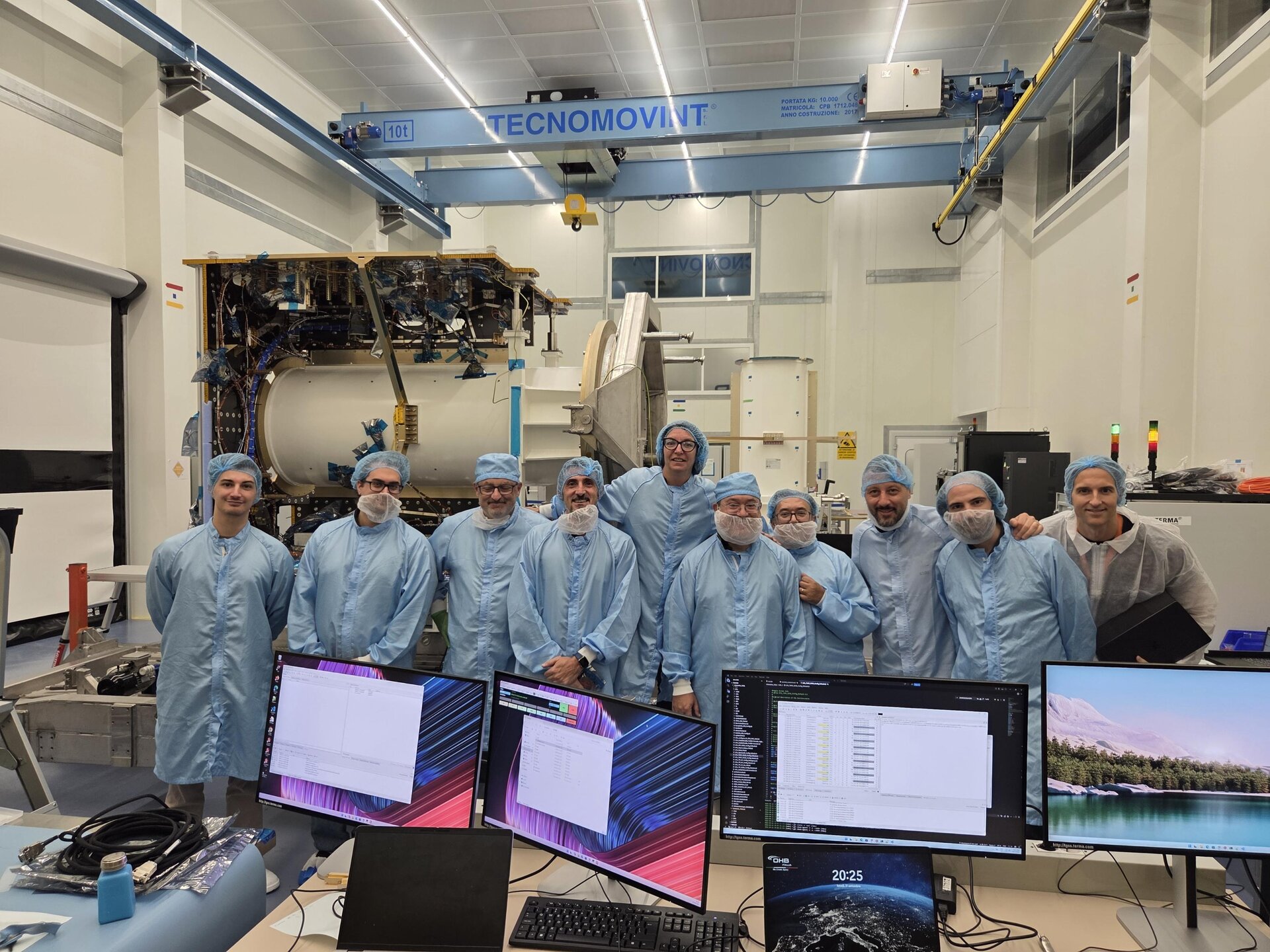
On 23 September 2026 the European Space Agency’s and Japan Aerospace Exploration Agency’s Ramses planetary defence spacecraft was switched on for the first time inside the Milan cleanroom of prime contractor OHB Italia, marking the start of full-scale integrated system testing ahead of a time-critical development schedule.
The switch-on powered the spacecraft’s On-Board Computer together with integrated subsystems mounted in the Ramses Core Module, enabling commands to be sent to each subsystem to verify their performance as a single, connected system. According to Ramses lead engineer Ingo Gerth, this was the first occasion that units previously tested individually were operated in unison inside the spacecraft body.
Units that were powered and checked during this milestone include the Mass Memory Unit for data storage, the Power Conditioning and Distribution Unit that delivers power throughout the spacecraft, and multiple Remote Terminal Units that convert outputs from instruments into digital data for the computer. Installation of these units and the connecting spacecraft harness was performed by OHB Italia teams in Milan.
Ramses project staff framed the event as the transition from design and simulation to a tangible spacecraft. Ramses functional architect Arnaud Bourdoux said the switch-on was “a very exciting moment,” noting these are the same system-critical units that will be powered on at the launch pad. Guiseppe Filomeno, Ramses project manager at OHB Italia, described the test as an important milestone providing “the first tangible confirmation that the integrated systems are working together as intended.” ESA’s Ramses project manager Paolo Martino added that the moment marked a new phase for the project, moving beyond paper calculations, simulations and unit tests to work with an actual spacecraft ready for integrated testing.
Ramses has a constrained development timeline: the spacecraft must reach space by spring 2028 to rendezvous with the cruise-liner-sized asteroid Apophis when it passes Earth on Friday 13 April 2029. The ESA statement highlights that the schedule represents less than three and a half years from contract signing to lift-off, underscoring the time-critical nature of completing assembly, testing and qualification.
The Core Module that was the focus of the switch-on contains Ramses’s main electronics and has a U-shaped structural body into which key units and the spacecraft harness have been fitted. The integrated functional test performed in Milan is the precursor to the mission’s full-scale integrated system testing phase; successful completion of these tests is necessary before environmental qualification, shipping to a launch provider and final integration with the launcher.
Planetary defence missions demand coordinated engineering and rapid progress when rendezvous windows are fixed by celestial mechanics. The Ramses mission is being implemented by ESA in cooperation with JAXA and built under contract by OHB Italia. The combined agencies are preparing to study Apophis during its unusually close Earth approach in April 2029; the asteroid’s encounter presents both scientific opportunity and a rare chance to exercise planetary defence observational capabilities.
Although the public announcement focuses on the electrical switch-on and integrated verification, that step forms part of a broader sequence: unit-level testing, system integration and functional checks now give way to more demanding environmental tests (thermal vacuum, vibration) that will demonstrate the spacecraft can survive launch and space conditions. Only after those environmental qualifications are passed can Ramses proceed to final launch preparations.
Because the spacecraft must be launched by spring 2028 to meet Apophis in April 2029, the schedule leaves limited margin for delays. The Milan switch-on therefore represents a visible sign that assembly and software integration engineering are proceeding on the planned timeline. If integrated testing and subsequent qualification phases proceed without major setbacks, Ramses will continue toward launch readiness within the required timeframe.
Looking beyond the immediate schedule, Ramses exemplifies international cooperation on planetary defence, combining ESA and JAXA scientific and engineering resources with industry partners such as OHB Italia to execute a mission driven by a fixed and unavoidable celestial rendezvous date. The coming months will determine whether the program stays on track through environmental qualification, spacecraft-level testing and delivery to the launch provider in time for the spring 2028 window.