BepiColombo begins its Mercury Arrival Phase
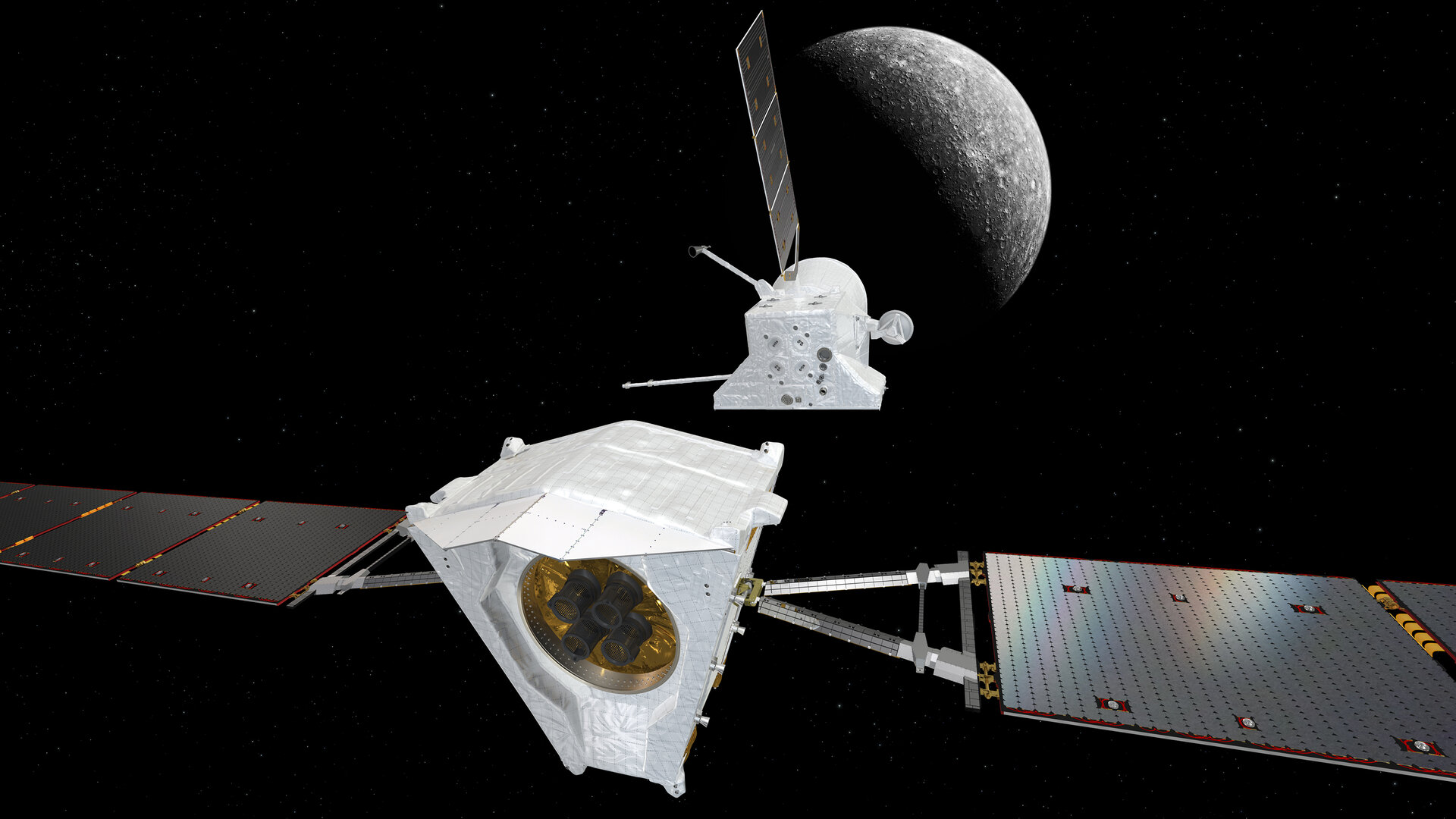
After eight years of travelling together as one stacked spacecraft, ESA and JAXA’s BepiColombo mission is about to enter its Mercury Arrival Phase. The European Space Agency (ESA) will livestream a critical early milestone on 3 September 2026, when the Mercury Transfer Module (MTM) separates from BepiColombo’s two science orbiters.
The separation is scheduled as part of a tightly choreographed sequence carried out by mission control at ESA’s European Space Operations Centre (ESOC) in Darmstadt, Germany. ESA describes this arrival as "one of the most demanding operational sequences ever carried out by ESA." The agency will broadcast the event live from ESOC, with the livestream programme starting at 13:45 CEST on 3 September and the planned MTM separation at 14:00 CEST.
The livestream schedule published by ESA lists several time markers for the day (all times in CEST and subject to change):
13:45 – Start of ESA livestream programme, streaming from ESA’s European Space Operations Centre (ESOC) in Darmstadt, Germany
14:00 – MTM separation
14:30 – One-hour break in livestream
15:30 – Livestream resumes
15:53 – Earliest expected acquisition of sign
Following separation, teams on Earth will listen for BepiColombo’s post separation acquisition of signal and carry out the first checks to confirm the spacecraft is healthy and that the operation has gone to plan. ESA will present live views from the Main Control Room while the Mission Control Team conducts the separation operations; co-hosts and experts from ESA and JAXA will provide behind-the-scenes insights and analysis during the broadcast.
MTM has provided the propulsion that powered the combined spacecraft on its interplanetary journey. Separation on 3 September is only the first step in a multi-month arrival campaign. According to ESA, in November the Mercury Planetary Orbiter (MPO), built by ESA, and JAXA’s Mercury Magnetospheric Orbiter (Mio) will enter orbit around Mercury together. The two orbiters are then planned to separate from each other in December 2026. Science operations for the mission are scheduled to begin in April 2027.
The sequence highlights the particular difficulty of reaching and operating at Mercury. As ESA notes, "Getting to Mercury is hard. Arriving there is even harder." The mission’s timeline underscores how arrival at the innermost planet requires a carefully staged set of maneuvers and an extended period of monitoring and checkouts after the initial separation.
For the public and the scientific community the separation marks a transition from cruise to arrival operations. The livestream will be available on ESA's YouTube channel and other ESA platforms, enabling people to follow the milestone and hear expert commentary as teams perform the manoeuvres and begin the post-separation verification phase.
Operationally, the coming months will be decisive: teams must confirm the health of both orbiters after separation, prepare and execute the orbit insertion steps in November, and manage the subsequent separation between MPO and Mio in December. If these steps proceed as planned, the mission will move into a dedicated science phase beginning in April 2027, when the orbiters will start systematic observations of Mercury.
ESA’s public briefing and livestream emphasise both the technical complexity of the arrival sequence and the careful collaboration between ESA and JAXA. The mission’s phased timeline — separation on 3 September, joint orbit insertion in November, orbiter separation in December, and the start of science operations in April 2027 — is the framework set out by ESA for the next year of operations.
Observers and the wider public can follow the event live from ESOC on 3 September, with ESA’s coverage beginning at 13:45 CEST. The agency has invited viewers to tune in to follow the first step of this demanding arrival campaign as teams on the ground work to deliver two scientific orbiters into Mercury orbit.