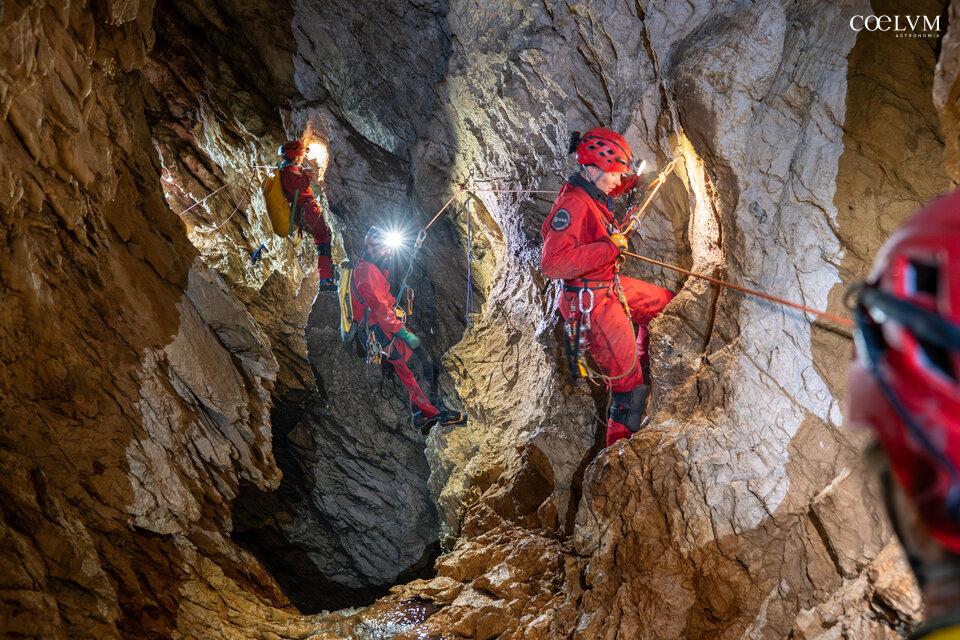
The European Space Agency (ESA) has successfully concluded the latest installment of its CAVES (Cooperative Adventure for Valuing and Exercising human behaviour and performance Skills) program, an intensive training course designed to mimic the challenges faced by astronauts in space. The recent mission took place in the Matese Caves, located in the rugged Apennine Mountains between the regions of Campania and Molise in Italy.
Initiated in 2011, the CAVES program aims to enhance the cooperative skills and performance of astronauts by placing them in environments that simulate aspects of space missions. The subterranean setting provides a unique opportunity for astronauts to experience isolation, limited communication, and the need for meticulous planning and teamwork—conditions analogous to those encountered on space missions.
The latest mission, officially concluded with an ESA announcement on July 1, 2026, involved a diverse group of astronauts from three different space agencies. The team included Rosemary Coogan and John McFall from ESA, Tracy Dyson and Ben Bailey from NASA, and Ayu Yoneda from the Japanese Aerospace Exploration Agency (JAXA). This international collaboration highlights the global nature of modern space exploration efforts and the shared commitment to preparing astronauts for the rigors of space travel.
Throughout their time in the caves, the astronauts engaged in a variety of tasks designed to test their ability to work as a cohesive unit under pressure. These exercises required them to rely on each other's strengths, communicate effectively despite obstacles, and make critical decisions in a timely manner. Such training is crucial for missions in space, where the inability to function as a team could lead to dire consequences.
The Matese Caves provide an ideal environment for this type of training. The natural complexity and the unknowns of cave exploration mirror the unpredictability and challenges of space missions. The caves' restrictive conditions force participants to adapt to low-light environments and navigate through narrow passages, fostering skills that are directly applicable to the spatial awareness required in the low-gravity environments of the International Space Station (ISS) or future missions to the Moon and Mars.
By concluding its eighth mission, the CAVES program continues to evolve as a critical component of astronaut training. Over the years, it has helped to refine the skills necessary for successful long-duration spaceflights. The program's focus on human behavior and performance skills addresses the psychological and social dynamics that are key to mission success.
Looking forward, the insights gained from the CAVES missions are expected to inform not only current missions to the ISS but also future exploratory missions beyond Earth's orbit. As space agencies worldwide prepare for more ambitious projects, such as establishing a sustainable human presence on the Moon and the eventual human exploration of Mars, the importance of comprehensive training programs like CAVES cannot be understated.
The CAVES program exemplifies how terrestrial environments can be utilized to prepare astronauts for extraterrestrial challenges. It underscores the necessity of international collaboration in the pursuit of advancing human space exploration. The continued success of such training initiatives will be critical as space agencies push the boundaries of what is possible in human spaceflight.