Overview
Over the past fortnight a string of observations — led by the James Webb Space Telescope (JWST) and complemented by X‑ray, optical and ground‑based facilities — has sharpened and in some cases overturned our picture of how stars die, merge and seed planetary systems. What links high‑resolution mid‑infrared images of the Cassiopeia A supernova remnant, the first detection of ice in the Beta Pictoris system, the forensic mapping of chaotic supernova ejecta, the identification of a stellar merger in Andromeda, and the reclassification of supernova impostors is not a single object but a single theme: stellar interiors and interactions are messier, faster and more consequential for planet formation than classical models have allowed.
Cas A and the hourglass of a dying massive star
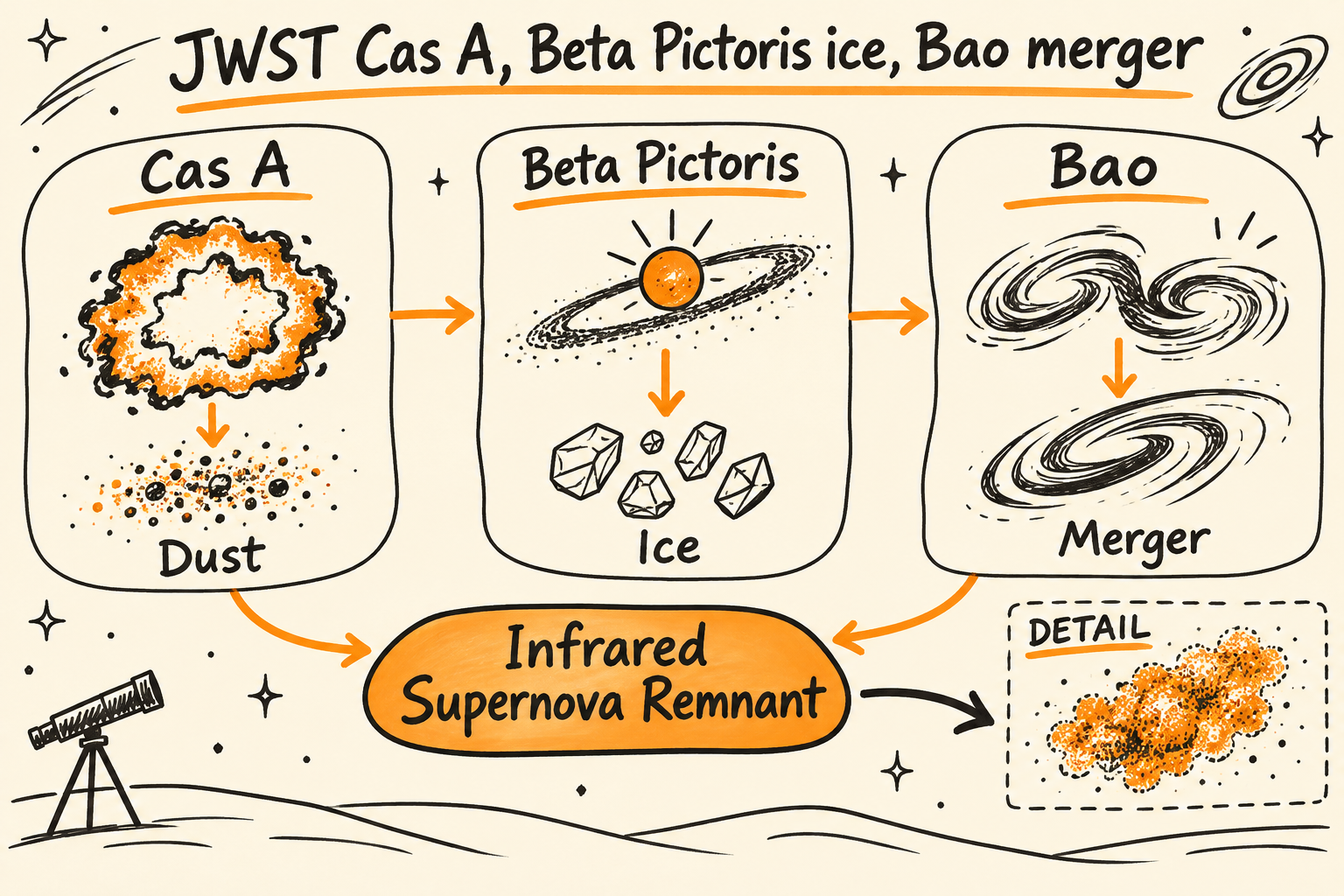
JWST’s new mid‑infrared views of Cassiopeia A (Cas A) show fine-grained hot dust and element‑stratified structures that suggest layers inside the progenitor star mixed and even merged just hours before core collapse. Historically, models treated the late burning phases of massive stars as quasi‑stable and layered like an onion. The Webb data — alongside Chandra X‑ray mappings and detailed spectral decompositions — indicate instead that convective instabilities and wave‑driven mixing can violently redistribute material in the final hours, changing the explosion’s nucleosynthetic yield and the dust composition expelled into the interstellar medium.
That finding reframes two long‑standing issues. First, it helps explain observed chemical oddities in some supernova remnants — the wrong abundance ratios and clumpy distributions of iron, silicon and oxygen. Second, it raises the possibility that the amount and grain size of dust surviving the blast — critical inputs into models of early galaxy evolution and planet formation — depend sensitively on chaotic pre‑explosion dynamics rather than only on explosion energy.
Forensics: from chaotic ejecta to ‘supernova impostors’
Work led by teams using JWST and Chandra highlights the power of multiwavelength forensics. Where optical light shows a bright, transient event, X‑rays and infrared can untangle whether a star truly exploded or simply flared. Chandra’s study of luminous blue variable (LBV) outbursts — some previously labelled “supernova impostors” — has found compelling evidence that periodic eruptions can be driven by binary interactions with a compact object. That mechanism explains outburst timing and energetics without requiring terminal explosion.
Combined with Webb’s ability to peer into dusty ejecta, this means some fraction of bright transients catalogued as exotic deaths are in fact non‑terminal interactions. Correctly classifying them changes the census of which stars contribute heavy elements and dust to the galaxy and which merely pump enriched material into circumstellar space on repeat visits.
Beta Pictoris: dirty ice, frequent collisions and a fresher origin story
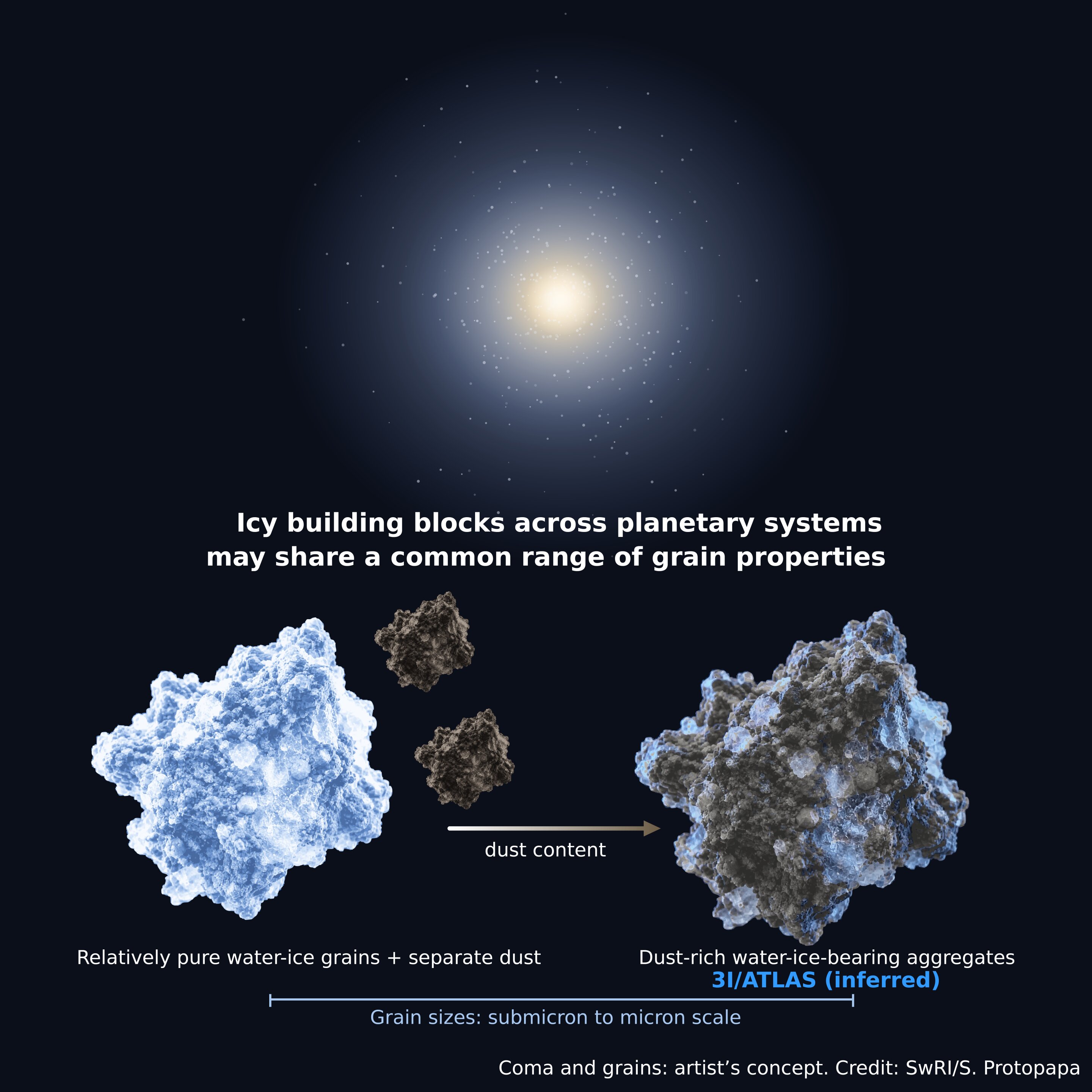
Perhaps most surprising for planetary scientists is JWST’s direct detection of noncrystalline, carbon dioxide‑mixed ice in the Beta Pictoris debris system. Beta Pic is a young, edge‑on star famed for its planet and warps in its dust disk. The ice being “dirty” — mixed with refractories and CO2 — and largely non‑crystalline indicates rapid, energetic collisions among comets and planetesimals that prevent slow, orderly annealing. This picture implies a chaotic epoch of late accretion and grain processing that can both deliver volatiles to forming terrestrial worlds and produce the kind of complex organics that seed prebiotic chemistry.
The Bao merger: a small star spirals into a supergiant
Adding to the theme of messy stellar interactions, astronomers have identified a first‑of‑its‑kind merger in Andromeda where a sun‑like star appears to have been absorbed by a puffy supergiant, producing a rejuvenated object nicknamed Bao. Such events are rare but consequential: they can spin up and chemically pollute the envelope of the larger star, alter subsequent mass‑loss and explosion prospects, and produce transient luminous events that might otherwise be misread as exotic supernovae. The rapid follow‑up by Webb and other telescopes demonstrates the value of responsive, multi‑facility campaigns.
Implications and the near future
These studies collectively push astrophysics toward a less tidy, more interactive view of stellar life cycles. For supernova theory, incorporating late‑stage multi‑dimensional mixing will be necessary to predict yields and dust survival with fidelity. For planet formation, the presence of processed, dirty ice in young debris disks suggests volatile delivery is efficient but stochastic, varying from system to system depending on collisional history. For observational strategy, the era of single‑wavelength taxonomy is over: distinguishing true stellar deaths from impostors and mapping internal mixing requires IR, X‑ray and time‑domain optical work in tandem.
Future prospects: upcoming coordinated programs that combine JWST spectroscopy, high‑cadence optical surveys and targeted X‑ray follow‑up are poised to turn these qualitative insights into quantitative rates — how often stars merge, how frequently interiors mix before collapse, and how much dust and ice are injected into nascent planetary systems. Each number will feed back into models spanning galaxy evolution to the habitability potential of exoplanets.
Conclusion
The latest observational cascade shows stars are social, volatile and messy architects of their environments. Integrating these new, cross‑disciplinary constraints will be essential to move from dramatic snapshots to a coherent, predictive theory of how stars and planets co‑evolve.