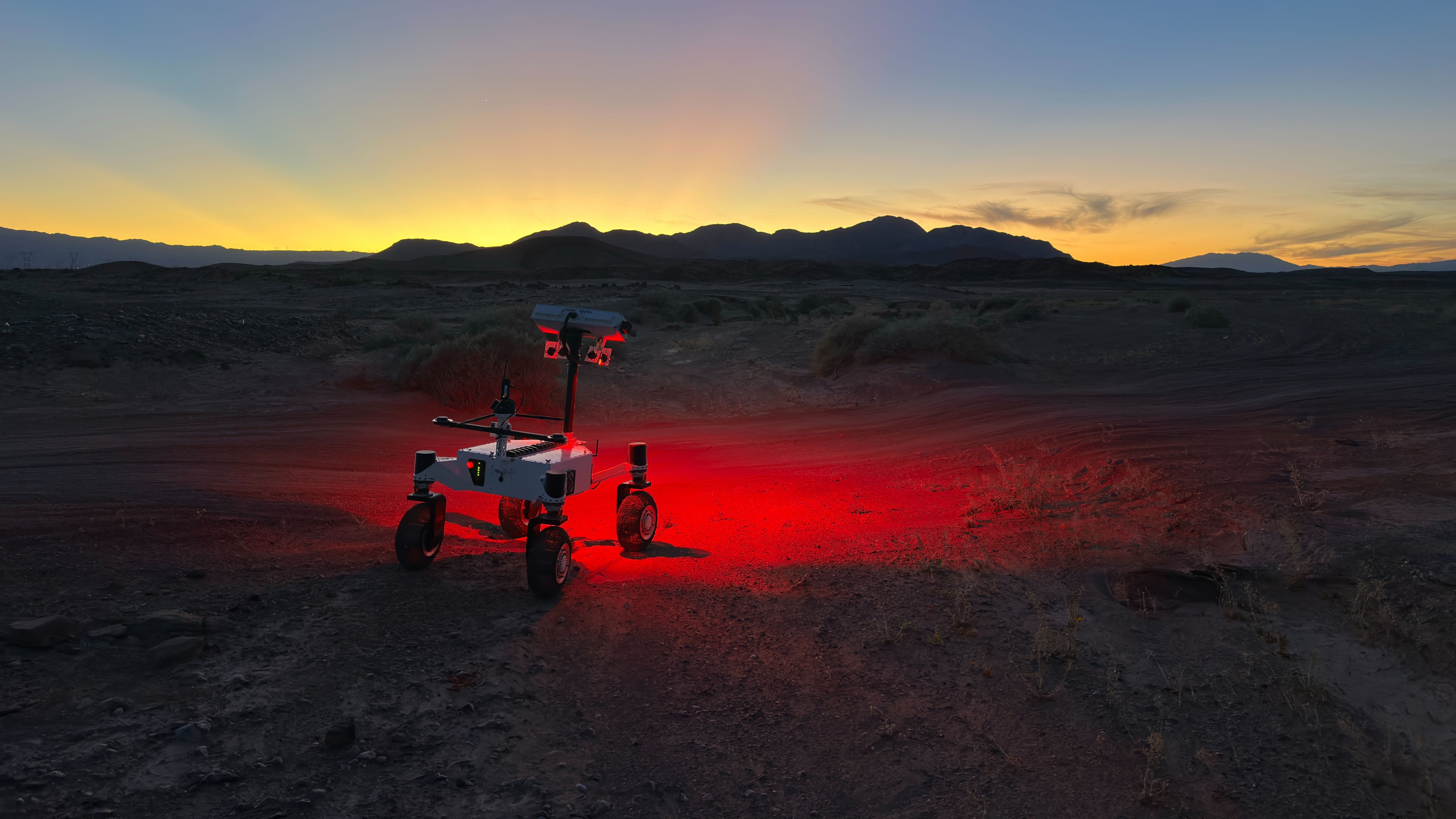
In the arid expanse of the Colorado Desert, NASA has been testing a promising new rover prototype named ERNEST (Exploration Rover for Navigating Extreme Sloped Terrain). This compact, four-wheeled machine recently completed a 16-mile (26-kilometer) journey with minimal human intervention, showcasing its potential to enhance robotic autonomy crucial for future lunar and Martian missions.
ERNEST's development is spearheaded by NASA's Jet Propulsion Laboratory (JPL), focusing on advancing the technologies required for the next generation of planetary exploration. As missions to the Moon and Mars become more ambitious, the ability for rovers to operate independently in harsh and unpredictable environments is increasingly vital. This autonomy is essential not only for scientific exploration but also for the safety and efficiency of missions where direct human control is limited by distance and delayed communication.
The tests in Southern California are part of a broader initiative to ensure these rovers can navigate extreme terrains, such as the rugged landscapes of the Moon's south pole or the steep slopes of Martian hills and valleys. The choice of the Colorado Desert, with its challenging conditions, serves as an excellent analog for these extraterrestrial environments, providing a rigorous testing ground for ERNEST's capabilities.
NASA's focus on autonomous navigation addresses several critical challenges. One of these is the latency in communication between Earth and distant worlds. On Mars, for instance, it can take anywhere from 4 to 24 minutes for a signal to travel one way, making real-time control impossible. Rovers like ERNEST are being designed to make independent decisions about navigation and obstacle avoidance, reducing the need for constant human oversight.
ERNEST is equipped with advanced sensors and algorithms that allow it to assess terrain features and adjust its path accordingly. These capabilities are not only about avoiding hazards but also about optimizing scientific exploration. By autonomously selecting interesting geological features for closer inspection, ERNEST can make the most of its time on the surface, maximizing the scientific return of each mission.
This technology represents a significant step forward from previous rover missions, such as the Mars Curiosity and Perseverance rovers, which have already demonstrated limited autonomous navigation. With each new rover, NASA builds on past successes, integrating more sophisticated autonomy to handle increasingly complex tasks.
The implications of this work extend beyond just rovers. Autonomous systems are expected to play a crucial role in the Artemis program, which aims to return humans to the Moon and establish a sustainable presence there by the end of the decade. Rovers like ERNEST could aid in site scouting, resource identification, and even in constructing habitats and infrastructure necessary for long-term human habitation.
Looking ahead, the lessons learned from ERNEST's development and testing will inform the design of future missions to Mars and the Moon. As NASA and its international partners plan for more ambitious explorations, the ability to deploy autonomous machines will be a key component of mission success. With the groundwork laid by projects like ERNEST, the vision of autonomous exploration on other worlds seems increasingly within reach.