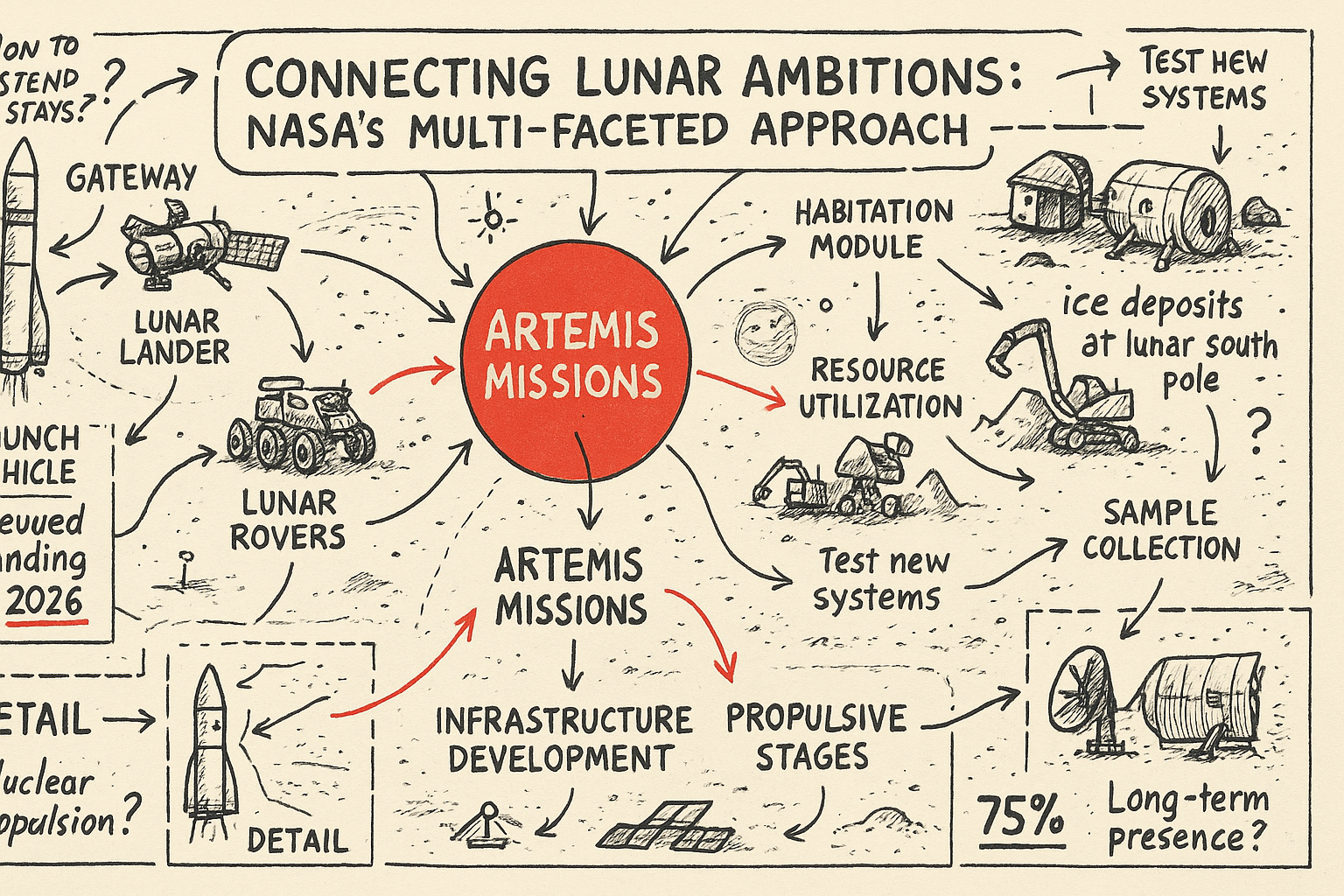
The European Space Agency (ESA) is navigating a new course for its contributions to NASA's Gateway project, a lunar orbiting space station intended to support missions to the Moon and beyond. This shift comes after NASA decided to pause the development of the Gateway to prioritize establishing a lunar base, altering the immediate trajectory of international lunar exploration efforts.
ESA had initially committed to providing three major components to the Gateway: the Lunar I-Hab habitation module, the Lunar View logistics and refueling module, and the Lunar Link communications system. However, with NASA's announcement of a revised focus under the Artemis program, these components now face an uncertain future. Speaking at a news briefing on June 17, Daniel Neuenschwander, ESA’s director of human and robotic exploration, outlined the agency's strategic plans for these projects.
The Lunar I-Hab module, designed to house astronauts and facilitate various activities in lunar orbit, will continue its development up to the critical design review stage. This phase is crucial as it represents the final major design verification before moving into full-scale production. Once this milestone is reached, ESA will evaluate how the module could be repurposed, potentially integrating it into other lunar missions or projects.
For the Lunar View module, Neuenschwander indicated that ESA plans to decelerate progress. Although development will slow, the agency is committed to preserving the vital technologies required for future deep space exploration. This approach ensures readiness for deployment when the opportunity arises, maintaining technological continuity and capability.
The Lunar Link communications system presents an interesting opportunity for repurposing. Originally intended to support communications between the Gateway and lunar surface missions, ESA is now exploring its potential inclusion in the Moonlight programme. This ambitious initiative aims to establish a constellation of satellites around the Moon, providing essential communication and navigation services to support lunar exploration activities.
Despite these adjustments, ESA remains optimistic about its role in the broader Artemis program. Josef Aschbacher, ESA's Director General, emphasized during the briefing that discussions about the agency’s involvement in the Artemis program are ongoing, highlighting ESA's commitment to international collaboration in space exploration.
This strategic pivot by ESA underscores the dynamic nature of space exploration, where agencies must adapt to shifting priorities and technological advancements. It also highlights the importance of international cooperation, as countries and agencies work together to achieve common goals in space exploration.
The decision to pause the Gateway development in favor of a lunar surface base is a significant step in NASA’s Artemis program. The program aims to return humans to the Moon, paving the way for future Mars missions. Establishing a sustainable human presence on the Moon is seen as a critical first step toward deeper space exploration, offering opportunities to test new technologies and conduct scientific research in a lunar environment.
ESA’s contributions to the Gateway were intended to bolster Europe’s role in this international endeavor, showcasing the continent’s technological prowess and commitment to space exploration. While the pause presents challenges, it also offers opportunities to innovate and adapt, ensuring that ESA remains at the forefront of lunar exploration.
As the space industry evolves, agencies like ESA continue to play a crucial role in shaping the future of space exploration. By reassessing and strategically redirecting their resources and expertise, they can contribute effectively to the collective effort of exploring the Moon and beyond. The outcome of these efforts will likely influence the trajectory of space exploration for decades to come, as humanity seeks to establish a foothold in the solar system.