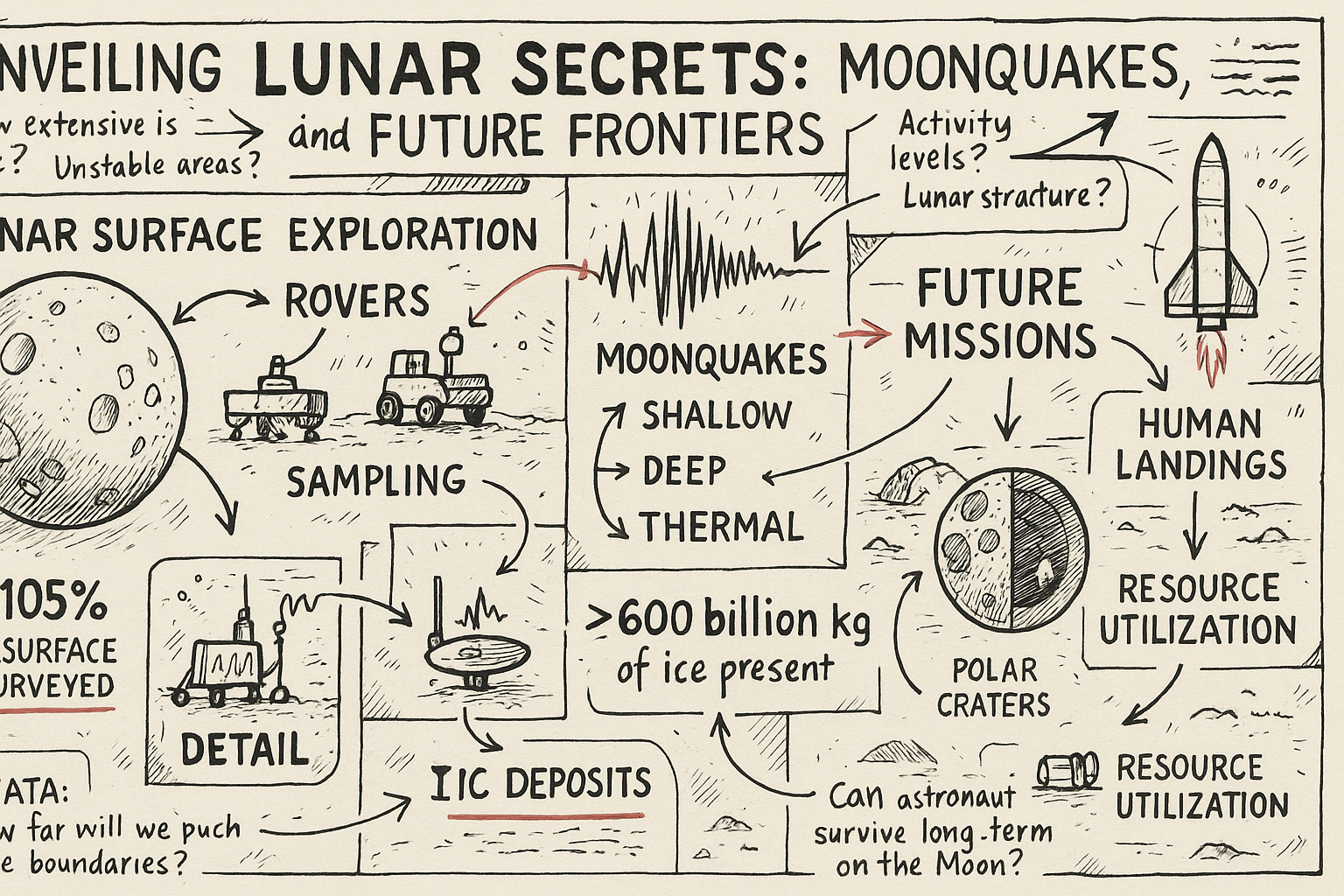
The Moon, our Earth's constant companion, has long been a subject of intrigue for scientists and explorers alike. Recent developments have uncovered new methods to explore and utilize its resources, specifically focusing on the valuable reserves of lunar ice. This revelation not only holds promise for scientific advancement but also paves the way for future lunar bases, a cornerstone of upcoming space exploration missions.
The Hidden Ice of the Moon
A groundbreaking study has proposed the use of seismic waves from moonquakes to map and locate hidden reserves of water ice beneath the Moon's surface (Source 1, 5, 6). This innovative approach leverages the natural seismic activity of the Moon to act as a locator beacon for these hidden resources. The presence of water ice is crucial as it can be processed into water, oxygen, and even fuel, making it an indispensable resource for sustaining future lunar colonies and long-duration missions.
The idea of using moonquakes to detect sub-surface ice deposits marks a significant shift from traditional imaging techniques, which have often failed to provide clear evidence due to the Moon's dusty landscape. This method represents a fusion of planetary science and seismology, providing a new lens through which to view the Moon's enigmatic surface.
NASA's Strategic Partnerships
In a move to bolster its lunar exploration efforts, NASA has invited India to join its Moon Base program (Source 3). This collaboration underscores the importance of international partnerships in advancing space exploration. India's space agency, ISRO, brings to the table a wealth of experience and technological prowess, as demonstrated by its successful lunar missions. Such collaborations are vital for pooling resources, technology, and expertise, thus accelerating the timeline for establishing a sustainable human presence on the Moon.
The inclusion of diverse international partners also reflects a broader trend in space exploration, where geopolitical interests are giving way to collective scientific and exploratory goals. This paradigm shift could redefine space policy, facilitating a more inclusive approach to exploring and utilizing extraterrestrial resources.
Technological Advancements: LEMS and Beyond
NASA's completion of the Lunar Environment Monitoring Station (LEMS) marks another milestone in lunar exploration technology (Source 4). Designed for deployment by Artemis astronauts, LEMS will provide critical data on the Moon's seismic activity, surface conditions, and potential ice deposits. This data is essential for informing the construction and operation of lunar bases, ensuring they are built on stable ground and near accessible resources.
The development of tools like LEMS highlights the importance of cutting-edge technology in overcoming the challenges of extraterrestrial environments. As technology continues to evolve, it will undoubtedly unlock new possibilities for lunar exploration and habitation.
The Milky Way's Dynamic Nature
While our focus often remains on celestial bodies within our immediate reach, the dynamics of our galaxy, the Milky Way, offer profound insights into cosmic evolution (Source 7). Recent data from the Gaia mission reveals a galaxy far more dynamic than previously imagined, with its disk and halo shaped by ancient mergers and perturbations. Understanding these cosmic interactions provides context for the formation and evolution of planetary systems, including our own.
The study of our galaxy's dynamism not only enhances our understanding of the universe but also informs our approach to exploration, emphasizing the interconnectedness of cosmic phenomena.
In conclusion, the convergence of innovative scientific methods, strategic international partnerships, and advanced technological tools is opening new frontiers in lunar exploration. As we stand on the cusp of a new era in space exploration, these developments underscore the importance of resource utilization, collaboration, and continued technological innovation in realizing the vision of a sustainable human presence on the Moon.