NASA advances SLS production with four vehicles in parallel
NASA and its contractors are now producing four Space Launch System (SLS) vehicles simultaneously, a step documented in status updates published on 30 August 2026. The overlapping production line covers hardware for Artemis III and long‑lead elements destined for Artemis IV, V and VI, and includes booster stacking in the Vehicle Assembly Building (VAB) and RS‑25 engine installation on Core Stage 3.
The progress reported by NASASpaceFlight describes ongoing work in multiple facilities. In High Bay 3 of the VAB, stacking of the Solid Rocket Boosters (SRBs) for Artemis III began in July. Aft segments were installed around 13 July, followed by the right aft‑center segment on 12 August and additional forward segments on 20 August that carried the NASA worm logo. According to the report, two motor segments remain to be added to each booster; the nosecones and forward skirts that will cap the stacks are already inside the VAB.
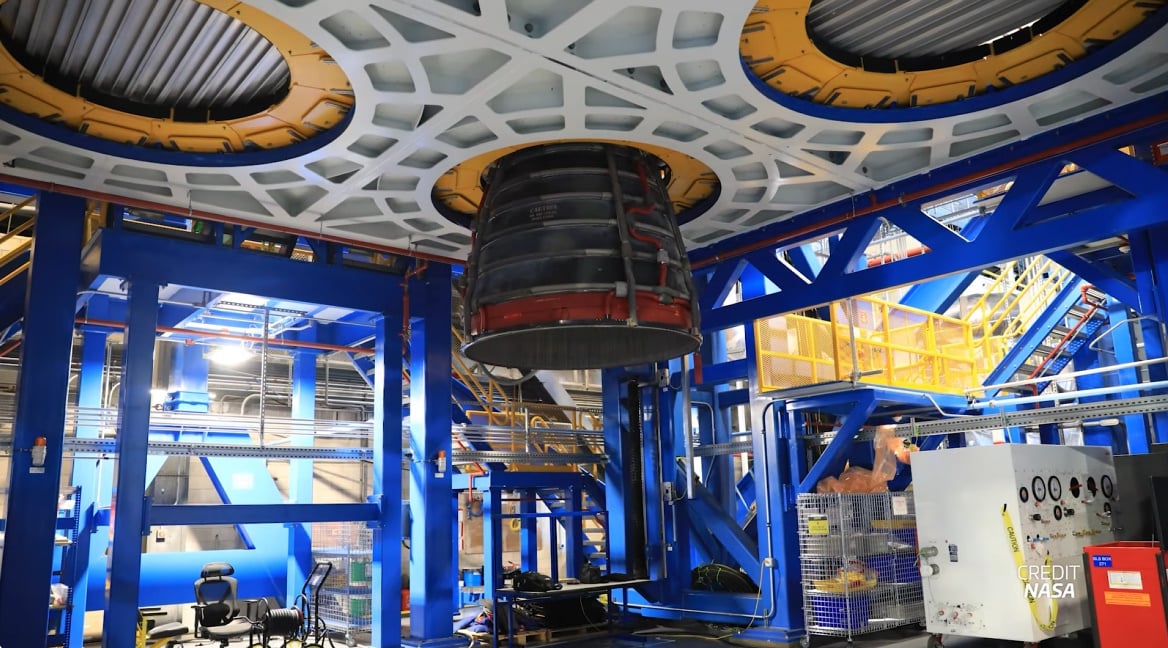
Meanwhile in High Bay 2, Core Stage 3 received its tank section earlier in the year after shipment from New Orleans, and that section was mated to the engine section. Teams have started installing the four RS‑25 engines; images accompanying the status update show at least engines 2 and 3 already fitted, with the remaining two expected to follow.
At the Operations and Checkout Building, teams completed umbilical connections between the Artemis III Orion crew module and its service module, and integration work on other spacecraft elements continues, according to the same coverage. The assemblage and checkout activities feed into NASA’s schedule for Artemis III, currently set to launch no earlier than June 2027 to fly Orion and a crew of four in Earth orbit to exercise lunar systems integration before a future lunar landing attempt.
The article frames the current activity as the clearest hardware sign yet of a higher SLS production cadence. Parts and assemblies for Artemis IV, V and VI are being advanced at Michoud and Marshall facilities, with tanks, engine sections, adapters and long‑lead items progressing in parallel. That overlapping production approach differs from earlier single‑vehicle focus and is intended to support back‑to‑back missions when operational tempo permits.
Public imagery and progress milestones described in the source give a view into how prime contractors and NASA centers coordinate the complex flow of large structures and engines. The RS‑25, a heritage engine with multiple refurbishments and modifications for SLS, is being installed in the current core stage; the four‑engine configuration remains a defining SLS characteristic. The SRB builds reflect continued use of segmented solid motors with forward and aft skirts and nosecones that must be integrated inside the VAB.
Historically, the SLS program has followed a cautiously incremental path: early flights were more than a decade in the making and required major development, test and qualification steps. The shift to overlapping production for Artemis IV–VI represents a maturation of the industrial flow toward steady output, but it is not a guarantee of faster flight frequency. Schedule targets and launch dates remain subject to test results, integration milestones and programmatic decisions.
What this production posture means for future Artemis missions is conditional. If hardware flow, testing and crewed mission preparations remain on track, the ability to assemble multiple vehicles concurrently should reduce lead times between launches compared with strictly sequential construction. However, the reporting also implies remaining work ahead: additional SRB motor segments, completion of RS‑25 installations, and final integration and testing of the Orion spacecraft and associated ground systems.
NovΔ mAInd's launch database: SLS Block 1B | Artemis III — scheduled 2027-09-15, it has NOT flown yet — no outcome exists, do not state one, orbit Crewed Spacecraft, operator NASA.
Looking forward, the production experience gained while building multiple SLS vehicles in parallel will inform how NASA and its partner industrial base manage parts flow, engine production and large‑scale assembly in the VAB. The SLS remains a heavy‑lift architecture tailored to Artemis objectives, and the current work to outfit Core Stage 3 and stack SRBs is a tangible step toward the next crewed mission integration milestones.
Sources: NASASpaceFlight coverage dated 30 August 2026.