Sweden signs HIMARS contract and partners with Finland on rocket-artillery capability
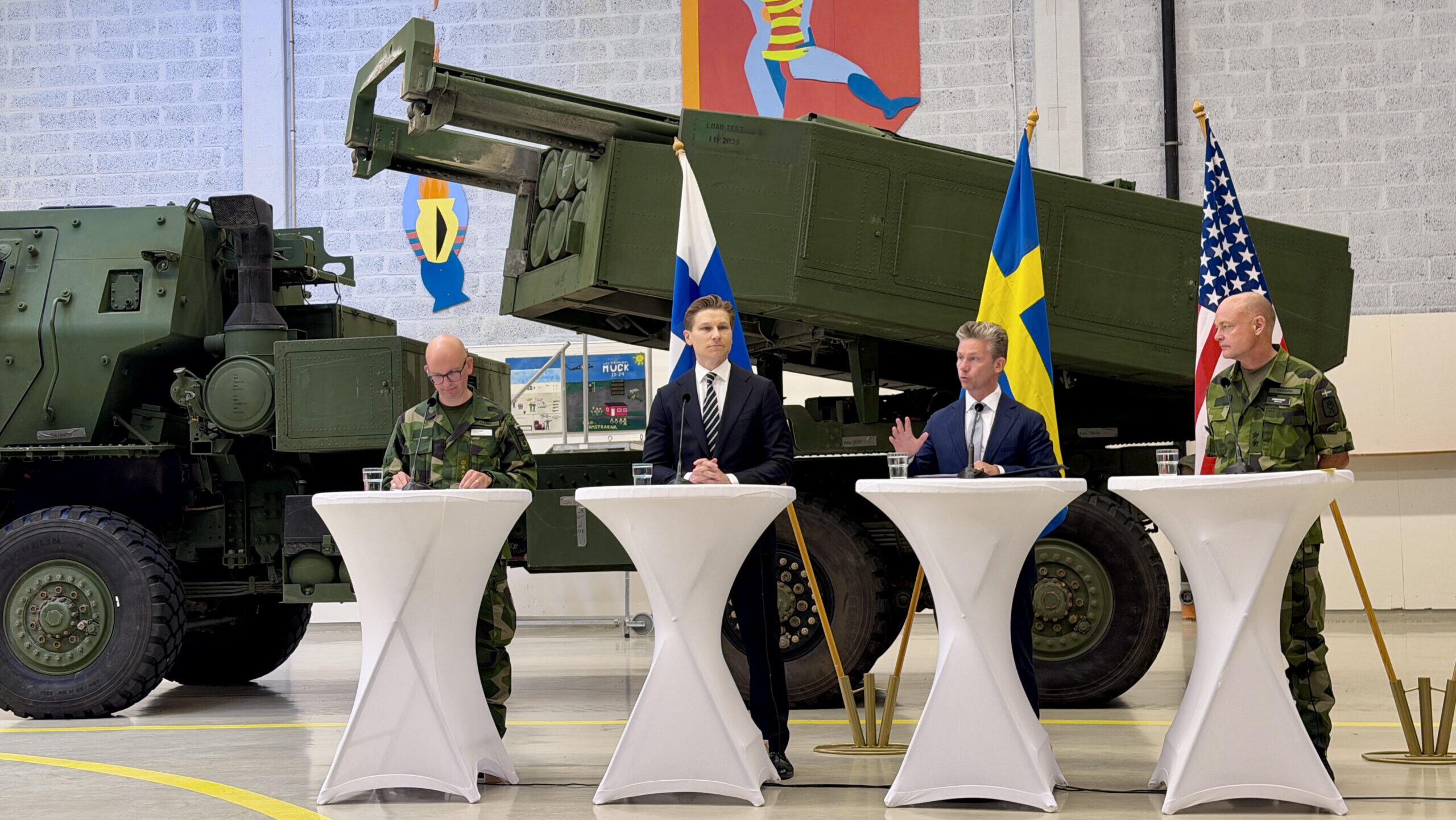
Sweden announced on 7 September 2026 that it has signed a SEK 7 billion ($732 million) contract to procure Lockheed Martin’s M142 High Mobility Artillery Rocket System (HIMARS). The acquisition, announced at Ärna Air Base north of Uppsala, comprises "just over" ten launchers together with a "substantial quantity" of ammunition, and Sweden’s defense leaders said first deliveries of launchers and ammunition are set for 2027.
The announcement was made in a joint briefing attended by Sweden’s Minister for Defence Pål Jonson and the head of the Swedish Army, Maj. Gen. Johan Pekkari, alongside Finnish defence representatives. Finland’s Minister of Defense Antti Häkkänen participated in the announcement, reflecting close bilateral cooperation in the effort to bring the capability into service.
Swedish officials framed the acquisition as filling a gap in the Army’s ground-based, long-range precision-strike toolkit. Maj. Gen. Johan Pekkari told reporters that the long-range precision capability provided by HIMARS is "something we [the Army] don’t have in our toolbox at the moment. We have it in the Air Force, but we also need it in the Army." He emphasised that the system will add a deep-strike capability complementary to the Air Force’s recently operational Taurus missiles carried by Gripen fighters.
Defence Minister Pål Jonson noted the contract is the first tranche of a deal the U.S. government approved in March. He also highlighted that the HIMARS-equipped architecture will allow "future use" of the Precision Strike Missile (PrSM), which Sweden described as having a range of up to 500 kilometres and being "capable of striking high-value targets in depth." The government did not provide a detailed breakdown of ammunition types or exact ranges for the initial package beyond the reference to potential PrSM employment in the future.
Alongside the procurement, Lockheed Martin and Swedish defence firm Saab signed a letter of intent to explore integration of Saab’s Ground-Launched Small Diameter Bomb (GLSDB) and to investigate production of munitions for HIMARS and other systems, including the Patriot air-defence system (PAC-3). Minister Jonson said the move reflects a desire to increase munitions production in Sweden and Europe and welcomed the Saab–Lockheed Martin teaming.
The presence of Finnish officials and the public mention of Finland’s role indicate that bilateral cooperation will support Sweden’s effort to operationalize HIMARS. The announcement follows a wider pattern of closer Swedish–Finnish defence collaboration reported in recent months, including joint work on counter-drone defences and other cooperative projects.
Sweden’s procurement comes amid broader European initiatives to strengthen munitions production and deepen interoperability among NATO and NATO-adjacent partners. The Swedish statement highlighted interest in both GLSDB and PrSM as part of a layered approach to long-range fires: GLSDB offers a weapon built from a GBU-39 Small Diameter Bomb coupled to a rocket motor, while PrSM is a dedicated ground-launched precision-strike missile under U.S. development with a stated maximum range near 500 kilometres as referenced in the announcement.
Operational fielding is scheduled to begin with deliveries in 2027, after which Swedish and Finnish personnel are expected to work on training, sustainment and munitions supply arrangements. The statement did not specify where the launchers would be based within Sweden, nor did it quantify the "substantial" ammunition stockpile beyond the general announcement.
Historically, Sweden has maintained a strong indigenous defence-industrial base centred on firms such as Saab, while increasingly procuring systems from international partners to meet capability gaps. This HIMARS deal follows other recent Swedish procurements and evaluations; for example, in parallel defence reporting Sweden is evaluating additional cruise-missile options for new frigates and pursuing a range of bilateral cooperative programmes with neighbouring states.
Looking ahead, Swedish officials have pointed to the potential for future integration of longer-range munitions such as PrSM and collaborative munitions production with Saab and Lockheed Martin. That path would align with European efforts to localise production of precision munitions and to ensure steady supply chains for high-demand ordnance. At the same time, several open questions remain: the precise number of launchers beyond the description "just over" ten, the composition and types of ammunition included in the initial deliveries, basing and command arrangements, and the timeline for integration of PrSM or GLSDB into Swedish service.
Sweden’s SEK 7 billion HIMARS deal marks a concrete step in the country’s ongoing efforts to expand ground-based long-range strike options, deepen cooperation with Finland, and grow domestic munitions production capacities in partnership with international suppliers.