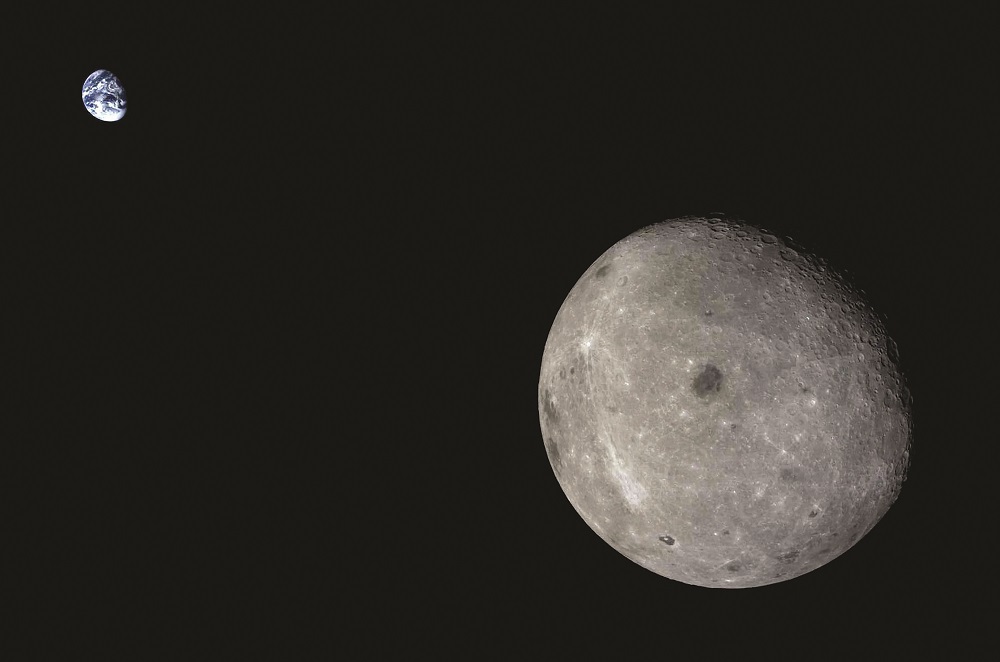
Chinese Deep Space Exploration Laboratory launches international Cislunar CubeSat Constellation (C3)
On 4 September 2026 the Chinese Deep Space Exploration Laboratory, together with the International Deep Space Exploration Association, presented the International Cislunar CubeSat Constellation (C3): a plan to place a constellation of 30 CubeSats into cislunar space by 2030. The announcement was made during the 2026 International Deep Space Exploration Conference held in Hefei.
C3 will consist of 30 CubeSats in the 12U form factor, each with a mass of approximately 30 kg. Instead of concentrating all satellites in a single cluster, the constellation will be organised into five groups of six satellites. These groups will occupy orbits in a 1:3 resonance between Earth and the Moon so that the platforms are simultaneously present in different regions of the cislunar environment. According to the presentation, this geometry is intended to enable simultaneous multi-point measurements of transient and distributed phenomena, improving reconstruction of spatial distributions and time evolution across the cislunar domain.
The stated scientific objectives of C3 encompass studies of gamma-ray bursts, space weather, lunar resources and monitoring of the environment between Earth and the Moon. The programme is described as international: Thailand, Serbia, Egypt, Senegal and Indonesia are listed as participating countries at the time of the announcement, and the Asia-Pacific Space Cooperation Organization is cited as a supporter. The developers said other countries may join later.
Project organisers indicated that development work has already begun. During the Hefei presentation it was reported that some of the Chinese systems planned for the first phase—specifically control, telemetry and tracking systems—are near completion. No launch dates, manifest details, or explicit procurement or funding figures were provided in the material released at the conference.
Technical details provided publicly emphasise the 12U CubeSat architecture. A 12U CubeSat typically implies a compact platform that balances mass, volume and power for instrument payloads; in C3 each satellite is reported to have a mass of about 30 kg. The use of multiple small satellites distributed in resonant orbits seeks to exploit coordinated observations to characterize dynamic processes across the cislunar region rather than relying on single-point measurements.
International and multi-point approaches to cislunar science have gained interest as activity in the Earth–Moon system increases. Cislunar space—a volume stretching from low Earth orbit through Earth–Moon Lagrange regions to lunar orbit and the lunar surface—hosts transient particle populations, variable plasma and radiation conditions, and objects of operational and scientific interest. Measuring these phenomena from several vantage points can constrain models of space weather, radiation transport and transient events such as gamma-ray bursts.
The plan to study lunar resources from CubeSats reflects broader scientific and exploration trends. Small satellites can carry compact instruments suited to remote sensing and in-situ precursor measurements that inform follow-on robotic or crewed missions. C3’s stated aims include resource assessment as one of several goals, alongside fundamental science and environmental monitoring.
The announcement positions the Deep Space Exploration Laboratory and the International Deep Space Exploration Association as the leading organisations for the programme. Participating nations named in the presentation—Thailand, Serbia, Egypt, Senegal and Indonesia—indicate the project’s explicitly international framing, with the Asia-Pacific Space Cooperation Organization cited as a backer. The organisers did not publish a full partner list, instrument manifest, or a detailed timeline beyond the target to deploy the constellation by 2030.
Historically, China has expanded both robotic lunar exploration and small-satellite capabilities in recent years. Within that context, C3 would mark a notable deployment of coordinated small spacecraft into cislunar space. If realised, a distributed constellation operating in resonant orbits could provide data that complement larger lunar missions and deep-space observatories by filling spatial and temporal gaps in monitoring the Earth–Moon environment.
Uncertainties remain. The public material from the Hefei presentation gives satellite count, form factor, mass and a high-level orbital concept, but leaves open key questions about launch vehicles, ground segment arrangements, instrument suites, data-sharing practices and financing. The announcement does not identify a launch manifest or specific timelines for individual launches, and it does not quote technical specifications beyond control, telemetry and tracking systems being near completion for some Chinese-built components.
Looking ahead, C3’s success will depend on coordination among participating countries and institutions, integration of payloads within the 12U platforms, and securing launches capable of inserting the groups into the intended 1:3 resonant trajectories. The project’s international nature suggests opportunities for partner nations to contribute instruments, operations or data products, but details on cooperation mechanisms remain to be defined by the Deep Space Exploration Laboratory and collaborating organisations.
As cislunar activity increases globally, multi-point constellations like C3—if implemented with clear technical, operational and data-sharing frameworks—could become an important class of infrastructure for scientific study and operational awareness in the Earth–Moon system.