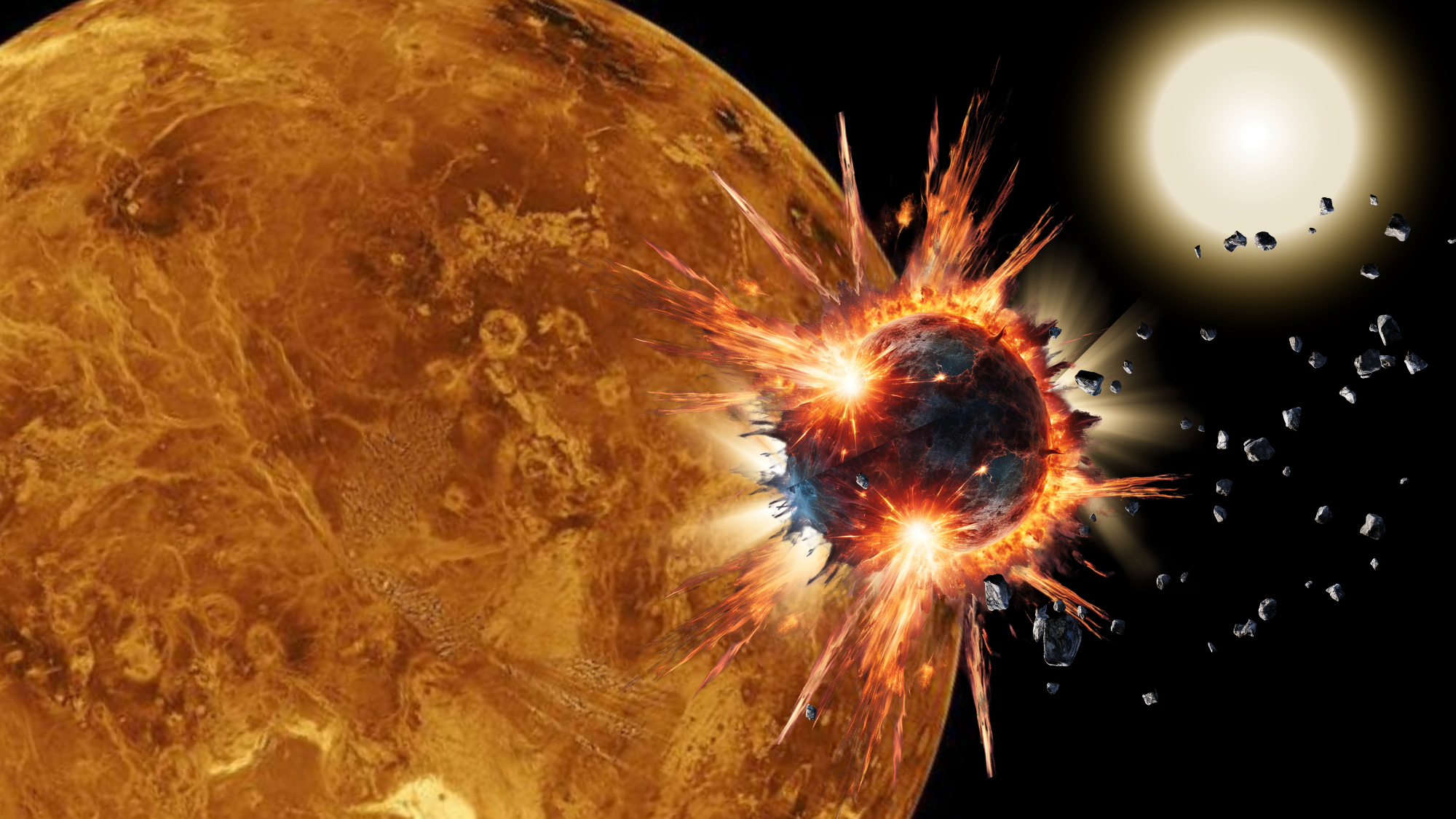
UC Riverside models suggest Venus’s slow spin caused a moon to fall in
Scientists at the University of California, Riverside (UCR) published a study in The Astrophysical Journal showing that Venus likely once had a natural satellite that did not require catastrophic destruction to disappear. Instead, according to lead author Stephen Kane, Venus’s own gravity combined with its slow, retrograde rotation would naturally drive a moon to spiral inward until it collided with the planet.
The paper builds on well-understood tidal dynamics that govern planet–moon systems. Earth and the Moon provide a calibration: Earth's 24-hour spin transfers rotational energy to the Moon, making the Moon recede at about four centimeters (1.6 inches) per year — a measurement confirmed by lunar laser ranging using retroreflectors left by Apollo astronauts. Kane used models that first reproduce that well-known Earth–Moon evolution as a check on his approach, then varied Venus’s rotation rate and hypothetical moon masses to test outcomes for Venus.
Venus contrasts sharply with Earth. It rotates once every 243 Earth days and rotates in the opposite (retrograde) direction relative to most planets. Those two facts change the sign of tidal evolution. Rather than tidal torque pushing a moon outward, the slow, retrograde spin means tidal interactions tend to drain orbital angular momentum from a satellite, causing it to spiral inward.
To test the stability of possible satellites, Kane’s simulations explored moon masses from half to 10 times the mass of Earth’s Moon. Across most scenarios, the moon crashed into Venus. The heavier the satellite, the faster the inward migration and final collision. That outcome, Kane argues, means Venus did not need a violent impact to lose a moon; normal tidal evolution tied to the planet’s rotation could suffice.
The UCR study therefore offers a dynamical explanation for a conspicuous fact of the inner Solar System: Venus, despite being similar to Earth in size, mass and bulk composition, lacks a large moon. Earlier explanations included catastrophic destruction of a moon in an impact or the planet never undergoing a giant impact to form a satellite in the first place; the new work suggests those are not required to explain the present-day absence.
Previous literature and commentary captured in public summaries of the work underscore the long-standing debate about whether Venus ever had a moon and how long one could have persisted. Some complementary studies and popular summaries have noted alternative possibilities — for example, that a moon could have been torn apart near the Roche limit and produced a ring before decaying — but the UCR paper emphasizes that, for a wide range of plausible moon masses, tidal torques driven by Venus’s slow rotation would produce an inward spiral and collision.
This result has implications beyond simply explaining Venus’s lonely status. If Venus did host a moon that fell in, the timing and mass of that satellite would influence Venus’s angular momentum history and could bear on questions about the planet’s past rotation rate, its thermal evolution, and even the timing of surface resurfacing events. Conversely, if Venus never experienced the kind of giant impact Earth did, that too would be informative about stochastic processes in the young Solar System. Kane’s models do not require choosing between those histories; they show that even if a moon formed, typical tidal physics would likely have doomed it under Venus’s present rotational state.
Observational confirmation of an ancient moon is challenging. Unlike Earth, Venus has no preserved orbital debris to measure with retroreflectors, and any direct traces of a satellite’s collision would be difficult to identify amid Venus’s dense atmosphere and geologically young surface. The study therefore rests on dynamical plausibility rather than discovery of physical remnants.
The work also demonstrates the value of comparative planetology: contrasting Earth’s expanding lunar orbit with Venus’s inward-driving tides illuminates how a planet’s rotation rate and tidal response can determine the fate of satellites. As Kane notes in summaries of the study, the same physics that steadily increases the Earth–Moon separation can produce the opposite effect for a slowly rotating world like Venus.
Looking forward, the result will influence how scientists model satellite formation and survival around terrestrial planets, both in our Solar System and for rocky exoplanets. It suggests that rotation state is a critical parameter in assessing whether a terrestrial planet will retain a large moon over geological time. Future missions to Venus, planned by multiple space agencies, may refine models of Venus’s rotation history, internal structure and tidal response, which in turn will sharpen constraints on any past satellite and the timing of its disappearance.
For now, the UCR paper presents a clear, physics-based scenario explaining why Earth’s nearest-sized twin ended up moonless: Venus’s slow, retrograde spin and gravitational tides are enough to have driven a moon to its doom.