Overview
In the space of a few weeks late in 2026, a pattern emerged: major national agencies and international partners are simultaneously advancing missions that will probe ancient worlds, test technologies for future campaigns, and build the navigation and science infrastructure that will underpin the next decade of exploration. China’s planned Tianwen-4 mission to Jupiter’s moon Callisto, NASA’s Lucy entering the Trojan region, India’s Venus Orbiter Mission entering construction, the Chinese Tanluozhe-1 Pathfinder launch, Europe’s PLATO Guest Observer selections, and a flurry of lunar navigation and public-engagement initiatives together illustrate an increasingly multitasked global space agenda.
From pure exploration to systematic reconnaissance
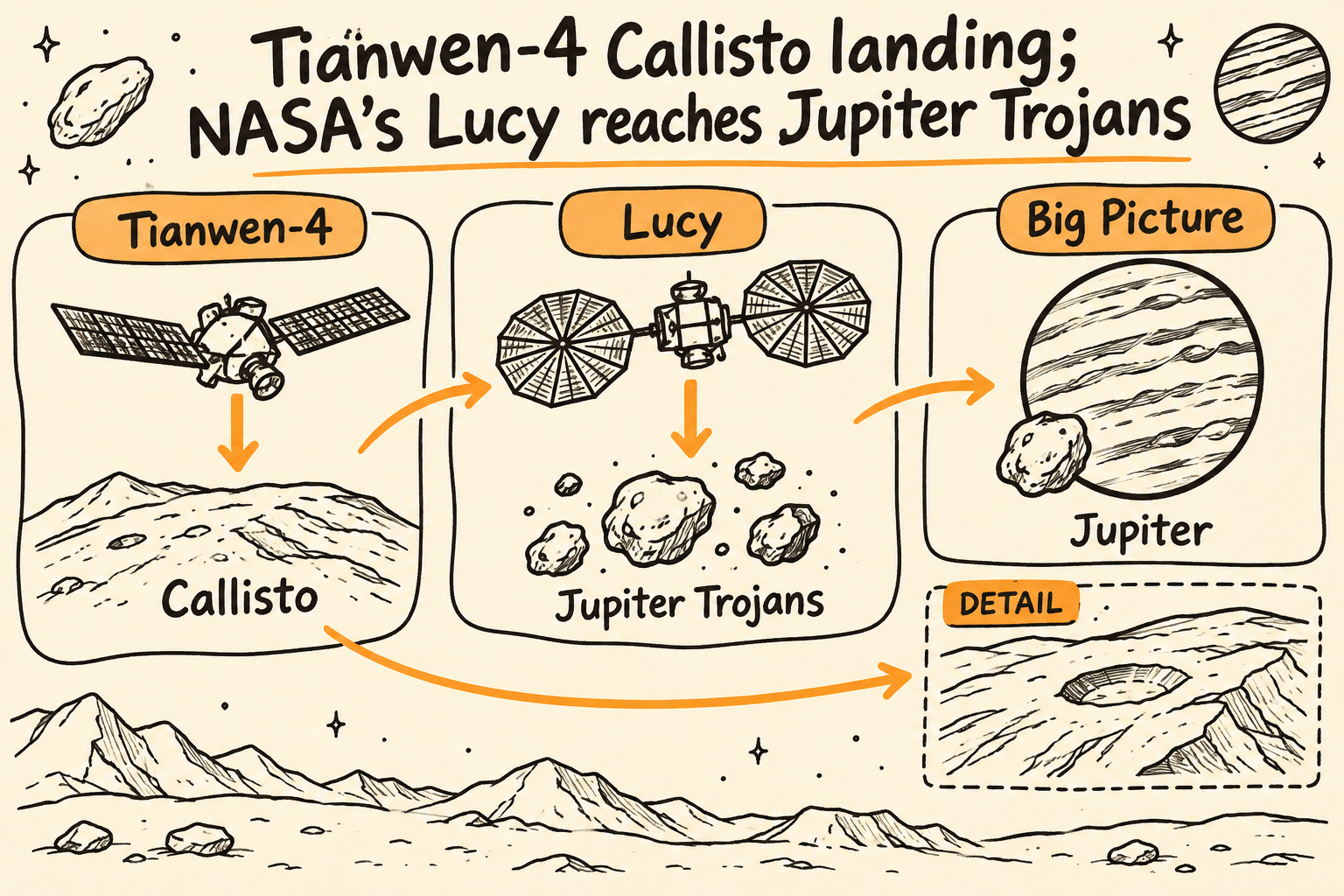
Historically, planetary exploration swung between prestige-driven flybys and slow, singular lander missions. The current wave is different: missions are designed not just for headline-making firsts but to fill systematic science gaps while maturing operational capabilities. Tianwen-4’s stated plan to orbit Callisto and attempt a landing signals China’s intent to combine orbital science with surface access on a Jovian moon — an audacious technical leap. Callisto is less geologically active than Europa or Io, but its heavily cratered surface and likely subsurface structure hold clues to early Solar System history. Attempting a landing there is risk-heavy but scientifically rational: long-term records of impact and irradiation sit relatively undisturbed.
At the same time NASA’s Lucy — now in the Trojan region — is executing a different strategy: long-range comparative planetology. By sampling multiple primitive bodies captured in Jupiter’s L4 and L5 swarms, Lucy treats small bodies as time capsules, testing models of Solar System formation. These complementary approaches show an emerging division of labor: targeted, high-risk landings (Tianwen-4) versus distributed reconnaissance (Lucy).
Technological and operational scaffolding
Exploration today is not only about destinations but about the scaffolding that makes repeated missions feasible. Italy’s ASI and Qascom contract for COLLINS, building on the LuGRE receiver heritage, is a concrete example of investing in navigation services around the Moon — a utility much like GPS on Earth. Reliable lunar navigation is a prerequisite for commercial and scientific activity: it reduces mission risk, lowers fuel margins, and enables complex coordination such as sample return rendezvous or multi-lander networks.
Similarly, China’s Tanluozhe-1 'Pathfinder' satellite is emblematic of an incremental engineering philosophy: validate instruments and operations in low-cost testbeds before committing them to flagship missions. This pattern mirrors terrestrial aerospace practice and reflects a maturation of national programs into engineering cultures that prioritize iterative validation.
Parallel rises: India, Europe, public outreach
India’s Shukrayaan/Venus Orbiter Mission entering construction with a March 2028 launch illustrates the widening geographic spread of planetary exploration. ISRO’s move into Venus science diversifies global observational baselines; as Venus has complex atmospheric chemistry and climate evolution questions, more missions with different instruments will help resolve debates about its runaway greenhouse history.
European science infrastructure also advances: ESA’s PLATO mission and its Guest Observer selections — including Italian-led programs — will begin planet-hunting operations that feed exoplanet demographics and target selection for follow-up missions. Meanwhile, NASA’s Dragonfly public engagement campaign — the "send my name" drives — continues to underline a cultural shift: agencies now blend public outreach directly into mission manifests, using symbolic inclusion as a soft-power tool that builds constituency for sustained budgets.
Two counterintuitive insights
1) Risk increases can coincide with risk reduction. Attempting a Callisto landing is riskier than orbiters of past decades, yet the broader network of small-pathfinder satellites, improved navigation systems like COLLINS, and incremental test missions actually reduce aggregate program risk. Agencies are accepting higher single-mission technical challenges because system-level redundancy and infrastructure investments make those risks survivable.
2) More missions do not equal more duplication. The proliferation of missions to different targets — Trojans, Callisto, Venus, Titan — might look like scattered ambition. In fact, this portfolio approach economizes science return: each class of target addresses distinct, non-overlapping questions about formation, volatile inventory, and habitability, producing a mosaic rather than redundant copies of the same data.
Implications and what to watch
First, expect tighter operational linkages: lunar navigation experiments will matter to lunar landers and growth of cislunar commerce. Second, international competition (notably US concerns about edging out China on lunar timelines) will accelerate schedules and put pressure on commercial partners like SpaceX and Blue Origin to deliver. But accelerated timetables can strain verification regimes — making pathfinder testbeds ever more crucial.
Finally, the next decade will be defined by networks: networks of small scouts, robust navigation and communications services, and a web of targeted science missions that, taken together, will let planetary scientists make synthetic, cross-target inferences about Solar System origins. The new era is less about single spectacular firsts and more about building a resilient, interoperable architecture for sustained exploration.
Conclusion
The recent flurry of missions and programs shows a global sector moving from symbolic acts to system-building. Landing on Callisto, traversing Jupiter’s Trojan swarms, probing Venus’s atmosphere, and fielding navigation and pathfinder platforms are separate steps in the same strategy: mature operational capability while pursuing high-value science. The coming years will test whether nations can coordinate those pieces into a durable exploratory enterprise — one that can balance ambition with the patient engineering discipline required to keep spacecraft, and the science they deliver, viable.