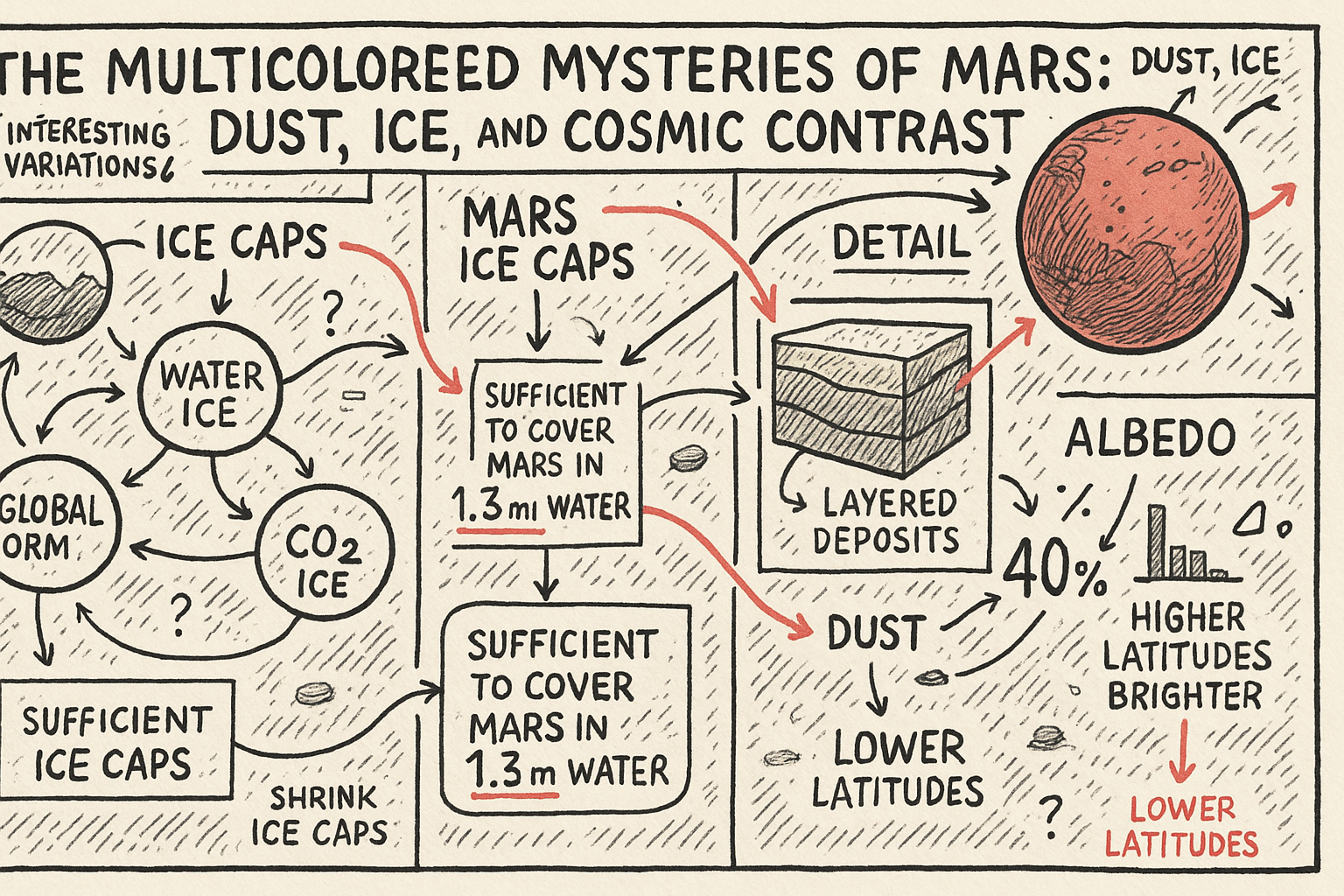
Mars, often referred to as the Red Planet due to its iron oxide-rich surface, is full of surprises that extend beyond its characteristic hue. Recent explorations and studies have unveiled that Mars is not just red; it is a planet of contrasting colors and unexpected clarity, especially at its poles.
New Insights into Martian Ice
One of the most intriguing revelations comes from the north pole of Mars, where the ice is significantly cleaner than previously thought. This discovery, as reported by sources such as Phys.org and Universe Today, suggests that the polar ice caps contain less dust than anticipated. The clarity of the ice is not just a curiosity; it is a crucial factor in understanding the planet's climatic history and its potential to support life or human habitation in the future.
The purity of the ice provides a clearer record of Mars' climatic past. Like ice cores on Earth, Martian ice can reveal patterns and changes in the planet's climate over millennia. This could answer long-standing questions about water's role in Mars' history and its implications for past life.
Beyond Red: The Purple Side of Mars
While Mars' red surface is iconic, the planet also showcases unexpected colors, as seen in images from the Mars Express mission. These images have revealed striking purple hues, particularly near the poles. This phenomenon is attributed to varying lighting conditions and mineral compositions. Such insights challenge our traditional perceptions and highlight Mars as a planet of complex geological and atmospheric processes.
The purple swirls observed at the Martian south pole, for instance, are not just a visual anomaly. They indicate diverse mineral deposits and atmospheric interactions that require further study to understand their implications for planetary science.
Comparative Planetology: Mars vs. Earth and Titan
The quest to understand Mars also involves comparing it with other celestial bodies. Recent studies emphasize that Earth and Mars were formed from different cosmic materials, as highlighted by Phys.org. This fundamental difference influences their respective geologies and potential for life. Understanding these differences is pivotal in the broader context of planetary formation and evolution.
Additionally, discussions have emerged about the habitability of other worlds, such as Titan, Saturn's largest moon. Titan's dense atmosphere and surface pressure comparable to Earth make it a contender for human exploration, potentially even more so than Mars. This comparison underscores the importance of atmospheric conditions in determining a planet or moon's suitability for life.
Future Implications for Exploration
The ongoing exploration of Mars is reshaping our understanding of the planet. The discovery of cleaner ice at the poles offers new opportunities for research and potential resource utilization. As NASA and other agencies consider human missions to Mars, the availability of pure water ice could be a game-changer for sustaining human presence on the planet.
Moreover, the varied hues of Mars prompt a reevaluation of its surface and climatic history, potentially leading to new insights into planetary science and the history of our solar system.
As we continue to explore Mars, these discoveries remind us that the planet is not just a barren red desert but a dynamic world with a rich tapestry of colors and histories waiting to be explored.