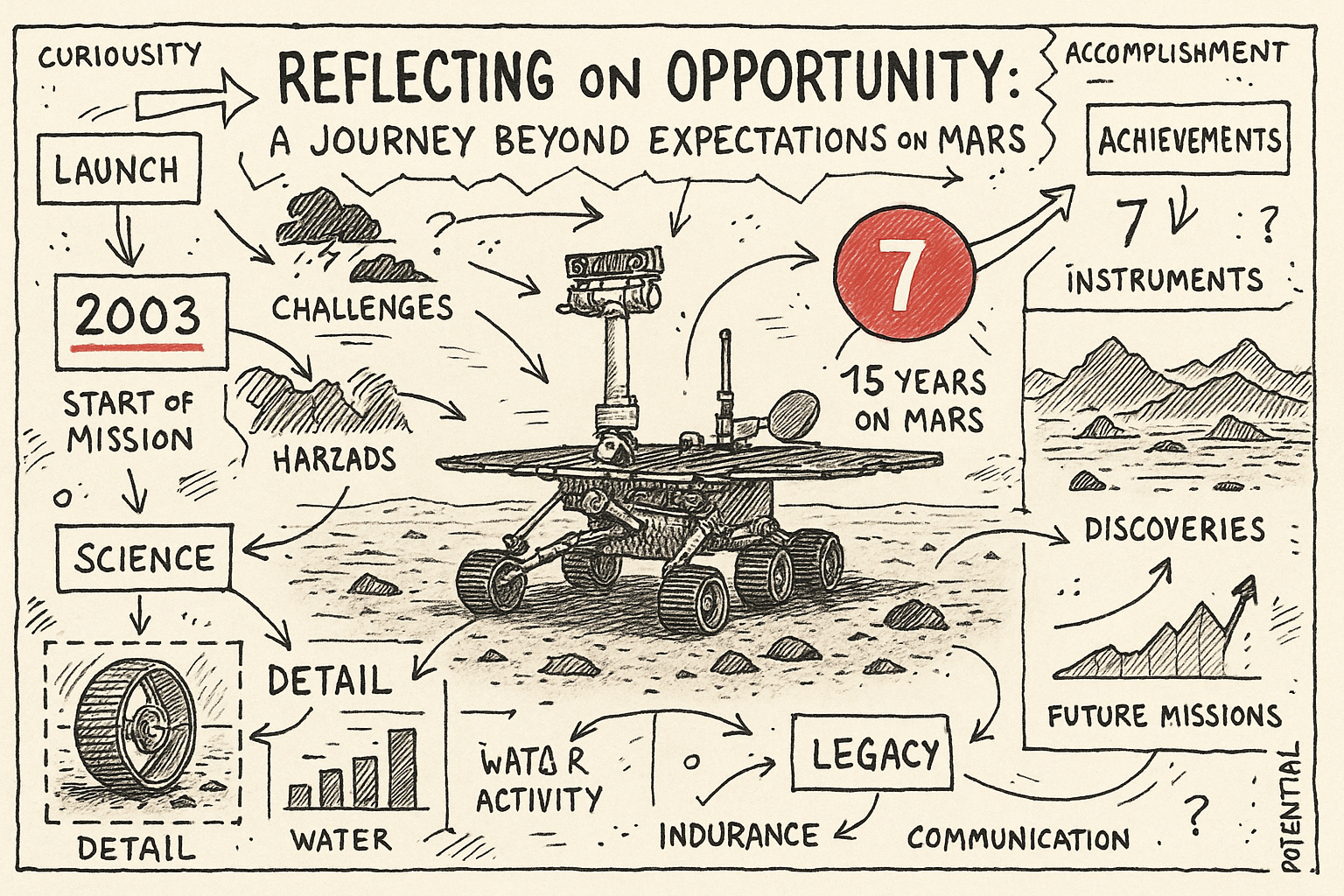
On July 7, 2003, NASA's Mars Exploration Rover Opportunity embarked on a journey that would not only exceed its initial mission parameters but also redefine our understanding of endurance and exploration on the Martian terrain. Designed for a mission duration of just 90 Martian days, Opportunity, affectionately known as 'Oppy', was expected to travel no more than 1,100 yards (1,000 meters). However, it far surpassed these expectations, lasting for 15 years and traversing over 28 miles (45 kilometers) before being silenced by a severe dust storm in 2018.
Opportunity's mission began with its launch from Cape Canaveral, Florida, marking the start of a seven-month journey through space. It eventually landed on Mars' Meridiani Planum on January 25, 2004, just three weeks after its twin rover Spirit touched down on the opposite side of the planet. While Spirit encountered mobility issues and ceased functioning in 2009, Opportunity continued to thrive against the odds.
The rover's persistence and scientific contributions were remarkable. It provided invaluable insights into Mars' geology and climate history, including evidence of past water activity. Opportunity's discoveries at locations like Endurance Crater and its final resting spot, Perseverance Valley, have enriched our understanding of Mars as a dynamic planet with a potentially habitable past.
Opportunity's journey, however, came to an end in June 2018 when a massive planet-wide dust storm blocked sunlight from reaching its solar panels. Despite extensive efforts by engineers at NASA's Jet Propulsion Laboratory to reestablish contact, Opportunity's final communication was received on June 10, 2018. After more than 1,000 recovery commands, the mission was officially concluded in February 2019.
As we reflect on Opportunity's legacy in 2026, its impact on subsequent Mars missions is evident. The rover set a high standard for durability and scientific output, paving the way for future explorers like the Perseverance rover. Launched in July 2020, Perseverance has already achieved significant milestones, including traversing a marathon distance on Mars as of June 2026. This achievement continues the legacy of exploring and pushing the boundaries of what is possible on the Red Planet.
Moreover, NASA's ongoing efforts to develop advanced rover technologies, such as the autonomous capabilities tested with the ERNEST prototype, underscore the lessons learned from both Opportunity and Perseverance. These advancements promise to enhance the ability of future missions to navigate the challenging Martian terrain with greater autonomy and efficiency.
The story of Opportunity is not just one of technological achievement, but also one of human curiosity and tenacity. It serves as a testament to the continuous drive to explore and understand worlds beyond our own, inspiring future generations of scientists and engineers to continue reaching for the stars. As we look towards the future of Mars exploration, the spirit of Opportunity will undoubtedly guide and inspire new missions, further unraveling the mysteries of our neighboring planet.