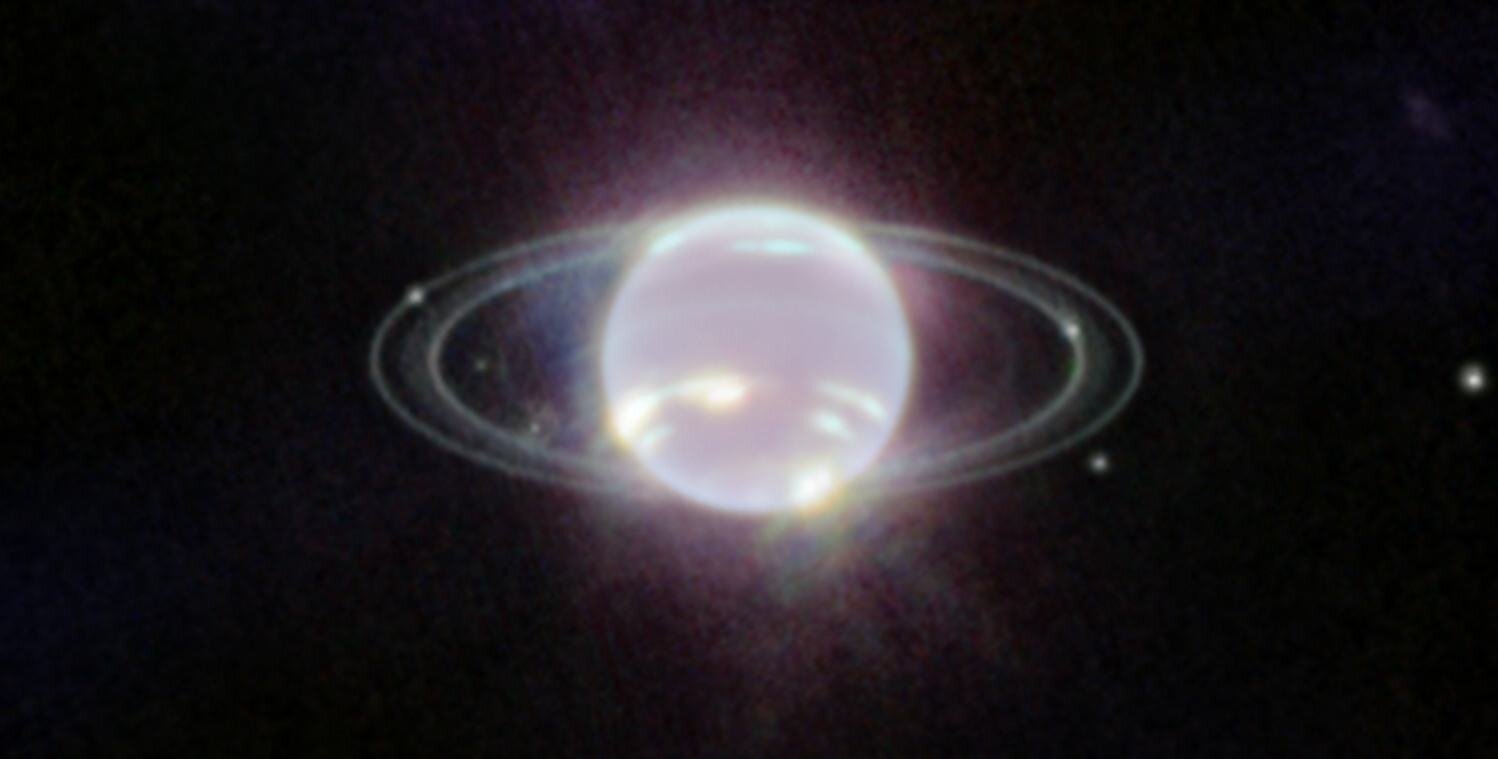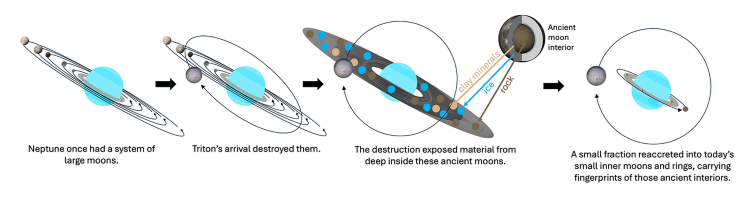
Neptune, the distant ice giant, has always intrigued astronomers with its complex system of moons and rings. Recent findings from the James Webb Space Telescope have shed new light on the origins of these celestial bodies, particularly focusing on the dramatic capture of its largest moon, Triton.
New analyses suggest that Triton was once a wandering object from the Kuiper Belt. Its capture by Neptune led to catastrophic interactions with the planet's original moon system. This event likely resulted in the destruction of many of Neptune's primordial moons, leaving behind the small inner moons we observe today.
Among these moons, Larissa and Galatea show evidence of mineral compositions that could have formed from the debris of this ancient collision. These findings, coupled with the imbalance in Neptune's moon system—dominated by the massive Triton—support the theory of a violent past.
The peculiar retrograde orbit of Triton compared to Neptune's rotation adds further intrigue, hinting at the dynamic forces at play during its capture. As researchers continue to analyze data from the James Webb Space Telescope, our understanding of Neptune's history continues to evolve, offering a glimpse into the chaotic processes that shape planetary systems.