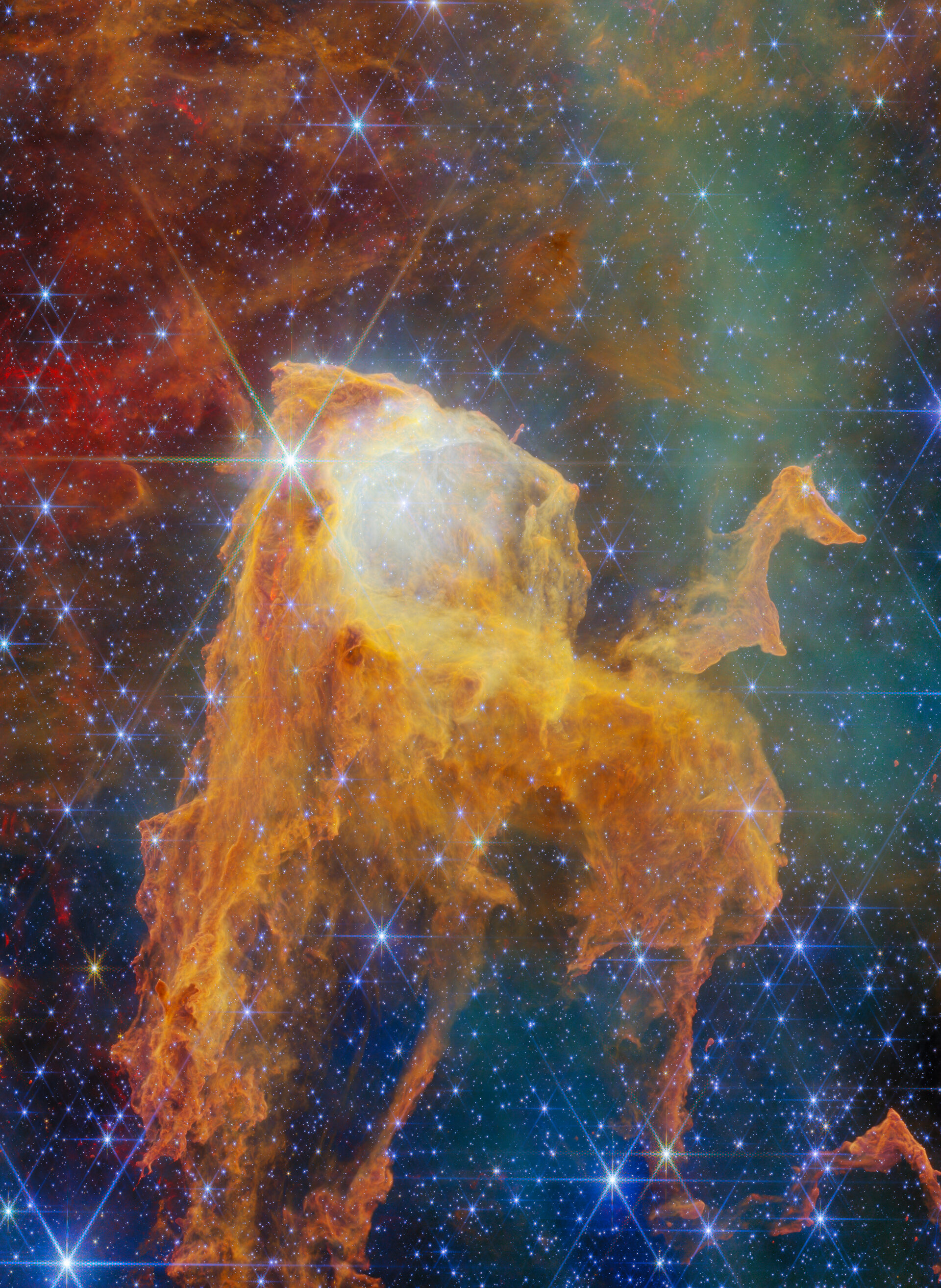
The James Webb Space Telescope (JWST), a collaborative project between NASA, ESA, and CSA, continues to illuminate our understanding of the cosmos with its recent discovery of the 'Treasure Chest' within the Carina Nebula. This finding represents a significant step in comprehending star formation in one of the nearest high-mass star-forming regions known to astronomers.
The Carina Nebula, located approximately 7,500 light-years away in the constellation Carina, spans about 260 light-years and is renowned for its massive stars and numerous protostars. The nebula is a crucial site for astronomers seeking to understand the processes that govern star formation and the sculpting of stellar environments.
Within this cosmic nursery lies the 'Treasure Chest,' a cometary globule characterized by a dense, dark head and a sweeping tail, resembling a wooden chest with an open lid. Unlike a traditional treasure chest filled with jewels, this astronomical feature hosts a compact cluster of around 70 young stars. The cluster's centerpiece is a rare O-type star, estimated to be about 19 times the mass of our Sun. This cluster, thought to be around 1.3 million years old, is still enveloped in the nebula's dust, with many stars surrounded by circumstellar discs.
The JWST's Near-Infrared Camera (NIRCam) has been instrumental in capturing this otherworldly glow, providing astronomers with unprecedented insights into the dynamics of star formation. Over time, the intense starlight from these young stars is expected to disperse the dust, gradually unveiling the full magnificence of the cluster.
Key to the Treasure Chest's unique shape is its proximity to Eta Carinae, situated just 39 light-years to the northwest. Eta Carinae is the brightest object in the Carina Nebula, featuring a star system with at least two stars, one of which is an astonishing 100 times the mass of the Sun. This massive star is approximately 5 million times more luminous than the Sun, exerting a significant influence on the surrounding nebula.
Discoveries like the 'Treasure Chest' underscore the transformative power of the James Webb Space Telescope, which is redefining our understanding of stellar and galactic formation. Its ability to capture high-resolution images and penetrate dusty cosmic environments is providing astronomers with crucial data to test and refine their theories about the universe's evolution.
The James Webb Space Telescope's contributions extend beyond the Carina Nebula. Its observations of distant galaxies and cosmic phenomena are helping scientists explore the early universe, shedding light on the processes that led to the formation of the first stars and galaxies. As the telescope continues to delve deeper into the cosmos, it promises to unlock answers to some of the most profound questions in astronomy.
The Webb's recent work in uncovering the 'Treasure Chest' not only showcases the telescope's technical prowess but also highlights the collaborative efforts of international space agencies in advancing our cosmic knowledge. As astronomers continue to analyze the data, they hope to gain a more comprehensive understanding of how massive stars influence their environments and contribute to the galaxy's evolution.
In the coming years, with the JWST's continued exploration, we can anticipate further revelations that will not only deepen our understanding of our galaxy but also offer insights into the broader universe. The 'Treasure Chest' is just one of many discoveries that illustrate the vast and intricate tapestry of the cosmos, waiting to be explored and understood.