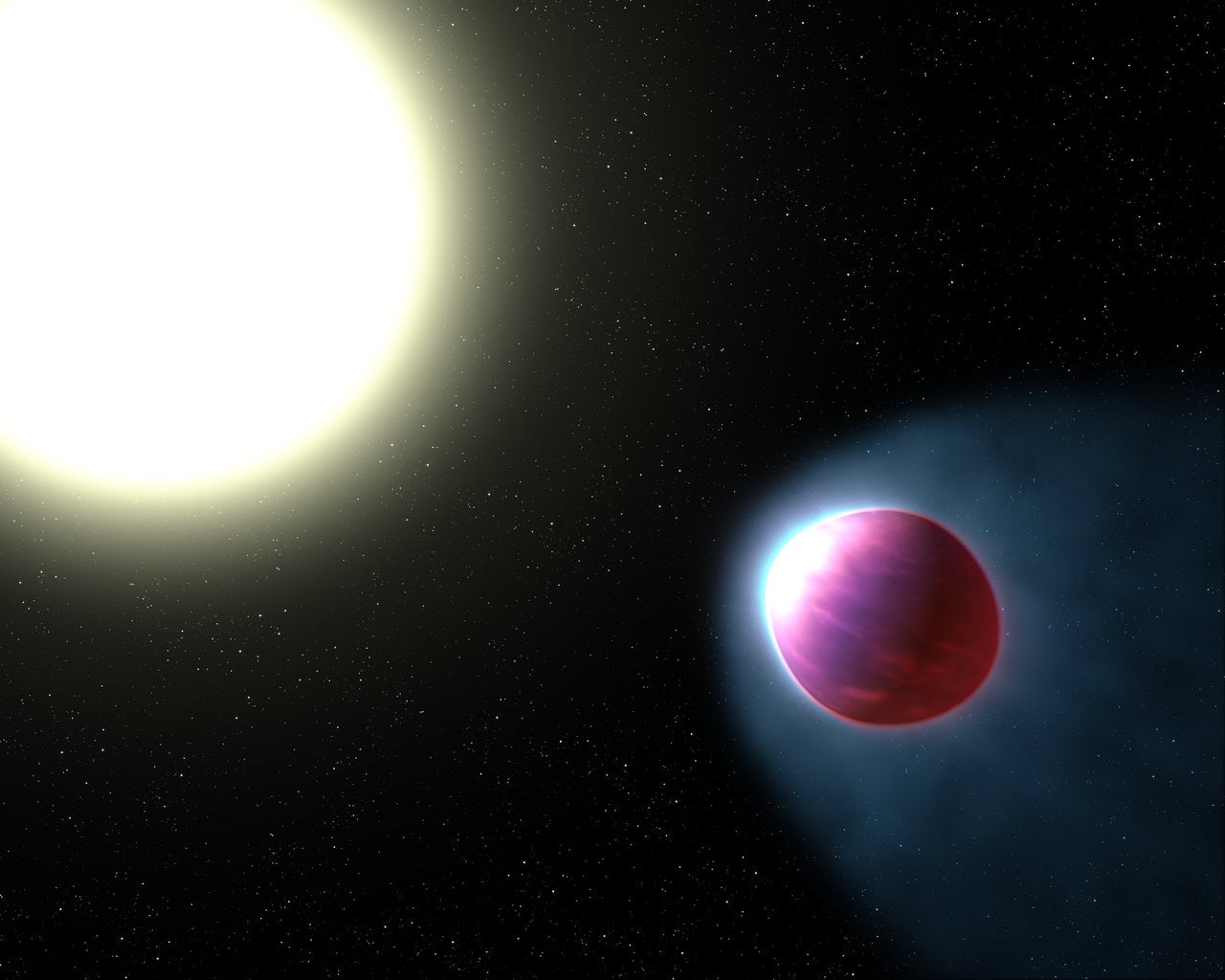
In a remarkable feat of astronomical observation, the James Webb Space Telescope (JWST) has provided groundbreaking insights into the atmospheric dynamics of WASP-121b, an ultra-hot Jupiter that continues to intrigue scientists with its extreme conditions. The planet, orbiting its host star at a blistering pace that completes a full revolution in just thirty hours, offers a unique natural laboratory for studying the atmospheric phenomena that occur in such hostile environments.
WASP-121b is a gas giant so close to its star that tidal forces have distorted it into an egg-like shape. This proximity has also locked the planet's rotation, a phenomenon known as tidal locking, resulting in one hemisphere perpetually facing the star while the other remains in constant darkness. The temperature disparity between these two sides is stark, with the dayside reaching temperatures of approximately 2500 degrees Celsius, while the nightside remains significantly cooler at about 725 degrees Celsius.
Cyril Gapp, a PhD student at the Max Planck Institute for Astronomy, leads the team studying the twilight zones of WASP-121b, the regions that transition from the planet’s scorching dayside to its cooler nightside. By tracking the changes in starlight that passes through the planet's atmosphere during its transit across the star, researchers have mapped the atmospheric conditions with unprecedented detail. This method stands in contrast to previous studies, which averaged these changes over the entire transit, missing the nuanced variations that occur as the planet rotates.
The findings reveal two distinct twilight zones. The evening terminator—where fierce winds sweep heat eastward from the dayside—absorbs more starlight than the morning terminator. This difference is marked by a rise in carbon monoxide, driven by the intense heat. The presence of water also varies dramatically; in the evening atmosphere, temperatures climb high enough to dissociate water molecules, resulting in significantly less water compared to the cooler morning side.
These observations have presented scientists with a conundrum. When compared against computer models, the real atmospheric signals detected by JWST were more pronounced than expected, suggesting the presence of additional cooling mechanisms. The most likely candidates for this cooling are clouds composed of vaporized minerals such as silicates, which could form in the morning terminator, effectively blocking incoming starlight and moderating temperatures.
The study of WASP-121b not only enhances our understanding of exoplanetary atmospheres but also challenges existing models, pushing astronomers to refine their theories about how such extreme planetary environments behave. This kind of research is crucial, as it helps scientists build a more comprehensive picture of the diversity of planetary systems beyond our own.
The insights gained from WASP-121b also contribute to broader discussions about atmospheric dynamics on exoplanets, particularly hot Jupiters, which have altered our understanding of planetary systems. Prior to the discovery of exoplanets like 51 Pegasi b in 1995, it was believed that all solar systems resembled ours, with rocky planets close to the star and gas giants further out. Hot Jupiters, with their close-in orbits and extreme conditions, have since compelled astronomers to reconsider these assumptions.
As the JWST continues to observe the cosmos, it promises to uncover even more secrets about the universe, potentially revealing new worlds and atmospheric phenomena that could reshape our understanding of planetary science. For WASP-121b, the story of its twilight zones is just the beginning, with future studies likely to delve deeper into the mysteries of its atmospheric composition and dynamics.