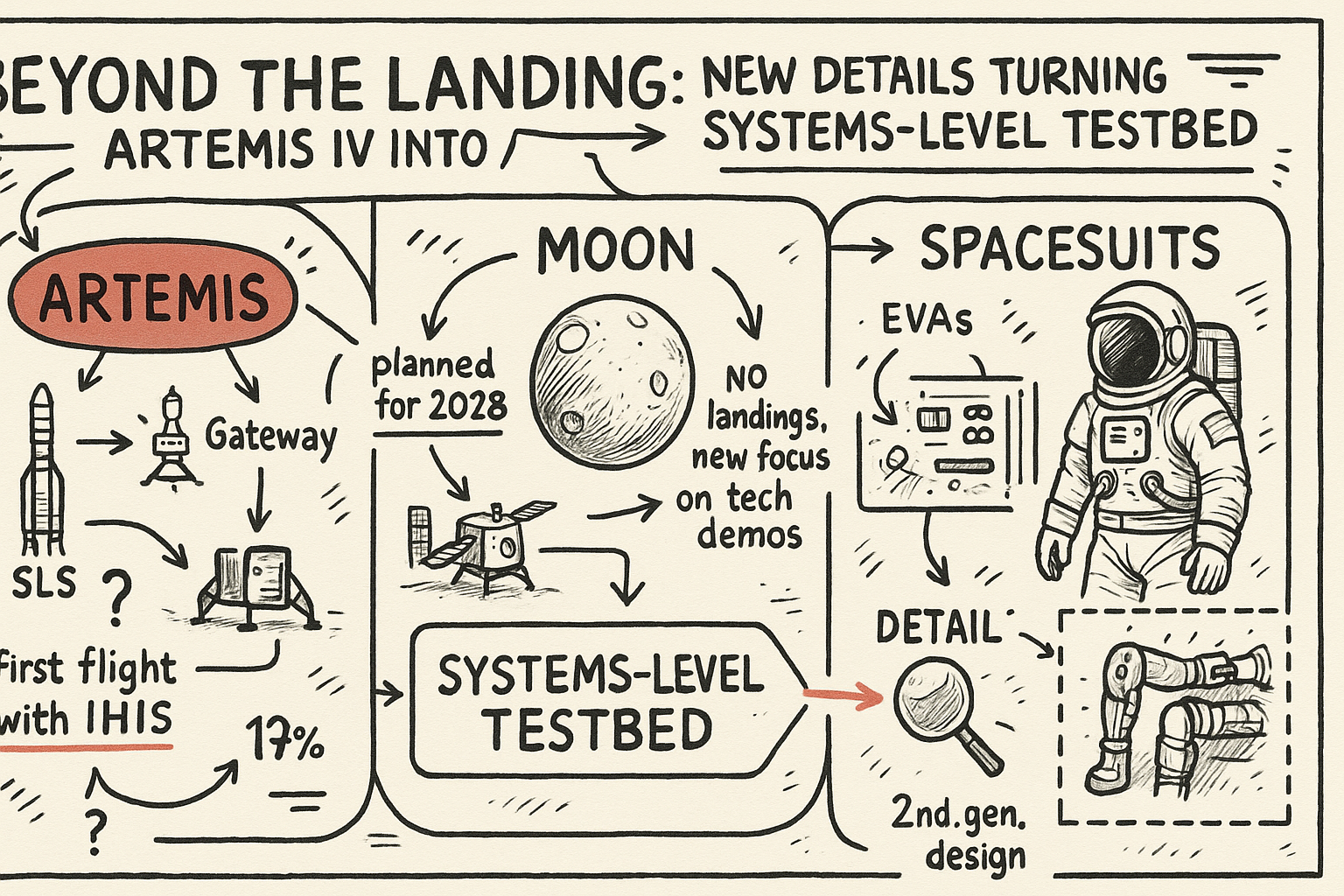
Fresh coverage and reporting since our earlier piece on Artemis has revealed layers of activity surrounding NASA’s next lunar missions that emphasize systems engineering, human factors and hardware validation over a simple touchdown. Together, those developments suggest Artemis IV could serve as a turning point in how people and machines operate on the Moon.
Artemis IV’s different journey
Outlets reporting on Artemis planning describe Artemis IV as aiming to put humans back on the Moon in 2028 and following a “radically different journey” than past lunar missions. That framing reframes the mission as more than a reprise of a landing: it is being developed to test approaches that could alter future space travel paradigms.
Spacesuit evolution and operational questions
New information highlights that the Artemis program is advancing spacesuit design. The Planetary Society noted “new Artemis spacesuits,” underscoring that suit evolution is an explicit element of current program activity. Suits are central to successful surface operations, and their development ties into other work aimed at ensuring astronauts can perform routine and scientific tasks once on the Moon.
Ground-based lunar gravity simulation
Complementing suit development, reporting from SpaceExplored outlines how a Massachusetts engineering firm, Atlas Devices, is recreating lunar gravity on Earth. Atlas Devices is using a gravity-defying simulator to mimic the Moon’s one-sixth gravity so engineers can evaluate ergonomics and human-equipment interactions before crewed surface operations. The company’s work focuses on questions such as whether astronauts can retrieve equipment from storage compartments comfortably, whether handrails are optimally placed, and how much extra effort routine tasks require while wearing a pressurized exploration suit.
That terrestrial testing is presented as answering problems computer models cannot resolve alone, and as contributing to the readiness of systems and procedures that astronauts will depend on during Artemis missions.
Operational personnel changes and program continuity
Personnel shifts among astronauts who helped lead Artemis II also figure into the program’s near-term human capital picture. Reports note that Artemis II commander Reid Wiseman and pilot Victor Glover have stepped away from active astronaut status and will continue to support the moon exploration program as emeritus astronauts. Coverage on Glover’s activities also documents his public presence around Artemis II events, including arriving at Kennedy Space Center ahead of the mission and participating in related rollout activities.
Those transitions highlight how individual careers are evolving alongside program needs: experienced crewmembers are moving into roles that support exploration even as other teams prepare for upcoming missions.
What this means for Artemis IV and beyond
Taken together, the reporting points to Artemis IV acting as a broader systems-level test rather than merely a repeat of a lunar landing. Upgrades to suits, hands-on validation of human performance in lunar-like gravity, and the reallocation of veteran astronaut expertise into supporting roles all indicate a shift toward operational maturity. If terrestrial simulation and suit improvements pay off, they could reduce risks for future surface expeditions and inform designs and procedures for longer stays.
As NASA and its industry partners press toward the 2028 timeline reported for Artemis IV, these non-launch elements—ergonomics, suit capability, and human systems engineering—are becoming defining features of the program’s next phase.